
Join Our JEE Preparation Group
Prep with like-minded aspirants; Get access to free daily tests and study material.
Sign in
Please select an account to continue using cracku.in
↓ →
Join Our JEE Preparation Group
Prep with like-minded aspirants; Get access to free daily tests and study material.
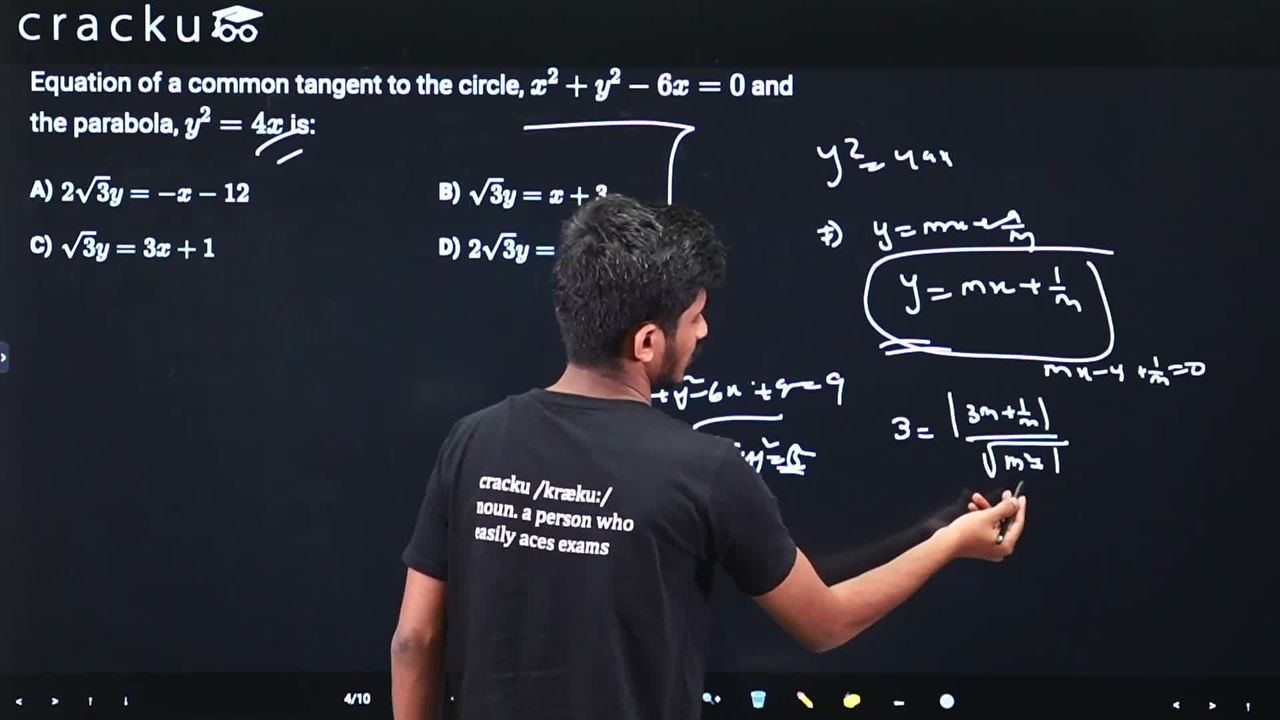
Equation of a common tangent to the circle, $$x^2 + y^2 - 6x = 0$$ and the parabola, $$y^2 = 4x$$ is:
First, let us rewrite the equation of the circle in its centre-radius form.
We have $$x^{2}+y^{2}-6x=0 \;.$$
Completing the square in $$x$$:
$$x^{2}-6x+y^{2}=0 \;\Longrightarrow\; (x^{2}-6x+9)+y^{2}=9 \;\Longrightarrow\; (x-3)^{2}+y^{2}=3^{2}\;.$$
So the circle has centre $$C(3,0)$$ and radius $$r=3$$.
Now let us take a straight line with slope $$m$$ in its slope-intercept form
$$y=mx+c\;.$$
For this line to be tangent to the circle, the perpendicular distance from the centre to the line must be equal to the radius. The perpendicular-distance formula is
$$\text{Distance}=\frac{|Ax_{0}+By_{0}+C|}{\sqrt{A^{2}+B^{2}}}$$
for a line $$Ax+By+C=0$$ and a point $$(x_{0},y_{0})$$. Writing $$y=mx+c$$ as $$mx-y+c=0$$, we identify $$A=m,\;B=-1,\;C=c$$ and substitute $$(x_{0},y_{0})=(3,0)$$:
$$\frac{|m\cdot3+(-1)\cdot0+c|}{\sqrt{m^{2}+(-1)^{2}}}=3 \;\Longrightarrow\; \frac{|3m+c|}{\sqrt{m^{2}+1}}=3\;.$$
Hence
$$|3m+c|=3\sqrt{m^{2}+1} \;\Longrightarrow\; c=-3m\pm3\sqrt{m^{2}+1}\;. \quad -(1)$$
Next, for the parabola $$y^{2}=4x$$ we recall the standard tangent formula. For the parabola $$y^{2}=4ax$$, a line of slope $$m$$ is a tangent iff
$$y=mx+\frac{a}{m}\;.$$
Here $$4a=4\;\Longrightarrow\;a=1$$, so the condition is
$$c=\frac{1}{m}\;. \quad -(2)$$
A common tangent must satisfy both (1) and (2). Equating the two expressions for $$c$$ we obtain two possibilities:
$$\frac{1}{m}=-3m+3\sqrt{m^{2}+1}\qquad\text{or}\qquad \frac{1}{m}=-3m-3\sqrt{m^{2}+1}\;.$$
First possibility
$$\frac{1}{m}=-3m+3\sqrt{m^{2}+1}\;.$$
Multiplying by $$m$$ gives
$$1=-3m^{2}+3m\sqrt{m^{2}+1}\;.$$
Dividing by 3,
$$\frac13=-m^{2}+m\sqrt{m^{2}+1}\;.$$
Let $$t=m^{2}$$ (so $$t\ge0$$). Then $$m\sqrt{m^{2}+1}=m\sqrt{t+1}=\sqrt{t}\sqrt{t+1}$$, and the equation becomes
$$\sqrt{t}\sqrt{t+1}=t+\frac13\;.$$
Squaring both sides,
$$t(t+1)=\left(t+\frac13\right)^{2} \;\Longrightarrow\; t^{2}+t=t^{2}+\frac23t+\frac19\;.$$
Subtracting $$t^{2}$$ from each side,
$$t=\frac23t+\frac19 \;\Longrightarrow\; t-\frac23t=\frac19 \;\Longrightarrow\; \frac13t=\frac19 \;\Longrightarrow\; t=\frac13\;.$$
Hence $$m^{2}=\dfrac13\;\Longrightarrow\;m=\pm\frac{1}{\sqrt3}\;.$$
Substituting $$m=\frac1{\sqrt3}$$ into (1) (with the ‘+’ sign we are using) to find $$c$$,
$$c=-3\!\left(\frac1{\sqrt3}\right)+3\sqrt{\frac13+1} =-\sqrt3+3\sqrt{\frac43} =-\sqrt3+3\cdot\frac{2}{\sqrt3} =-\sqrt3+\frac{6}{\sqrt3} =\frac{-3+6}{\sqrt3} =\sqrt3\;.$$
So one tangent is
$$y=\frac1{\sqrt3}x+\sqrt3 \;\Longrightarrow\; \sqrt3\,y=x+3\;.$$
Taking $$m=-\dfrac1{\sqrt3}$$ in the same branch does not satisfy the equation (check gives $$-\,\sqrt3\neq3\sqrt3$$), hence only $$m=+\dfrac1{\sqrt3}$$ works here.
Second possibility
$$\frac{1}{m}=-3m-3\sqrt{m^{2}+1}\;.$$
Repeating exactly the same algebra (or directly substituting $$m=-\dfrac1{\sqrt3}$$) yields another valid tangent
$$\sqrt3\,y=-x-3\;.$$
Although two common tangents exist, only the first one appears among the given options.
The required common tangent from the list is therefore
$$\boxed{\;\sqrt3\,y=x+3\;}\;.$$
Hence, the correct answer is Option 2.
Was this solution helpful?
Click on the Email ☝️ to Watch the Video Solution
Create a FREE account and get:
_1.webp)

Educational materials for JEE preparation

Ask our AI anything

AI can make mistakes. Please verify important information.
AI can make mistakes. Please verify important information.
