
Join Our JEE Preparation Group
Prep with like-minded aspirants; Get access to free daily tests and study material.
Sign in
Please select an account to continue using cracku.in
↓ →
Join Our JEE Preparation Group
Prep with like-minded aspirants; Get access to free daily tests and study material.
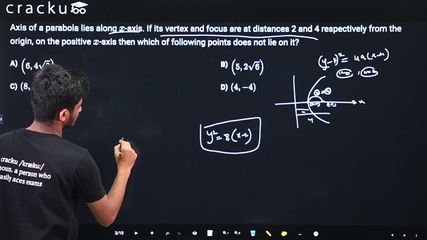
Axis of a parabola lies along $$x$$-axis. If its vertex and focus are at distances 2 and 4 respectively from the origin, on the positive $$x$$-axis then which of following points does not lie on it?
First we read the geometrical data. The axis of the parabola is along the $$x$$-axis, its vertex is 2 units away from the origin on the positive $$x$$-axis, and its focus is 4 units away from the origin on the same axis.
Because the distance is measured from the origin along the positive $$x$$-axis, we immediately obtain the co-ordinates
$$\text{Vertex } V(2,0)$$ and $$\text{Focus } F(4,0).$$
The focus lies to the right of the vertex, so the parabola opens rightwards. Let $$h$$ and $$k$$ be the co-ordinates of the vertex. Here $$h=2$$ and $$k=0.$$ The distance between the vertex and the focus is denoted by $$p$$, so
$$p = 4-2 = 2.$$
For a parabola whose axis is horizontal (parallel to the $$x$$-axis) and which opens to the right, the standard equation is stated first:
$$ (y-k)^2 = 4p\,(x-h). $$
Now we substitute the values $$k=0,\, h=2,\, p=2$$ obtained above. This gives
$$ (y-0)^2 = 4\,(2)\,(x-2). $$
Simplifying the constants on the right-hand side, we have
$$ y^2 = 8\,(x-2). $$
This is the explicit Cartesian equation of the required parabola. Any point $$P(x,y)$$ will lie on the parabola if and only if its co-ordinates satisfy $$y^2 = 8(x-2).$$ We now test each option one by one, substituting the given values of $$x$$ and $$y$$ and checking equality.
Option A: $$P(6,\,4\sqrt2).$$ We compute the left-hand side (LHS) and the right-hand side (RHS) of the parabola’s equation.
$$\text{LHS}=y^2 = (4\sqrt2)^2 = 16\cdot2 = 32,$$
$$\text{RHS}=8(x-2)=8(6-2)=8\cdot4=32.$$
LHS = RHS, so Option A satisfies the equation and the point lies on the parabola.
Option B: $$P(5,\,2\sqrt6).$$
$$\text{LHS}=y^2 = (2\sqrt6)^2 = 4\cdot6 = 24,$$
$$\text{RHS}=8(x-2)=8(5-2)=8\cdot3=24.$$
LHS = RHS once again, so Option B also lies on the parabola.
Option C: $$P(8,\,6).$$
$$\text{LHS}=y^2 = 6^2 = 36,$$
$$\text{RHS}=8(x-2)=8(8-2)=8\cdot6=48.$$
Here $$36 \neq 48,$$ so the equality fails; the point does not satisfy the parabola’s equation.
Option D: $$P(4,\,-4).$$
$$\text{LHS}=y^2 = (-4)^2 = 16,$$
$$\text{RHS}=8(x-2)=8(4-2)=8\cdot2=16.$$
LHS = RHS, so Option D is also a point on the parabola.
We have evaluated all four candidates and discovered that every point except Option C satisfies the defining equation of the parabola. Therefore Option C is the lone point that does not lie on the given parabola.
Hence, the correct answer is Option C.
Was this solution helpful?
Click on the Email ☝️ to Watch the Video Solution
Create a FREE account and get:
_1.webp)

Educational materials for JEE preparation

Ask our AI anything

AI can make mistakes. Please verify important information.
AI can make mistakes. Please verify important information.
