
Join Our JEE Preparation Group
Prep with like-minded aspirants; Get access to free daily tests and study material.
Sign in
Please select an account to continue using cracku.in
↓ →
Join Our JEE Preparation Group
Prep with like-minded aspirants; Get access to free daily tests and study material.
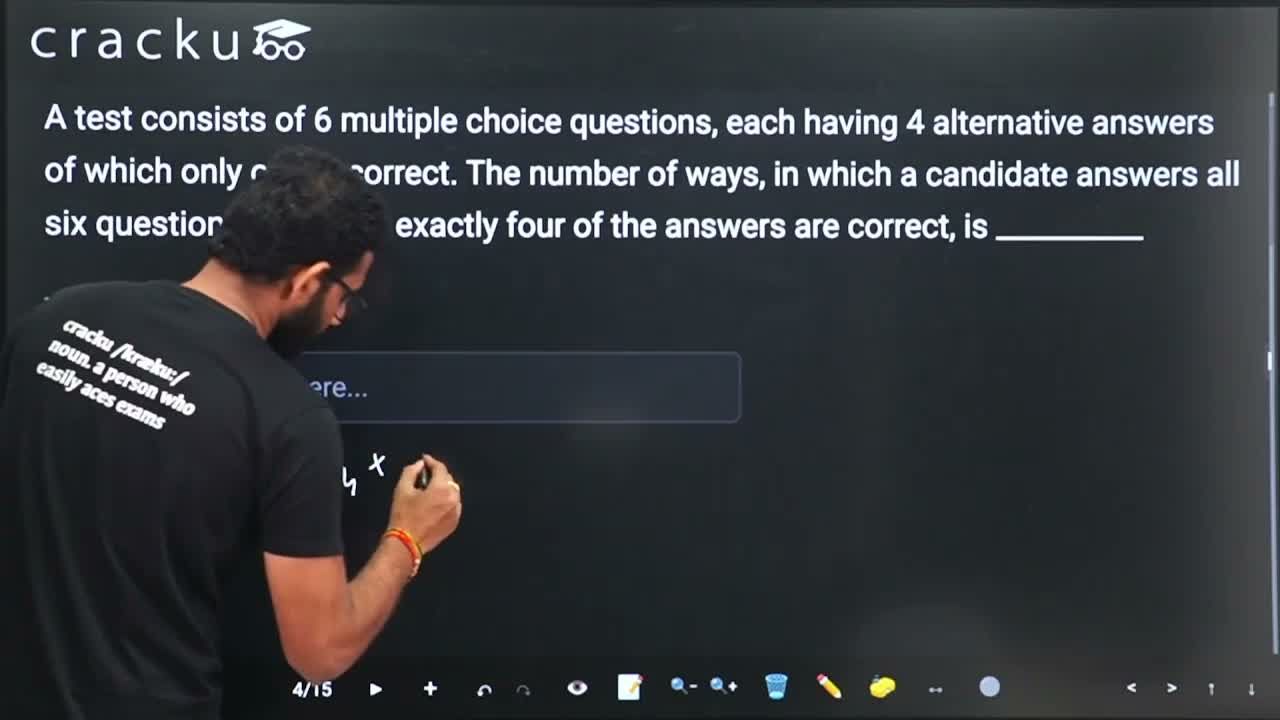
A test consists of 6 multiple choice questions, each having 4 alternative answers of which only one is correct. The number of ways, in which a candidate answers all six questions such that exactly four of the answers are correct, is __________
Correct Answer: 135
We have six different questions, and each question carries four alternative choices, exactly one of which is right.
First, we decide which questions are answered correctly. Out of the total $$6$$ questions, we want exactly $$4$$ to be correct. The number of ways of choosing these $$4$$ questions is obtained by the combination formula
$$^{n}C_{r}=\dfrac{n!}{r!\,(n-r)!}.$$
Here $$n=6$$ and $$r=4$$, so
$$^{6}C_{4}=\dfrac{6!}{4!\,2!}=15.$$
Now, for each of the chosen $$4$$ questions, there is only one way to answer correctly because only one option is the right one. Thus, the total number of answer patterns for these $$4$$ questions remains $$1^{4}=1$$.
Next, we look at the remaining $$6-4=2$$ questions, which must be answered incorrectly. Each of these questions has $$4-1=3$$ wrong alternatives. Therefore, for every question to be answered wrongly, there are $$3$$ possible choices. Since the two questions are independent, the total number of incorrect answer patterns is
$$3 \times 3 = 3^{2}=9.$$
Finally, we multiply the number of ways of choosing which questions are correct with the number of answer patterns for correct responses and with the number of answer patterns for incorrect responses:
$$\text{Total ways}=^{6}C_{4}\times 1^{4}\times 3^{2}=15\times 1\times 9=135.$$
So, the answer is $$135$$.
Was this solution helpful?
Click on the Email ☝️ to Watch the Video Solution
Create a FREE account and get:
_1.webp)

Educational materials for JEE preparation

Ask our AI anything

AI can make mistakes. Please verify important information.
AI can make mistakes. Please verify important information.


