
Join Our JEE Preparation Group
Prep with like-minded aspirants; Get access to free daily tests and study material.
Sign in
Please select an account to continue using cracku.in
↓ →
Join Our JEE Preparation Group
Prep with like-minded aspirants; Get access to free daily tests and study material.
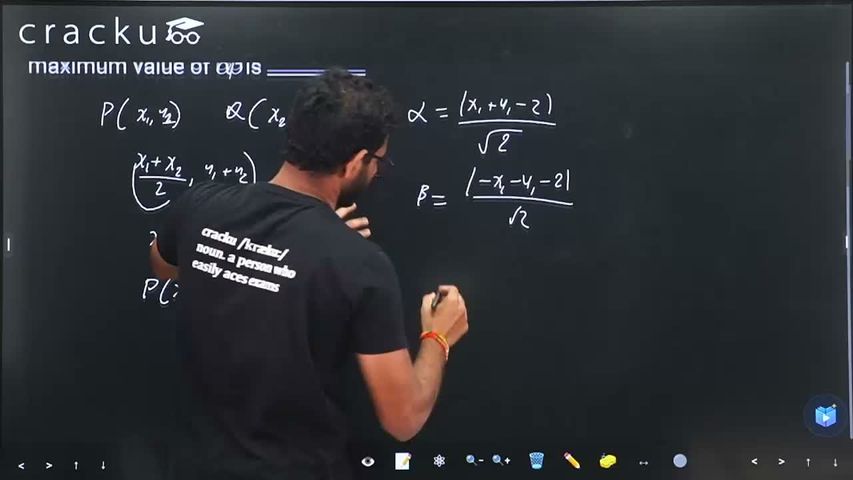
Let PQ be a diameter of the circle $$x^2 + y^2 = 9$$. If $$\alpha$$ and $$\beta$$ are the lengths of the perpendiculars from P and Q on the straight line, $$x + y = 2$$ respectively, then the maximum value of $$\alpha\beta$$ is __________
Correct Answer: 7
We have the circle $$x^2 + y^2 = 9$$ whose centre is clearly the origin $$O(0,0)$$ and whose radius is $$3$$ because in the standard form $$x^2 + y^2 = r^2$$ the constant term equals $$r^2$$.
Let the end-points of a diameter be $$P(x_1 , y_1)$$ and $$Q(x_2 , y_2)$$. By the very definition of a diameter, the centre is the mid-point of $$PQ$$, so $$\dfrac{x_1 + x_2}{2}=0$$ and $$\dfrac{y_1 + y_2}{2}=0$$. Hence $$x_2 = -x_1$$ and $$y_2 = -y_1$$. Thus we may write
$$P(x_1 , y_1), \qquad Q(-x_1 , -y_1).$$
Because $$P$$ lies on the circle, it satisfies the equation of the circle:
$$x_1^2 + y_1^2 = 9.$$
The given straight line is $$x + y = 2$$. For distance calculations we write it in the standard form $$Ax + By + C = 0$$:
$$x + y - 2 = 0,$$
so $$A = 1, \; B = 1, \; C = -2$$.
Now we recall the perpendicular distance formula.
Formula: The distance from a point $$(x_0 , y_0)$$ to the line $$Ax + By + C = 0$$ is
$$
\text{Distance} \;=\; \dfrac{|Ax_0 + By_0 + C|}{\sqrt{A^2 + B^2}}.
$$
Using this formula, the length of the perpendicular from $$P(x_1 , y_1)$$ to the line $$x + y - 2 = 0$$ is
$$ \alpha \;=\; \dfrac{|1\cdot x_1 + 1\cdot y_1 - 2|}{\sqrt{1^2 + 1^2}} \;=\; \dfrac{|x_1 + y_1 - 2|}{\sqrt{2}}. $$
Similarly, the perpendicular distance from $$Q(-x_1 , -y_1)$$ to the same line is
$$ \beta \;=\; \dfrac{|1(-x_1) + 1(-y_1) - 2|}{\sqrt{2}} \;=\; \dfrac{|\, -x_1 - y_1 - 2|}{\sqrt{2}} \;=\; \dfrac{|x_1 + y_1 + 2|}{\sqrt{2}}. $$
We multiply the two distances to get
$$ \alpha\beta \;=\; \left(\dfrac{|x_1 + y_1 - 2|}{\sqrt{2}}\right) \left(\dfrac{|x_1 + y_1 + 2|}{\sqrt{2}}\right) \;=\; \dfrac{|x_1 + y_1 - 2| \; |x_1 + y_1 + 2|}{2}. $$
Notice that $$|a-b|\,|a+b| = |a^2 - b^2|$$ for any real numbers. Putting $$a = x_1 + y_1$$ and $$b = 2$$, we get
$$ |x_1 + y_1 - 2|\;|x_1 + y_1 + 2| \;=\; |(x_1 + y_1)^2 - 2^2| \;=\; |(x_1 + y_1)^2 - 4|. $$
Hence
$$ \alpha\beta \;=\; \dfrac{\bigl|(x_1 + y_1)^2 - 4\bigr|}{2}. $$
For convenience let us set
$$ s \;=\; x_1 + y_1. $$
Then the expression to be maximised is
$$ \alpha\beta \;=\; \dfrac{|\,s^2 - 4\,|}{2}. $$
We must now find the range of the quantity $$s = x_1 + y_1$$ subject to the circular condition $$x_1^2 + y_1^2 = 9$$. For any real numbers $$x_1, y_1$$ we have the Cauchy-Schwarz (or simply the AM-QM) inequality
$$ (x_1 + y_1)^2 \;\le\; 2\,(x_1^2 + y_1^2). $$
Substituting the fixed value $$x_1^2 + y_1^2 = 9$$ gives
$$ s^2 \;\le\; 2 \times 9 = 18, \qquad\text{so}\qquad -3\sqrt{2} \;\le\; s \;\le\; 3\sqrt{2}. $$
Thus $$s^2$$ ranges from $$0$$ up to $$18$$.
Now observe that $$\alpha\beta$$ depends only on $$s^2$$, not on the sign of $$s$$, and that
$$ \alpha\beta \;=\; \frac{|s^2 - 4|}{2} \;=\; \begin{cases} \dfrac{4 - s^2}{2}, & 0 \le s^2 \le 4, \\ \dfrac{s^2 - 4}{2}, & 4 \le s^2 \le 18. \end{cases} $$
• For $$0 \le s^2 \le 4$$, the numerator $$4 - s^2$$ decreases as $$s^2$$ increases, so the largest value in this interval occurs at the left end $$s^2 = 0$$, giving $$\dfrac{4 - 0}{2} = 2.$$
• For $$4 \le s^2 \le 18$$, the numerator $$s^2 - 4$$ increases as $$s^2$$ increases, so the largest value in this interval occurs at the right end $$s^2 = 18$$, giving $$\dfrac{18 - 4}{2} = \dfrac{14}{2} = 7.$$
Comparing the two candidates $$2$$ and $$7$$, the maximum of $$\alpha\beta$$ is clearly $$7$$.
Hence, the correct answer is 7.
Was this solution helpful?
Click on the Email ☝️ to Watch the Video Solution
Create a FREE account and get:
_1.webp)

Educational materials for JEE preparation

Ask our AI anything

AI can make mistakes. Please verify important information.
AI can make mistakes. Please verify important information.


