
Join Our JEE Preparation Group
Prep with like-minded aspirants; Get access to free daily tests and study material.
Sign in
Please select an account to continue using cracku.in
↓ →
Join Our JEE Preparation Group
Prep with like-minded aspirants; Get access to free daily tests and study material.
In a game two players A and B take turns in throwing a pair of fair dice starting with player A and total of scores on the two dice, in each throw is noted. A wins the game if he throws a total of 6 before B throws a total of 7 and B wins the game if he throws a total of 7 before A throws a total of six. The game stops as soon as either of the players wins. The probability of A winning the game is:
Each throw of a pair of fair dice has $$36$$ equally likely outcomes. We first list the numbers of favourable outcomes for the two critical totals.
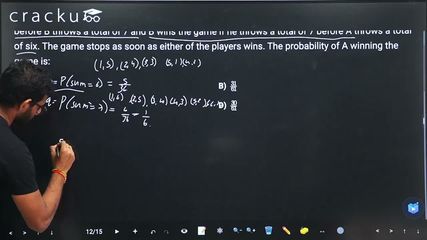
$$\displaystyle \text{Sum }6 : (1,5),(2,4),(3,3),(4,2),(5,1)$$ $$\Rightarrow$$ $$5$$ ways $$\displaystyle \text{Sum }7 : (1,6),(2,5),(3,4),(4,3),(5,2),(6,1)$$ $$\Rightarrow$$ $$6$$ ways
So we have
$$p=\Pr(\text{sum }6)=\frac{5}{36},\qquad q=\Pr(\text{sum }7)=\frac{6}{36}=\frac16,\qquad r=\Pr(\text{neither }6\text{ nor }7)=1-(p+q)=1-\frac{11}{36}=\frac{25}{36}.$$
A starts the game. The rules are:
• A wins the moment he throws a $$6$$. • B wins the moment he throws a $$7$$. • Any other result leaves the game undecided and the next player throws. • A result of $$7$$ on A’s throw or $$6$$ on B’s throw has no special effect.
On A’s turn the probability that he wins immediately is simply
$$p=\frac{5}{36}.$$
If A fails to throw a $$6$$ (probability $$1-p=\frac{31}{36}$$), B now gets a turn. On B’s turn the probability that he wins immediately is
$$q=\frac{6}{36}=\frac16.$$
If B also fails to win (probability $$1-q=\frac{30}{36}$$), the game returns to exactly the same situation that existed just before A’s first throw: nobody has yet won and it is again A’s turn. We call the pair of throws “A then B” a round.
The probability that a whole round passes without a winner is therefore
$$s=(1-p)(1-q)=\frac{31}{36}\times\frac{30}{36}=\frac{930}{1296}=\frac{155}{216}.$$
The probability that A wins in the first round is $$p$$. If the first round is neutral (probability $$s$$) and the game enters a second round, A can again win on his next throw with probability $$p$$, and so on. Thus the overall probability that A finally wins is the infinite geometric sum
$$\Pr(A\text{ wins})=p\bigl(1+s+s^{2}+s^{3}+\dots\bigr).$$
For an infinite geometric series with first term $$1$$ and common ratio $$s$$ ($$|s|\lt 1$$), the sum is $$\dfrac{1}{1-s}$$. Stating the formula:
$$1+s+s^{2}+s^{3}+\dots=\frac{1}{1-s}.$$ Substituting $$p=\dfrac{5}{36}$$ and $$s=\dfrac{155}{216}$$:
$$\Pr(A\text{ wins})=\frac{5}{36}\times\frac{1}{1-\frac{155}{216}} =\frac{5}{36}\times\frac{1}{\frac{61}{216}} =\frac{5}{36}\times\frac{216}{61} =\frac{5\times216}{36\times61} =\frac{5\times6}{61} =\frac{30}{61}.$$
Hence, the correct answer is Option D.
Was this solution helpful?
Click on the Email ☝️ to Watch the Video Solution
Create a FREE account and get:
_1.webp)

Educational materials for JEE preparation

Ask our AI anything

AI can make mistakes. Please verify important information.
AI can make mistakes. Please verify important information.


