
Join Our JEE Preparation Group
Prep with like-minded aspirants; Get access to free daily tests and study material.
Sign in
Please select an account to continue using cracku.in
↓ →
Join Our JEE Preparation Group
Prep with like-minded aspirants; Get access to free daily tests and study material.
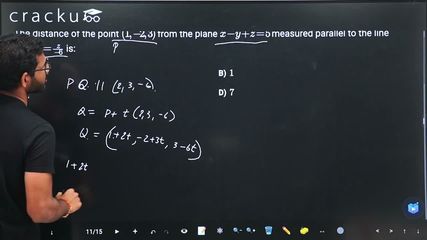
The distance of the point $$(1, -2, 3)$$ from the plane $$x - y + z = 5$$ measured parallel to the line $$\frac{x}{2} = \frac{y}{3} = \frac{z}{-6}$$ is:
We have to find the distance of the point $$P(1,-2,3)$$ from the plane $$x-y+z=5$$, but this distance is to be measured parallel to the line whose symmetric form is $$\dfrac{x}{2}=\dfrac{y}{3}=\dfrac{z}{-6}$$.
First, we identify the direction ratios of the given line. From the standard symmetric form $$\dfrac{x-x_{0}}{a}=\dfrac{y-y_{0}}{b}=\dfrac{z-z_{0}}{c}$$ we know that the numbers $$a,\;b,\;c$$ represent the direction ratios. Thus here the direction ratios are $$2,\;3,\;-6$$. We collect them in a direction vector $$\vec d=\langle 2,\,3,\,-6\rangle$$.
Next we draw a line through the given point $$P(1,-2,3)$$ that is parallel to $$\vec d$$. Using the one-point form of a line in vector/parametric form, $$\text{if } (x_{0},y_{0},z_{0})$$ is a point and $$\langle a,b,c\rangle$$ is a direction vector, then $$(x,y,z)=(x_{0},y_{0},z_{0})+t\langle a,b,c\rangle,$$ we write the parametric equations of our required line through $$P$$:
$$ x = 1 + 2t, \qquad y = -2 + 3t, \qquad z = 3 - 6t. $$
This line will meet the plane $$x-y+z=5$$ at some point $$Q$$. To obtain that point we substitute the coordinates of the general point of the line into the plane equation.
Substituting, $$ (1+2t) - (-2+3t) + (3-6t) = 5. $$ We now open the brackets and collect like terms:
$$ 1 + 2t + 2 - 3t + 3 - 6t = 5. $$
Combine the constant terms first: $$ 1 + 2 + 3 = 6, $$ and then the coefficients of $$t$$: $$ 2t - 3t - 6t = -7t. $$ So the equation becomes $$ 6 - 7t = 5. $$
Moving the constant to one side we get $$ 6 - 5 = 7t \quad\Longrightarrow\quad 1 = 7t. $$ Hence $$ t = \frac{1}{7}. $$
We now substitute $$t=\dfrac{1}{7}$$ back into the parametric form of the line to find the coordinates of $$Q$$:
$$ x_Q = 1 + 2\left(\frac{1}{7}\right) = 1 + \frac{2}{7} = \frac{9}{7}, $$ $$ y_Q = -2 + 3\left(\frac{1}{7}\right) = -2 + \frac{3}{7} = -\frac{11}{7}, $$ $$ z_Q = 3 - 6\left(\frac{1}{7}\right) = 3 - \frac{6}{7} = \frac{15}{7}. $$
Thus $$ Q\Bigl(\frac{9}{7},\, -\frac{11}{7},\, \frac{15}{7}\Bigr). $$
Now we calculate the vector $$\vec{PQ}$$: $$ \vec{PQ} = \Bigl(\frac{9}{7}-1,\; -\frac{11}{7}+2,\; \frac{15}{7}-3\Bigr) = \Bigl(\frac{9}{7}-\frac{7}{7},\; -\frac{11}{7}+\frac{14}{7},\; \frac{15}{7}-\frac{21}{7}\Bigr) = \Bigl(\frac{2}{7},\; \frac{3}{7},\; -\frac{6}{7}\Bigr).$$
Notice that this vector is just $$\dfrac{1}{7}\langle 2,3,-6\rangle$$, that is, $$ \vec{PQ} = \frac{1}{7}\vec d. $$ Therefore its magnitude equals $$ |\vec{PQ}| = \frac{1}{7}\,|\vec d|. $$ We now find $$ |\vec d| $$ first. Using the distance (magnitude) formula for a 3-D vector $$\langle a,b,c\rangle$$, namely $$ |\langle a,b,c\rangle| = \sqrt{a^{2}+b^{2}+c^{2}}, $$ we have $$ |\vec d| = \sqrt{2^{2}+3^{2}+(-6)^{2}} = \sqrt{4+9+36} = \sqrt{49} = 7. $$
Hence $$ |\vec{PQ}| = \frac{1}{7}\times 7 = 1. $$ This length is exactly the required distance because the measurement was to be taken parallel to the given line, and $$PQ$$ is along that very direction.
Hence, the correct answer is Option B.
Was this solution helpful?
Click on the Email ☝️ to Watch the Video Solution
Create a FREE account and get:
_1.webp)

Educational materials for JEE preparation

Ask our AI anything

AI can make mistakes. Please verify important information.
AI can make mistakes. Please verify important information.


