
Join Our JEE Preparation Group
Prep with like-minded aspirants; Get access to free daily tests and study material.
Sign in
Please select an account to continue using cracku.in
↓ →
Join Our JEE Preparation Group
Prep with like-minded aspirants; Get access to free daily tests and study material.
The solution of the differential equation $$\frac{dy}{dx} - \frac{y+3x}{\log_e(y+3x)} + 3 = 0$$ is (where C is a constant of integration)
We begin with the given differential equation
$$\frac{dy}{dx}-\frac{y+3x}{\log_e(y+3x)}+3=0.$$
First, we separate the derivative from the remaining terms:
$$\frac{dy}{dx}= \frac{y+3x}{\log_e(y+3x)}-3.$$
At this point it is very convenient to introduce a new variable that appears naturally in the fraction. We set
$$t = y+3x.$$
Differentiating both sides with respect to $$x$$ gives
$$\frac{dt}{dx}= \frac{d}{dx}(y+3x)=\frac{dy}{dx}+3.$$
Now we already have an expression for $$\dfrac{dy}{dx}$$ from the differential equation, so we substitute it:
$$\frac{dt}{dx}= \left(\frac{y+3x}{\log_e(y+3x)}-3\right)+3.$$
Simplifying the right side, the two “$$-3$$” terms cancel:
$$\frac{dt}{dx}= \frac{y+3x}{\log_e(y+3x)}.$$
But $$y+3x$$ is exactly our new variable $$t$$. Hence we have a much simpler differential equation,
$$\frac{dt}{dx}= \frac{t}{\log_e t}.$$
This form is separable. We rewrite it by bringing all $$t$$-terms to the left and the $$x$$-term to the right:
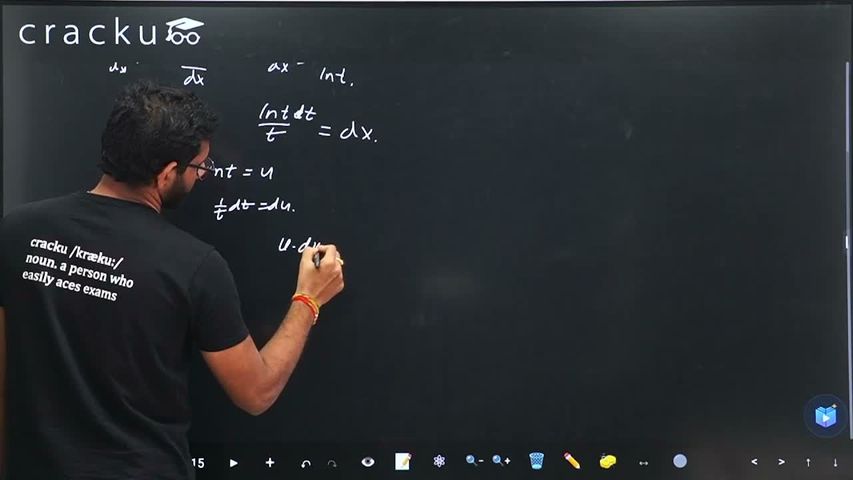
$$\frac{\log_e t}{t}\,dt = dx.$$
Next, we integrate both sides. For the left‐hand side we will make an explicit substitution. Let
$$u = \log_e t \quad\Longrightarrow\quad t = e^u,\quad dt = e^u\,du.$$
Then
$$\frac{\log_e t}{t}\,dt \;=\; \frac{u}{e^u}\cdot e^u\,du \;=\; u\,du.$$
Now we use the standard integral formula
$$\int u\,du = \frac{u^2}{2} + \text{constant}.$$
Therefore, integrating both sides gives
$$\int \frac{\log_e t}{t}\,dt = \int dx \quad\Longrightarrow\quad \frac{u^2}{2} = x + C_1,$$
where $$C_1$$ is a constant of integration. Substituting back $$u = \log_e t$$ we obtain
$$\frac{(\log_e t)^2}{2} = x + C_1.$$
Now we restore the original variable $$t = y+3x$$:
$$\frac{(\log_e(y+3x))^2}{2} = x + C_1.$$
It is customary to collect the constant on one side. Multiplying by $$1$$ does not change the expression, so we write
$$x - \frac{1}{2}\bigl(\log_e(y+3x)\bigr)^2 = -C_1.$$
Since $$-C_1$$ is just another arbitrary constant, we rename it as $$C$$. Thus the implicit solution finally reads
$$x - \frac{1}{2}\bigl(\log_e(y + 3x)\bigr)^2 = C.$$
This matches exactly Option A.
Hence, the correct answer is Option A.
Was this solution helpful?
Click on the Email ☝️ to Watch the Video Solution
Create a FREE account and get:
_1.webp)

Educational materials for JEE preparation

Ask our AI anything

AI can make mistakes. Please verify important information.
AI can make mistakes. Please verify important information.


