
Join Our JEE Preparation Group
Prep with like-minded aspirants; Get access to free daily tests and study material.
Sign in
Please select an account to continue using cracku.in
↓ →
Join Our JEE Preparation Group
Prep with like-minded aspirants; Get access to free daily tests and study material.
The integral $$\int_{\frac{\pi}{6}}^{\frac{\pi}{3}} \tan^3 x \cdot \sin^2 3x(2\sec^2 x \cdot \sin^2 3x + 3\tan x \cdot \sin 6x)dx$$ is equal to:
We have to evaluate the definite integral
$$I=\int_{\frac{\pi}{6}}^{\frac{\pi}{3}}\tan^{3}x\;\sin^{2}3x\;\bigl(2\sec^{2}x\;\sin^{2}3x+3\tan x\;\sin 6x\bigr)\;dx.$$
The expression inside the integral looks as if it might be the product of some function and its derivative. So we try to create a single simple function whose derivative reproduces the bracket.
Let us define
$$u=\tan^{2}x\;\sin^{2}3x.$$
Before using this substitution, we carefully find its derivative with respect to $$x$$. We use the product rule and the standard derivatives
$$\frac{d}{dx}\bigl(\tan x\bigr)=\sec^{2}x, \qquad \frac{d}{dx}\bigl(\sin^{2}3x\bigr)=2\sin 3x\;\cos 3x\;(3)=6\sin 3x\cos 3x=3\sin 6x,$$
because $$\sin 6x=2\sin 3x\cos 3x$$.
Applying the product rule, we get
$$\frac{du}{dx} =\frac{d}{dx}\bigl(\tan^{2}x\bigr)\;\sin^{2}3x+\tan^{2}x\;\frac{d}{dx}\bigl(\sin^{2}3x\bigr) =2\tan x\;\sec^{2}x\;\sin^{2}3x+\tan^{2}x\;(3\sin 6x).$$
So
$$\frac{du}{dx}=2\tan x\sec^{2}x\sin^{2}3x+3\tan^{2}x\sin 6x.$$
Now multiply both sides by $$u=\tan^{2}x\sin^{2}3x$$:
$$u\;\frac{du}{dx} =\bigl(\tan^{2}x\sin^{2}3x\bigr)\Bigl(2\tan x\sec^{2}x\sin^{2}3x+3\tan^{2}x\sin 6x\Bigr).$$
Carry out the multiplication term by term:
$$\displaystyle u\;\frac{du}{dx} =2\tan^{3}x\;\sec^{2}x\;\sin^{4}3x +3\tan^{4}x\;\sin^{2}3x\;\sin 6x. $$
Compare this with the integrand:
$$\tan^{3}x\;\sin^{2}3x\;\bigl(2\sec^{2}x\;\sin^{2}3x+3\tan x\;\sin 6x\bigr) =2\tan^{3}x\;\sec^{2}x\;\sin^{4}3x +3\tan^{4}x\;\sin^{2}3x\;\sin 6x.$$
The two expressions are exactly the same. Therefore
$$\tan^{3}x\;\sin^{2}3x\;\bigl(2\sec^{2}x\;\sin^{2}3x+3\tan x\;\sin 6x\bigr)=u\;\frac{du}{dx}.$$
Hence, inside our integral, $$dx$$ times the integrand becomes $$u\,du$$:
$$I=\int_{\frac{\pi}{6}}^{\frac{\pi}{3}}u\;\frac{du}{dx}\;dx=\int_{u(x=\frac{\pi}{6})}^{u(x=\frac{\pi}{3})}u\;du.$$
We now evaluate the new limits. First for $$x=\frac{\pi}{6}$$:
$$\tan\frac{\pi}{6}=\frac{1}{\sqrt3},\qquad \tan^{2}\frac{\pi}{6}=\frac13,\qquad \sin 3\left(\frac{\pi}{6}\right)=\sin\frac{\pi}{2}=1,\qquad \sin^{2}\frac{\pi}{2}=1.$$
Thus
$$u\Bigl(\tfrac{\pi}{6}\Bigr)=\frac13\cdot1=\frac13.$$
Next for $$x=\frac{\pi}{3}$$:
$$\tan\frac{\pi}{3}=\sqrt3,\qquad \tan^{2}\frac{\pi}{3}=3,\qquad \sin 3\left(\frac{\pi}{3}\right)=\sin\pi=0,\qquad \sin^{2}\pi=0.$$
Hence
$$u\Bigl(\tfrac{\pi}{3}\Bigr)=3\cdot0=0.$$
So the integral becomes
$$I=\int_{\frac13}^{0}u\;du.$$
We know the elementary integral
$$\int u\;du=\frac{u^{2}}{2}.$$
Applying the limits:
$$I=\left.\frac{u^{2}}{2}\right|_{u=\frac13}^{u=0} =\frac{0^{2}}{2}-\frac{\left(\frac13\right)^{2}}{2} =0-\frac{\frac19}{2} =-\frac{1}{18}.$$
Hence, the correct answer is Option C.
Was this solution helpful?
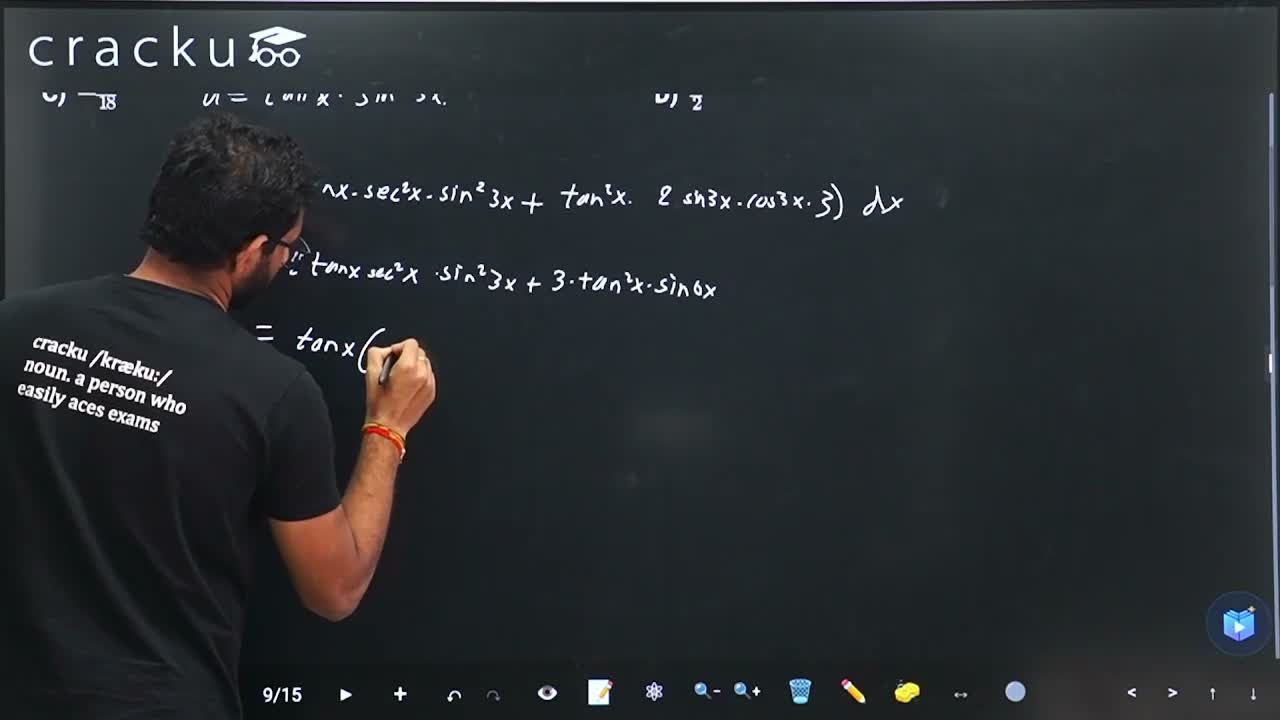
Click on the Email ☝️ to Watch the Video Solution
Create a FREE account and get:
_1.webp)

Educational materials for JEE preparation

Ask our AI anything

AI can make mistakes. Please verify important information.
AI can make mistakes. Please verify important information.


