
Join Our JEE Preparation Group
Prep with like-minded aspirants; Get access to free daily tests and study material.
Sign in
Please select an account to continue using cracku.in
↓ →
Join Our JEE Preparation Group
Prep with like-minded aspirants; Get access to free daily tests and study material.
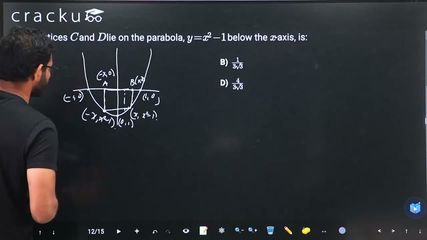
The area (in sq. units) of the largest rectangle $$ABCD$$ whose vertices $$A$$ and $$B$$ lie on the $$x$$-axis and vertices $$C$$ and $$D$$ lie on the parabola, $$y = x^2 - 1$$ below the $$x$$-axis, is:
1. Understand the Geometry of the Curve
The given parabola equation is:
$$y = x^2 - 1$$
This is a vertically opening parabola with its vertex at $$(0, -1)$$. It intersects the $$x$$-axis at $$x = 1$$ and $$x = -1$$. The region of the parabola that lies below the $$x$$-axis corresponds to the interval where $$-1 < x < 1$$, meaning $$y$$ is negative.
2. Set Up the Coordinates of the Rectangle
By symmetry about the $$y$$-axis, let the vertices of the rectangle be:
$$B = (x, 0)$$ on the positive $$x$$-axis, where $$0 < x < 1$$
$$A = (-x, 0)$$ on the negative $$x$$-axis
$$C = (x, x^2 - 1)$$ on the parabola in the fourth quadrant
$$D = (-x, x^2 - 1)$$ on the parabola in the third quadrant
3. Formulate the Area Function
The length of the rectangle along the $$x$$-axis is:
$$\text{Length} = x - (-x) = 2x$$
The height of the rectangle is the absolute distance from the $$x$$-axis down to the curve. Since $$y$$ is negative in this region, the height is:
$$\text{Height} = 0 - y = -(x^2 - 1) = 1 - x^2$$
The area $$A(x)$$ of the rectangle can be expressed as a function of $$x$$:
$$A(x) = \text{Length} \times \text{Height}$$
$$A(x) = 2x(1 - x^2)$$
$$A(x) = 2x - 2x^3$$
4. Maximize the Area Using Differentiation
To find the value of $$x$$ that yields the maximum area, differentiate $$A(x)$$ with respect to $$x$$ and set it to $$0$$:
$$A'(x) = \frac{d}{dx}(2x - 2x^3) = 2 - 6x^2$$
Setting the first derivative to zero:
$$2 - 6x^2 = 0$$
$$6x^2 = 2$$
$$x^2 = \frac{1}{3}$$
$$x = \frac{1}{\sqrt{3}}$$
Since the second derivative $$A''(x) = -12x$$ is strictly negative for $$x = \frac{1}{\sqrt{3}}$$, this point confirms a local maximum.
5. Compute the Maximum Area
Substitute $$x = \frac{1}{\sqrt{3}}$$ back into the area function:
$$A\left(\frac{1}{\sqrt{3}}\right) = 2\left(\frac{1}{\sqrt{3}}\right) - 2\left(\frac{1}{\sqrt{3}}\right)^3$$
$$A\left(\frac{1}{\sqrt{3}}\right) = \frac{2}{\sqrt{3}} - \frac{2}{3\sqrt{3}}$$
$$A\left(\frac{1}{\sqrt{3}}\right) = \frac{6 - 2}{3\sqrt{3}} = \frac{4}{3\sqrt{3}}$$
Was this solution helpful?
Click on the Email ☝️ to Watch the Video Solution
Create a FREE account and get:
_1.webp)

Educational materials for JEE preparation

Ask our AI anything

AI can make mistakes. Please verify important information.
AI can make mistakes. Please verify important information.


