
Join Our JEE Preparation Group
Prep with like-minded aspirants; Get access to free daily tests and study material.
Sign in
Please select an account to continue using cracku.in
↓ →
Join Our JEE Preparation Group
Prep with like-minded aspirants; Get access to free daily tests and study material.
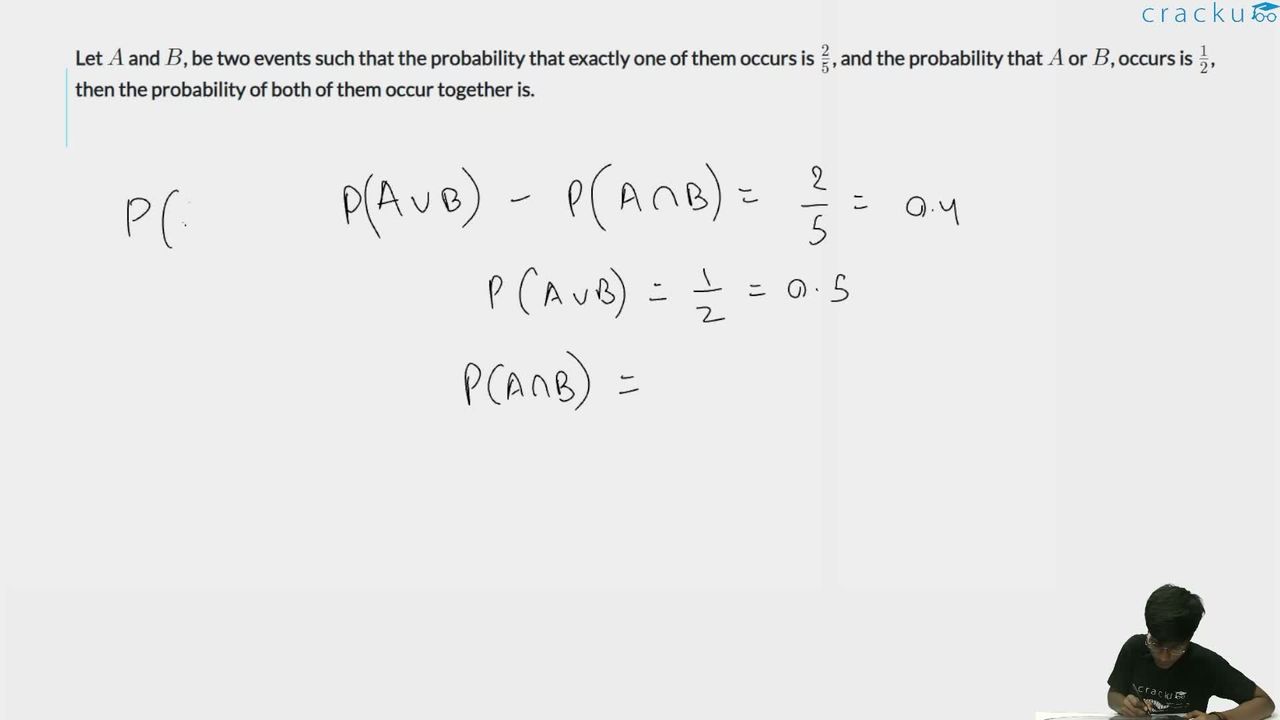
Let $$A$$ and $$B$$, be two events such that the probability that exactly one of them occurs is $$\frac{2}{5}$$, and the probability that $$A$$ or $$B$$, occurs is $$\frac{1}{2}$$, then the probability of both of them occur together is.
Let us denote the probability of an event by the symbol $$\text P(\,\cdot\,)$$.
We have two events $$A$$ and $$B$$. The statement “exactly one of them occurs” refers to the event in which either $$A$$ happens alone or $$B$$ happens alone, but not both together. In probability notation, this “exactly one” event is $$A \triangle B=(A\setminus B)\cup(B\setminus A)$$, and its probability is known to be $$\frac{2}{5}$$, that is
$$\text P(A\triangle B)=\frac{2}{5}.$$
Next, the phrase “$$A$$ or $$B$$ occurs” means the union $$A\cup B$$. Its probability is given as $$\frac12$$, so we know
$$\text P(A\cup B)=\frac12.$$
We now translate the verbal conditions into algebraic equations involving the unknown probability $$\text P(A\cap B)$$, which is what we want to find.
First, recall the relation that expresses the probability of the union of two events:
$$\text P(A\cup B)=\text P(A)+\text P(B)-\text P(A\cap B).$$
Second, recall the formula for the probability that exactly one of the two events occurs. Exactly one occurs when we add the individual probabilities and then subtract twice the overlap (because the overlap contributes to both $$A$$ and $$B$$ but must be excluded entirely in the “exactly one” count). Thus,
$$\text P(A\triangle B)=\text P(A)+\text P(B)-2\,\text P(A\cap B).$$
Let us set
$$x=\text P(A)+\text P(B)\quad\text{and}\quad y=\text P(A\cap B).$$
The two factual statements now become a pair of linear equations:
1. From the “exactly one” condition $$x-2y=\frac25.$$
2. From the “union” condition $$x-y=\frac12.$$
We have a very small system of two equations in the two unknowns $$x$$ and $$y$$:
$$\begin{aligned} x-2y &=\frac25,\\ x-y &=\frac12. \end{aligned}$$
To isolate $$y$$, subtract the first equation from the second. Performing that subtraction step by step, we have
$$\bigl(x-y\bigr)-\bigl(x-2y\bigr)=\frac12-\frac25.$$
Expanding the left‐hand side, the $$x$$ terms cancel and we get
$$-y+2y\;=\;y.$$
On the right‐hand side, put both fractions over the common denominator $$10$$:
$$\frac12=\frac5{10},\quad\frac25=\frac4{10},\quad\text{so}\quad\frac12-\frac25=\frac5{10}-\frac4{10}=\frac1{10}.$$
Therefore, the entire subtraction gives
$$y=\frac1{10}.$$
But $$y=\text P(A\cap B)$$, so we have found
$$\text P(A\cap B)=\frac1{10}=0.10.$$
Hence, the correct answer is Option D.
Was this solution helpful?
Click on the Email ☝️ to Watch the Video Solution
Create a FREE account and get:
_1.webp)

Educational materials for JEE preparation

Ask our AI anything

AI can make mistakes. Please verify important information.
AI can make mistakes. Please verify important information.


