
Join Our JEE Preparation Group
Prep with like-minded aspirants; Get access to free daily tests and study material.
Sign in
Please select an account to continue using cracku.in
↓ →
Join Our JEE Preparation Group
Prep with like-minded aspirants; Get access to free daily tests and study material.
The mirror image of the point (1, 2, 3), in a plane is $$\left(-\frac{7}{3}, -\frac{4}{3}, -\frac{1}{3}\right)$$. Which of the following points lies on this plane?
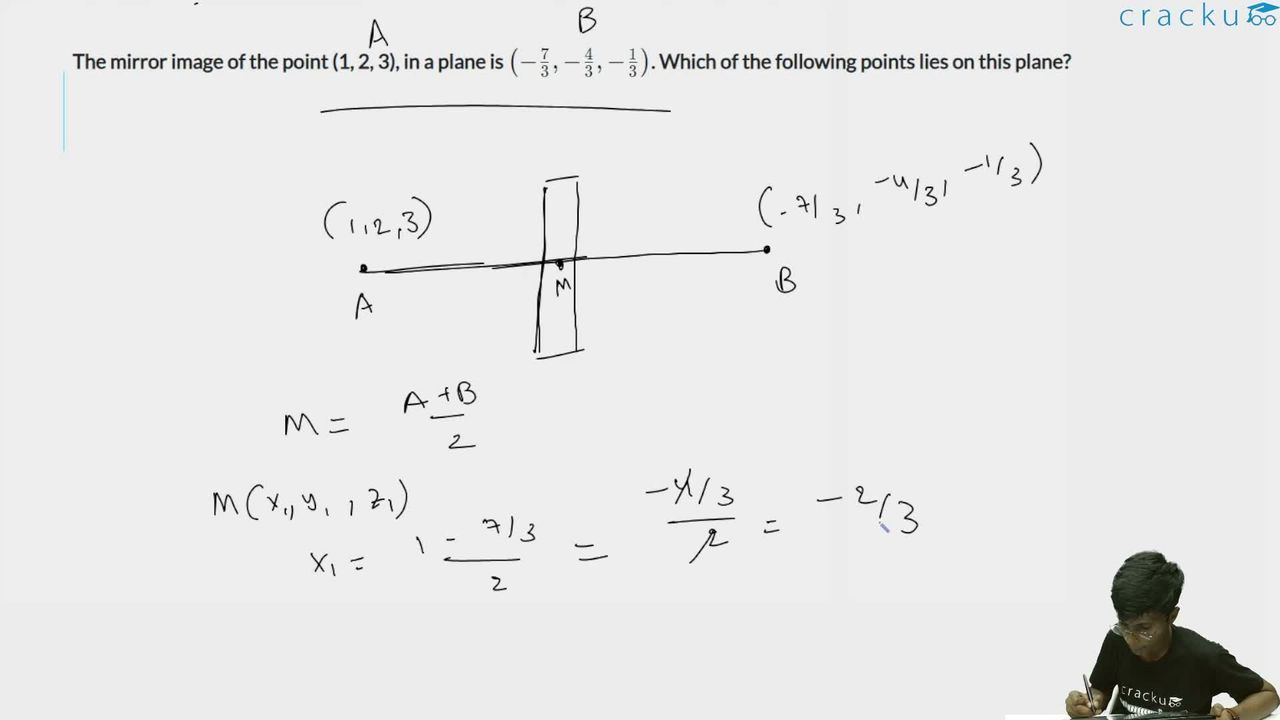
We denote the given point by $$P(1,\,2,\,3)$$ and its mirror image by $$P'\!\left(-\dfrac73,\,-\dfrac43,\,-\dfrac13\right).$$ By definition of reflection, the unknown plane must satisfy two facts: it is perpendicular to the segment $$PP'$$ and it passes through the midpoint of that segment.
First we find the vector $$\overrightarrow{PP'}.$$ Subtracting the coordinates we get
$$\overrightarrow{PP'} = \left(-\dfrac73-1,\;-\dfrac43-2,\;-\dfrac13-3\right) = \left(-\dfrac{10}3,\;-\dfrac{10}3,\;-\dfrac{10}3\right).$$
This vector is a common multiple of $$(-1,\,-1,\,-1),$$ so the normal vector of the plane may be taken as $$\mathbf n=(1,\,1,\,1).$$
Now we need the midpoint $$M$$ of $$PP'$$. Using the midpoint formula
$$M\! \left(\dfrac{1+\left(-\dfrac73\right)}2,\; \dfrac{2+\left(-\dfrac43\right)}2,\; \dfrac{3+\left(-\dfrac13\right)}2\right)$$
we compute each coordinate step by step:
$$\dfrac{1+\left(-\dfrac73\right)}2 = \dfrac{\dfrac33-\dfrac73}{2} = \dfrac{-\dfrac43}{2} = -\dfrac23,$$
$$\dfrac{2+\left(-\dfrac43\right)}2 = \dfrac{\dfrac63-\dfrac43}{2} = \dfrac{\dfrac23}{2} = \dfrac13,$$
$$\dfrac{3+\left(-\dfrac13\right)}2 = \dfrac{\dfrac93-\dfrac13}{2} = \dfrac{\dfrac83}{2} = \dfrac43.$$
So $$M\!\left(-\dfrac23,\,\dfrac13,\,\dfrac43\right).$$
Because $$\mathbf n=(1,\,1,\,1)$$ is normal to the plane and the plane passes through $$M,$$ its equation is written (stating the point-normal form first)
$$\mathbf n\cdot\bigl((x,y,z)-M\bigr)=0,$$ i.e. $$1\,(x+ \tfrac23)\;+\;1\,(y-\tfrac13)\;+\;1\,(z-\tfrac43)=0.$$
Adding the three terms gives
$$x+\dfrac23+y-\dfrac13+z-\dfrac43=0.$$
Combining the constants,
$$x+y+z+\left(\dfrac23-\dfrac13-\dfrac43\right)=0 \;\;\Longrightarrow\;\; x+y+z-1=0.$$
Thus the plane is $$x+y+z=1.$$
We now test each option:
A. For $$(1,1,1)$$ we find $$1+1+1=3\neq1,$$ so it does not lie on the plane.
B. For $$(1,-1,1)$$ we have $$1+(-1)+1=1,$$ so this point satisfies the equation.
C. For $$(-1,-1,1)$$ we get $$-1-1+1=-1\neq1,$$ hence not on the plane.
D. For $$(-1,-1,-1)$$ we have $$-1-1-1=-3\neq1,$$ so it is also not on the plane.
Only option B fulfills the condition.
Hence, the correct answer is Option B.
Was this solution helpful?
Click on the Email ☝️ to Watch the Video Solution
Create a FREE account and get:
_1.webp)

Educational materials for JEE preparation

Ask our AI anything

AI can make mistakes. Please verify important information.
AI can make mistakes. Please verify important information.


