
Join Our JEE Preparation Group
Prep with like-minded aspirants; Get access to free daily tests and study material.
Sign in
Please select an account to continue using cracku.in
↓ →
Join Our JEE Preparation Group
Prep with like-minded aspirants; Get access to free daily tests and study material.
If the system of linear equations $$x - 2y + z = -4$$, $$2x + \alpha y + 3z = 5$$, $$3x - y + \beta z = 3$$ has infinitely many solutions, then $$12\alpha + 13\beta$$ is equal to
The system has infinitely many solutions, so the coefficient matrix and augmented matrix must have the same rank, which must be less than 3.
The coefficient matrix is $$A = \begin{bmatrix} 1 & -2 & 1 \\ 2 & \alpha & 3 \\ 3 & -1 & \beta \end{bmatrix}$$.
For infinitely many solutions, $$\det(A) = 0$$ and the augmented matrix also has rank < 3.
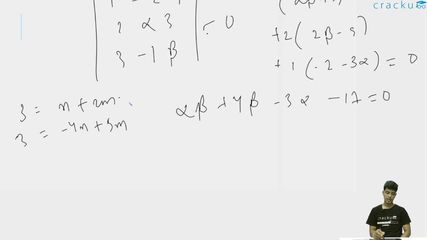
$$\det(A) = 1(\alpha\beta + 3) + 2(2\beta - 9) + 1(-2 - 3\alpha)$$
$$= \alpha\beta + 3 + 4\beta - 18 - 2 - 3\alpha$$
$$= \alpha\beta - 3\alpha + 4\beta - 17 = 0$$ ... (1)
The augmented matrix is $$[A|B] = \begin{bmatrix} 1 & -2 & 1 & -4 \\ 2 & \alpha & 3 & 5 \\ 3 & -1 & \beta & 3 \end{bmatrix}$$.
Replace R2 with R2 - 2R1, R3 with R3 - 3R1:
$$\begin{bmatrix} 1 & -2 & 1 & -4 \\ 0 & \alpha+4 & 1 & 13 \\ 0 & 5 & \beta-3 & 15 \end{bmatrix}$$
For rank < 3, the last two rows must be proportional:
$$\frac{\alpha+4}{5} = \frac{1}{\beta-3} = \frac{13}{15}$$
From $$\frac{1}{\beta-3} = \frac{13}{15}$$: $$\beta - 3 = \frac{15}{13}$$, so $$\beta = 3 + \frac{15}{13} = \frac{54}{13}$$.
From $$\frac{\alpha+4}{5} = \frac{13}{15}$$: $$\alpha + 4 = \frac{65}{15} = \frac{13}{3}$$, so $$\alpha = \frac{13}{3} - 4 = \frac{1}{3}$$.
$$12\alpha + 13\beta = 12 \cdot \frac{1}{3} + 13 \cdot \frac{54}{13} = 4 + 54 = 58$$.
Was this solution helpful?
Click on the Email ☝️ to Watch the Video Solution
Create a FREE account and get:
_1.webp)

Educational materials for JEE preparation

Ask our AI anything

AI can make mistakes. Please verify important information.
AI can make mistakes. Please verify important information.
