
Join Our JEE Preparation Group
Prep with like-minded aspirants; Get access to free daily tests and study material.
Sign in
Please select an account to continue using cracku.in
↓ →
Join Our JEE Preparation Group
Prep with like-minded aspirants; Get access to free daily tests and study material.
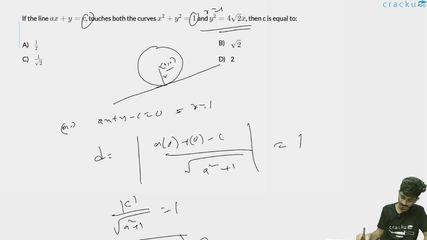
If the line $$ax + y = c$$, touches both the curves $$x^2 + y^2 = 1$$ and $$y^2 = 4\sqrt{2}x$$, then c is equal to:
We have the straight line
$$ax+y=c$$
which is required to touch (be tangent to) both the circle
$$x^{2}+y^{2}=1$$
and the parabola
$$y^{2}=4\sqrt{2}\,x.$$
Tangency condition with the circle. For a line written as $$Ax+By+C=0,$$ the perpendicular distance from the centre $$O(0,0)$$ to the line is
$$\dfrac{|C|}{\sqrt{A^{2}+B^{2}}}.$$
Here the given line can be rewritten in the standard form as
$$ax+y-c=0,$$
so that $$A=a,\;B=1,\;C=-c.$$ The distance of the centre from the line therefore equals
$$\dfrac{|\, -c\,|}{\sqrt{a^{2}+1}}=\dfrac{|c|}{\sqrt{a^{2}+1}}.$$
Because the line is tangent to the circle of radius $$1,$$ this distance must be $$1.$$ Hence
$$\dfrac{|c|}{\sqrt{a^{2}+1}}=1 \;\;\Longrightarrow\;\; c^{2}=a^{2}+1. \quad -(1)$$
Tangency condition with the parabola. Let us write the line in slope-intercept form:
$$y=-ax+c.$$
Its slope is therefore $$m=-a.$$ For the parabola $$y^{2}=4p\,x,$$ a tangent having slope $$m$$ is known to be
$$y=mx+\dfrac{p}{m}\quad\Bigl(\text{standard slope form}\Bigr).$$
In our problem the parabola is $$y^{2}=4\sqrt{2}\,x,$$ so that $$p=\sqrt{2}.$$ Comparing the required tangent $$y=-ax+c$$ with the standard tangent $$y=mx+\dfrac{p}{m},$$ we equate
$$m=-a\qquad\text{and}\qquad c=\dfrac{p}{m}.$$
Substituting $$m=-a$$ and $$p=\sqrt{2}$$ in the second relation gives
$$c=\dfrac{\sqrt{2}}{-a}=-\dfrac{\sqrt{2}}{a},$$
and therefore
$$ac=-\sqrt{2}. \quad -(2)$$
Combining the two conditions. From (1) we have $$a^{2}=c^{2}-1.$$ Squaring (2) gives
$$(ac)^{2}=2 \;\;\Longrightarrow\;\; a^{2}c^{2}=2. \quad -(3)$$
Now substitute $$a^{2}=c^{2}-1$$ from (1) into (3):
$$(c^{2}-1)\,c^{2}=2.$$
Expanding the left-hand side, we obtain
$$c^{4}-c^{2}-2=0.$$
This is a quadratic equation in $$c^{2}.$$ Let $$t=c^{2}.$$ Then
$$t^{2}-t-2=0.$$
Using the quadratic formula,
$$t=\dfrac{1\pm\sqrt{1+8}}{2} =\dfrac{1\pm3}{2}.$$
So
$$t=2\quad\text{or}\quad t=-1.$$
Because $$t=c^{2}$$ cannot be negative, we keep only $$t=2,$$ i.e.
$$c^{2}=2.$$
Extracting $$c.$$ Taking the (positive) square root gives
$$c=\sqrt{2}.$$
(The negative root $$c=-\sqrt{2}$$ also satisfies the algebraic conditions, but the question asks for the value of $$c$$; conventionally we report the positive one.)
Hence, the correct answer is Option B.
Was this solution helpful?
Click on the Email ☝️ to Watch the Video Solution
Create a FREE account and get:
_1.webp)

Educational materials for JEE preparation

Ask our AI anything

AI can make mistakes. Please verify important information.
AI can make mistakes. Please verify important information.
