
Join Our JEE Preparation Group
Prep with like-minded aspirants; Get access to free daily tests and study material.
Sign in
Please select an account to continue using cracku.in
↓ →
Join Our JEE Preparation Group
Prep with like-minded aspirants; Get access to free daily tests and study material.
Let $$p_n$$ denote the total number of triangles formed by joining the vertices of an $$n$$-side regular polygon. If $$p_{n+1} - p_n = 66$$, then the sum of all distinct prime divisors of $$n$$ is :
For a convex regular polygon, any choice of three distinct vertices forms a triangle. Hence, the total number of triangles that can be drawn is simply the combination
$$p_n = \binom{n}{3} = \frac{n(n-1)(n-2)}{6}$$
The condition given in the question is
$$p_{n+1} - p_n = 66$$
Compute each term:
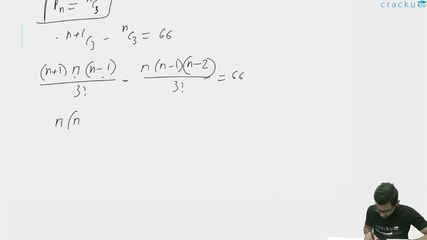
$$p_{n+1}= \binom{n+1}{3}= \frac{(n+1)n(n-1)}{6}$$
$$p_n = \binom{n}{3}= \frac{n(n-1)(n-2)}{6}$$
Subtracting, we get
$$p_{n+1}-p_n = \frac{(n+1)n(n-1) - n(n-1)(n-2)}{6}$$
Factor out the common term $$n(n-1)$$:
$$p_{n+1}-p_n = \frac{n(n-1)\big[(n+1)-(n-2)\big]}{6} = \frac{n(n-1)\times 3}{6} = \frac{n(n-1)}{2}$$
Set this equal to the given value 66:
$$\frac{n(n-1)}{2}=66 \quad\Longrightarrow\quad n(n-1)=132$$
This is a quadratic equation:
$$n^2-n-132=0$$
Factoring (or using the quadratic formula) gives
$$(n-12)(n+11)=0\quad\Longrightarrow\quad n=12\;(\text{positive solution})$$
The distinct prime factors of $$12$$ are $$2$$ and $$3$$. Their sum is
$$2+3 = 5$$
Therefore, the required sum is $$5$$.
Option C which is: 5
Was this solution helpful?
Click on the Email ☝️ to Watch the Video Solution
Create a FREE account and get:
_1.webp)

Educational materials for JEE preparation

Ask our AI anything

AI can make mistakes. Please verify important information.
AI can make mistakes. Please verify important information.
