
Join Our JEE Preparation Group
Prep with like-minded aspirants; Get access to free daily tests and study material.
Sign in
Please select an account to continue using cracku.in
↓ →
Join Our JEE Preparation Group
Prep with like-minded aspirants; Get access to free daily tests and study material.
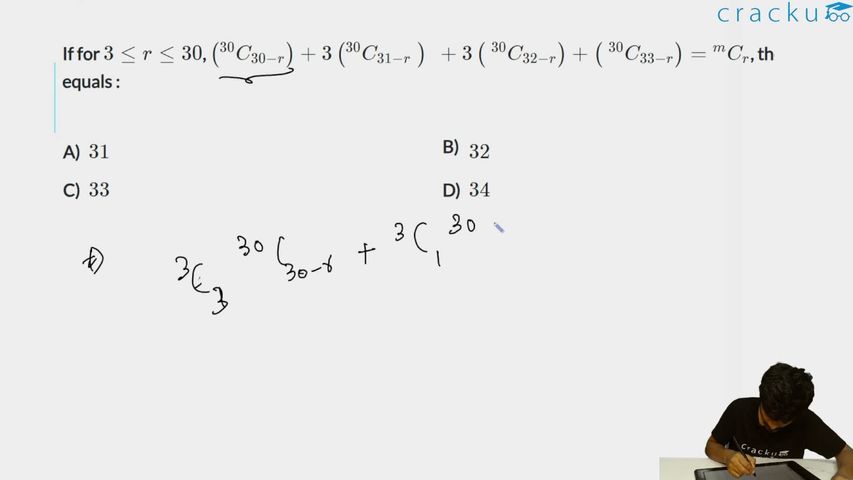
If for $$3 \le r \le 30$$, $$\left({}^{30}C_{30-r}\right) + 3\left( ^{30}C_{31-r} \right) + 3\left( ^{30}C_{32-r}\right) + \left( ^{30}C_{33-r}\right) = {}^{m}C_r$$, then $$m$$ equals :
Write the given expression in terms of $$r$$ only:
$$\binom{30}{30-r}+3\binom{30}{31-r}+3\binom{30}{32-r}+\binom{30}{33-r}.$$
This mixture of subscripts suggests the convolution formula that appears when we multiply two binomial expansions.
Recall:
$$(1+x)^{30}=\sum_{k=0}^{30}\binom{30}{k}x^{k},$$
$$(1+x)^{3} = \sum_{i=0}^{3}\binom{3}{i}x^{i}=1+3x+3x^{2}+x^{3}.$$
The coefficient of $$x^{K}$$ in the product $$(1+x)^{30}(1+x)^{3}=(1+x)^{33}$$ is obtained by the convolution rule:
$$\text{Coeff. of }x^{K}=\sum_{i=0}^{3}\binom{30}{K-i}\binom{3}{i}.$$
Set $$K=33-r$$. Then
$$\sum_{i=0}^{3}\binom{30}{(33-r)-i}\binom{3}{i}$$ $$=\binom{30}{33-r}\binom{3}{0}+3\binom{30}{32-r}\binom{3}{1}$$ $$\quad +3\binom{30}{31-r}\binom{3}{2}+\binom{30}{30-r}\binom{3}{3}.$$ Because $$\binom{3}{0}=1,\; \binom{3}{1}=3,\; \binom{3}{2}=3,\; \binom{3}{3}=1,$$ the last line is exactly
$$\binom{30}{30-r}+3\binom{30}{31-r}+3\binom{30}{32-r}+\binom{30}{33-r}.$$
But the coefficient of $$x^{K}$$ in $$(1+x)^{33}$$ is just $$\binom{33}{K}$$. Therefore
$$\binom{30}{30-r}+3\binom{30}{31-r}+3\binom{30}{32-r}+\binom{30}{33-r} =\binom{33}{K},\qquad K=33-r.$$
Using the symmetry $$\binom{n}{n-k}=\binom{n}{k},$$ we have
$$\binom{33}{K}=\binom{33}{33-K}=\binom{33}{r}.$$
Hence the entire left-hand side equals $$\binom{33}{r}$$, so the integer $$m$$ in the problem statement is
$$m=33.$$
Option C which is: 33
Was this solution helpful?
Click on the Email ☝️ to Watch the Video Solution
Create a FREE account and get:
_1.webp)

Educational materials for JEE preparation

Ask our AI anything

AI can make mistakes. Please verify important information.
AI can make mistakes. Please verify important information.
