
Join Our JEE Preparation Group
Prep with like-minded aspirants; Get access to free daily tests and study material.
Sign in
Please select an account to continue using cracku.in
↓ →
Join Our JEE Preparation Group
Prep with like-minded aspirants; Get access to free daily tests and study material.
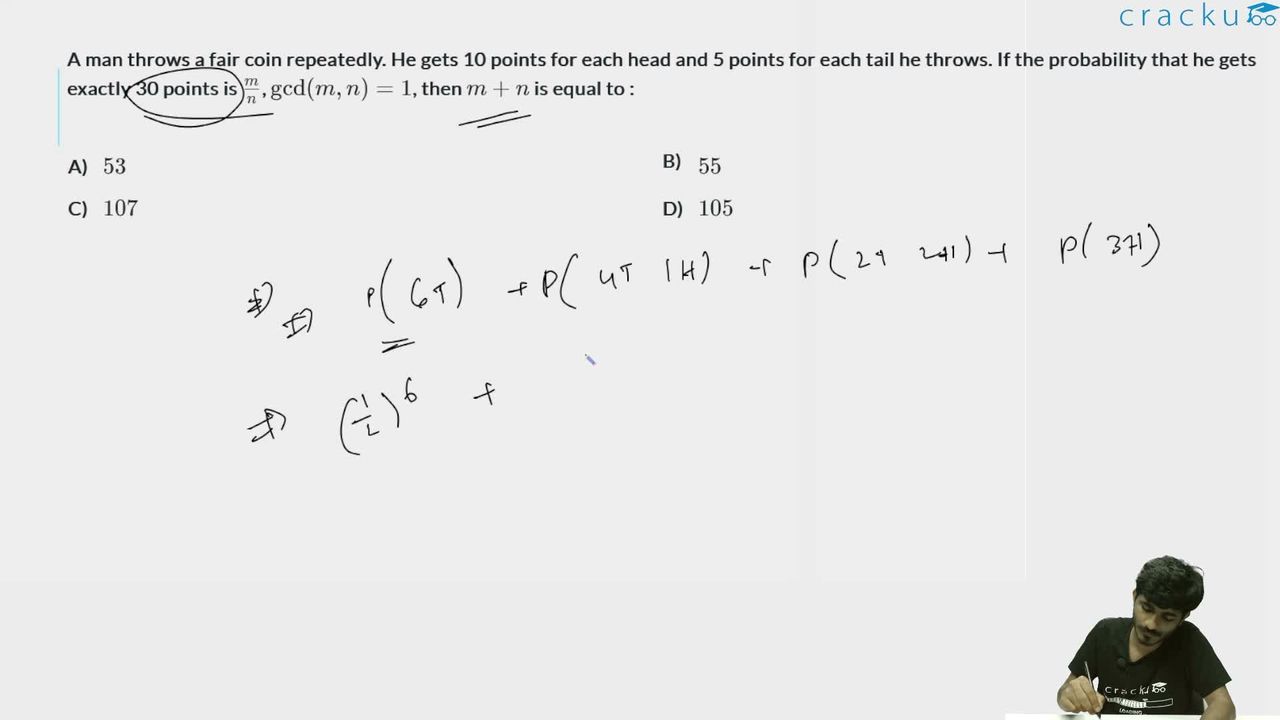
A man throws a fair coin repeatedly. He gets 10 points for each head and 5 points for each tail he throws. If the probability that he gets exactly 30 points is $$\frac{m}{n}$$, $$\gcd(m, n) = 1$$, then $$m + n$$ is equal to :
Let $$h$$ be the number of heads and $$t$$ the number of tails obtained before the total reaches 30 points.
Each head gives 10 points and each tail gives 5 points, so
$$10h + 5t = 30 \;\Longrightarrow\; 2h + t = 6$$
The non-negative integer solutions of $$2h + t = 6$$ are found by assigning values to $$h$$:
$$\begin{array}{c|c} h & t = 6 - 2h \\ \hline 0 & 6\\ 1 & 4\\ 2 & 2\\ 3 & 0 \end{array}$$
Thus four ordered pairs $$(h,t)$$ are possible: $$(0,6),\,(1,4),\,(2,2),\,(3,0).$$
For each pair, the tosses are arranged in $$(h+t)$$ positions. Number of favourable sequences $$= \binom{h+t}{h},$$ and since the coin is fair, the probability of any specific sequence of $$h+t$$ tosses is $$\left(\tfrac12\right)^{h+t}.$$ Therefore the probability contribution of a pair $$(h,t)$$ is $$\binom{h+t}{h}\left(\tfrac12\right)^{h+t}.$$
Compute each term:
$$\begin{aligned} (h,t)=(0,6):&\; \binom{6}{0}\left(\tfrac12\right)^6 = \frac{1}{64}\\[4pt] (h,t)=(1,4):&\; \binom{5}{1}\left(\tfrac12\right)^5 = \frac{5}{32}\\[4pt] (h,t)=(2,2):&\; \binom{4}{2}\left(\tfrac12\right)^4 = \frac{6}{16} = \frac{3}{8}\\[4pt] (h,t)=(3,0):&\; \binom{3}{3}\left(\tfrac12\right)^3 = \frac{1}{8} \end{aligned}$$
Add the four contributions:
$$\frac{1}{64} + \frac{5}{32} + \frac{3}{8} + \frac{1}{8} = \frac{1}{64} + \frac{10}{64} + \frac{24}{64} + \frac{8}{64} = \frac{43}{64}$$
The required probability is $$\dfrac{43}{64},$$ already in lowest terms, so $$m = 43,\; n = 64.$$ Hence $$m + n = 43 + 64 = 107.$$
Option C which is: 107
Was this solution helpful?
Click on the Email ☝️ to Watch the Video Solution
Create a FREE account and get:
_1.webp)

Educational materials for JEE preparation

Ask our AI anything

AI can make mistakes. Please verify important information.
AI can make mistakes. Please verify important information.
