
Join Our JEE Preparation Group
Prep with like-minded aspirants; Get access to free daily tests and study material.
Sign in
Please select an account to continue using cracku.in
↓ →
Join Our JEE Preparation Group
Prep with like-minded aspirants; Get access to free daily tests and study material.
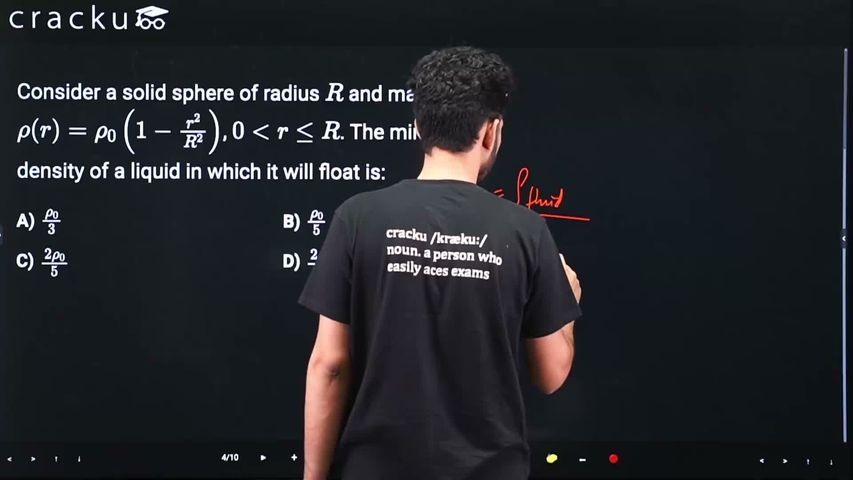
Consider a solid sphere of radius $$R$$ and mass density $$\rho(r) = \rho_0\left(1 - \frac{r^2}{R^2}\right)$$, $$0 < r \le R$$. The minimum density of a liquid in which it will float is:
We are given a solid sphere of radius $$R$$ whose mass density varies with the radial distance $$r$$ from the centre according to the relation
$$\rho(r)=\rho_0\left(1-\dfrac{r^2}{R^2}\right),\qquad 0<r\le R.$$
To decide whether the sphere will float in a liquid we compare its average (bulk) density with the density of the liquid. Archimedes’ principle tells us that the sphere will just float when
$$\text{density of liquid}=\text{average density of sphere}.$$
Hence we first find the total mass $$M$$ of the sphere and then its average density $$\bar\rho=\dfrac{M}{V}$$, where $$V$$ is the volume of the sphere.
The infinitesimal mass of a thin spherical shell of radius $$r$$ and thickness $$dr$$ is obtained from
$$dM=\rho(r)\,dV,$$
and for a spherical shell the elemental volume is
$$dV=4\pi r^{2}\,dr.$$
Therefore, using the given density function,
$$dM=4\pi r^{2}\,\rho_0\!\left(1-\dfrac{r^{2}}{R^{2}}\right)\!dr.$$
To obtain the total mass we integrate from the centre $$r=0$$ to the surface $$r=R$$:
$$M=\int_{0}^{R}4\pi\rho_0\bigl(r^{2}-\dfrac{r^{4}}{R^{2}}\bigr)\,dr.$$
We now evaluate the two integrals separately, remembering the standard results
$$\int r^{2}\,dr=\dfrac{r^{3}}{3}\quad\text{and}\quad \int r^{4}\,dr=\dfrac{r^{5}}{5}.$$
So we have
$$\begin{aligned} M &=4\pi\rho_0\left[\int_{0}^{R}r^{2}\,dr-\dfrac{1}{R^{2}}\int_{0}^{R}r^{4}\,dr\right] \\ &=4\pi\rho_0\left[\left.\dfrac{r^{3}}{3}\right|_{0}^{R}-\dfrac{1}{R^{2}}\left.\dfrac{r^{5}}{5}\right|_{0}^{R}\right] \\ &=4\pi\rho_0\left[\dfrac{R^{3}}{3}-\dfrac{1}{R^{2}}\cdot\dfrac{R^{5}}{5}\right] \\ &=4\pi\rho_0\left[\dfrac{R^{3}}{3}-\dfrac{R^{3}}{5}\right] \\ &=4\pi\rho_0R^{3}\left(\dfrac{1}{3}-\dfrac{1}{5}\right). \end{aligned}$$
Inside the brackets the numerical subtraction gives
$$\dfrac{1}{3}-\dfrac{1}{5}=\dfrac{5-3}{15}=\dfrac{2}{15}.$$
Substituting this result,
$$M=4\pi\rho_0R^{3}\cdot\dfrac{2}{15}=\dfrac{8\pi\rho_0R^{3}}{15}.$$
The geometric volume of a sphere is well-known:
$$V=\dfrac{4}{3}\pi R^{3}.$$
Now we form the average density $$\bar\rho$$:
$$\bar\rho=\dfrac{M}{V} =\dfrac{\dfrac{8\pi\rho_0R^{3}}{15}}{\dfrac{4\pi R^{3}}{3}} =\dfrac{8}{15}\cdot\dfrac{3}{4}\,\rho_0 =\dfrac{24}{60}\,\rho_0 =\dfrac{2\rho_0}{5}.$$
Thus the least (minimum) density a liquid must have for the sphere to be able to float is
$$\rho_{\text{liq,min}}=\dfrac{2\rho_0}{5}.$$
Looking at the options provided, this matches Option C.
Hence, the correct answer is Option C.
Was this solution helpful?
Click on the Email ☝️ to Watch the Video Solution
Create a FREE account and get:
_1.webp)

Educational materials for JEE preparation

Ask our AI anything

AI can make mistakes. Please verify important information.
AI can make mistakes. Please verify important information.
