
Join Our JEE Preparation Group
Prep with like-minded aspirants; Get access to free daily tests and study material.
Sign in
Please select an account to continue using cracku.in
↓ →
Join Our JEE Preparation Group
Prep with like-minded aspirants; Get access to free daily tests and study material.
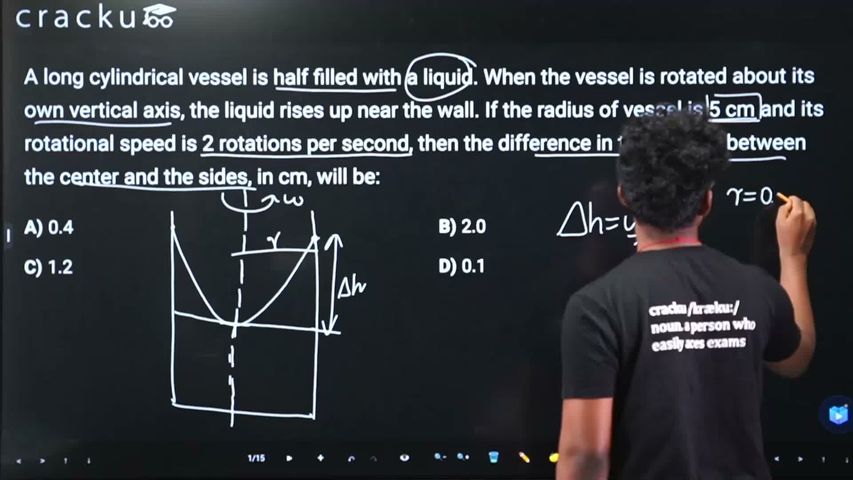
A long cylindrical vessel is half filled with a liquid. When the vessel is rotated about its own vertical axis, the liquid rises up near the wall. If the radius of vessel is 5 cm and its rotational speed is 2 rotations per second, then the difference in the heights between the center and the sides, in cm, will be:
We begin by recalling what happens to the free surface of a liquid when its container spins steadily about a vertical axis. The surface becomes a paraboloid whose height, measured upward from the lowest point, is given by the equation
$$z \;=\; \frac{\omega^{2} r^{2}}{2g} + C,$$
where $$\omega$$ is the angular speed of the vessel, $$r$$ is the radial distance from the axis, $$g$$ is the acceleration due to gravity and $$C$$ is a constant representing the level at the centre. Hence, the rise of the liquid at any radius is
$$z(r) - z(0) \;=\; \frac{\omega^{2} r^{2}}{2g}.$$
We are interested in the maximum rise, i.e. the difference in height between the wall (radius $$R = 5 \text{ cm}$$) and the centre ($$r = 0$$). Putting $$r = R$$ gives
$$\Delta h \;=\; \frac{\omega^{2} R^{2}}{2g}.$$
Now we calculate each quantity one by one.
The vessel completes $$n = 2$$ full rotations every second, so the angular speed is
$$\omega \;=\; 2\pi n \;=\; 2\pi \times 2 \;=\; 4\pi \; \text{rad s}^{-1}.$$
Next, convert the radius to metres so that all SI units are consistent:
$$R = 5 \text{ cm} = 0.05 \text{ m}.$$
Square both $$\omega$$ and $$R$$ so we can place them into the formula:
$$\omega^{2} = (4\pi)^{2} = 16\pi^{2},$$
$$R^{2} = (0.05)^{2} = 0.0025.$$
Multiply these two squared quantities:
$$\omega^{2} R^{2} = 16\pi^{2} \times 0.0025.$$
Using $$\pi^{2} \approx 9.8696$$ we have
$$16\pi^{2} = 16 \times 9.8696 \approx 157.9136,$$
so
$$\omega^{2} R^{2} \approx 157.9136 \times 0.0025 \approx 0.3948.$$
We take $$g = 9.8 \text{ m s}^{-2}$$. Substituting everything into the formula for $$\Delta h$$ we obtain
$$\Delta h \;=\; \frac{0.3948}{2 \times 9.8}.$$
The denominator is $$2g = 2 \times 9.8 = 19.6$$, so
$$\Delta h = \frac{0.3948}{19.6} \approx 0.02016 \text{ m}.$$
Convert this height back into centimetres:
$$0.02016 \text{ m} = 0.02016 \times 100 \text{ cm} = 2.016 \text{ cm}.$$
Thus the difference in height between the liquid level at the wall and at the centre is essentially $$2.0 \text{ cm}$$ (to the precision of the given data).
Hence, the correct answer is Option B.
Was this solution helpful?
Click on the Email ☝️ to Watch the Video Solution
Create a FREE account and get:
_1.webp)

Educational materials for JEE preparation

Ask our AI anything

AI can make mistakes. Please verify important information.
AI can make mistakes. Please verify important information.


