
Join Our JEE Preparation Group
Prep with like-minded aspirants; Get access to free daily tests and study material.
Sign in
Please select an account to continue using cracku.in
↓ →
Join Our JEE Preparation Group
Prep with like-minded aspirants; Get access to free daily tests and study material.
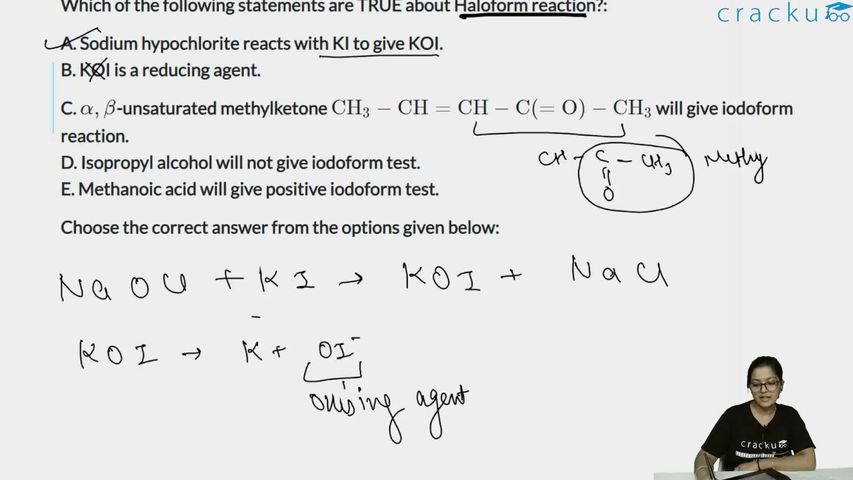
Which of the following statements are TRUE about Haloform reaction?:
A. Sodium hypochlorite reacts with KI to give KOI.
B. KOI is a reducing agent.
C. $$ \alpha,\beta$$-unsaturated methylketone $$\mathrm{CH_3 - CH = CH - C(=O) - CH_3}$$ will give iodoform reaction.
D. Isopropyl alcohol will not give iodoform test.
E. Methanoic acid will give positive iodoform test.
Choose the correct answer from the options given below:
The haloform reaction involves compounds with a methyl ketone group (R-CO-CH3) or compounds that can be oxidized to methyl ketones (like secondary alcohols with the structure R-CH(OH)-CH3), reacting with halogen (I2, Br2, Cl2) in the presence of base to form a haloform (CHX3) and a carboxylate ion.
Evaluating each statement:
Statement A: "Sodium hypochlorite reacts with KI to give KOI."
Sodium hypochlorite (NaOCl) reacts with potassium iodide (KI) in the reaction: $$\text{NaOCl} + \text{KI} \rightarrow \text{NaCl} + \text{KOI}$$ where KOI is potassium hypoiodite. This reaction occurs because hypochlorite oxidizes iodide to hypoiodite. Thus, statement A is true.
Statement B: "KOI is a reducing agent."
Potassium hypoiodite (KOI) contains the hypoiodite ion (OI-), which acts as an oxidizing agent in reactions like the haloform reaction. It oxidizes methyl ketones to carboxylates and is not a reducing agent. Thus, statement B is false.
Statement C: "α,β-unsaturated methylketone $$\mathrm{CH_3 - CH = CH - C(=O) - CH_3}$$ will give iodoform reaction."
The compound $$\mathrm{CH_3 - CH = CH - C(=O) - CH_3}$$ is a methyl ketone because it has the -CO-CH3 group. The α,β-unsaturation does not prevent enolization of the methyl group, so it undergoes the haloform reaction. Thus, statement C is true.
Statement D: "Isopropyl alcohol will not give iodoform test."
Isopropyl alcohol $$\mathrm{(CH_3)_2CHOH}$$ is a secondary alcohol that can be oxidized to acetone $$\mathrm{(CH_3)_2C=O}$$, a methyl ketone, which gives a positive iodoform test. Therefore, isopropyl alcohol gives a positive test, and statement D is false.
Statement E: "Methanoic acid will give positive iodoform test."
Methanoic acid (HCOOH) lacks a methyl group or a group oxidizable to a methyl ketone. It does not undergo the haloform reaction and gives a negative test. Thus, statement E is false.
True statements are A and C only. The correct option is D.
Was this solution helpful?
Click on the Email ☝️ to Watch the Video Solution
Create a FREE account and get:
_1.webp)

Educational materials for JEE preparation

Ask our AI anything

AI can make mistakes. Please verify important information.
AI can make mistakes. Please verify important information.
