
Join Our JEE Preparation Group
Prep with like-minded aspirants; Get access to free daily tests and study material.
Sign in
Please select an account to continue using cracku.in
↓ →
Join Our JEE Preparation Group
Prep with like-minded aspirants; Get access to free daily tests and study material.
Observe the following reactions at T(K).
I. $$A\rightarrow$$products
II. $$5Br^{-}(aq)+BrO_{3}\text{ } ^{-}(aq)\rightarrow 3Br_2(aq)+3H_2O(l)$$
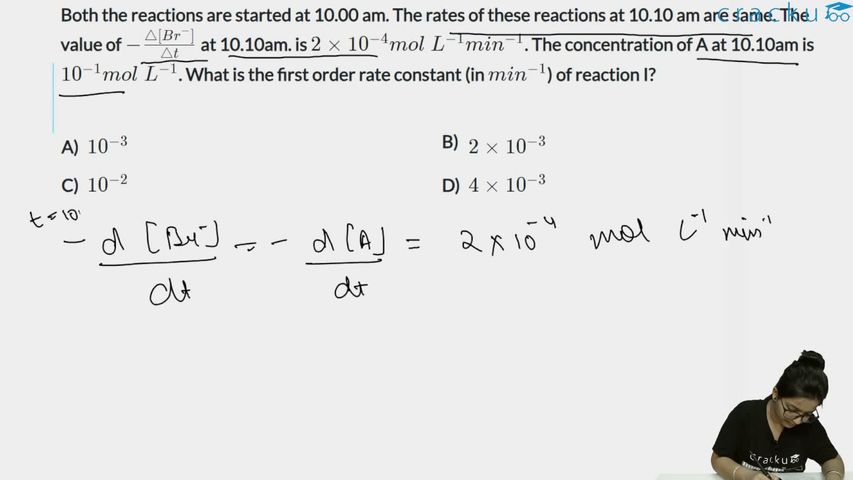
Both the reactions are started at 10.00 am. The rates of these reactions at 10.10 am are same. The value of $$-\frac{\triangle[Br^{-}]}{\triangle t}$$ at 10.10am. is $$2\times 10^{-4} mol \text{ }L^{-1}min^{-1}$$. The concentration of A at 10.10am is $$10^{-1}mol \text{ } L^{-1}$$. What is the first order rate constant (in $$min^{-1}$$) of reaction I?
At 10:10 am, the rates of reactions I and II are equal.
Reaction I: $$A \rightarrow$$ products (first order)
Reaction II: $$5Br^-(aq) + BrO_3^-(aq) \rightarrow 3Br_2(aq) + 3H_2O(l)$$
At 10:10 am, $$-\frac{\Delta[Br^-]}{\Delta t} = 2 \times 10^{-4}$$ mol L$$^{-1}$$ min$$^{-1}$$ and $$[A] = 10^{-1}$$ mol L$$^{-1}$$.
We first note that the rate of disappearance of $$A$$ in reaction I equals the rate of disappearance of $$Br^-$$ in reaction II:
$$-\frac{d[A]}{dt} = -\frac{d[Br^-]}{dt} = 2 \times 10^{-4} \text{ mol L}^{-1}\text{min}^{-1}$$
To find the rate constant $$k$$, we apply the first-order rate law:
For a first-order reaction: $$-\frac{d[A]}{dt} = k[A]$$
$$k \times 10^{-1} = 2 \times 10^{-4}$$
$$k = \frac{2 \times 10^{-4}}{10^{-1}} = 2 \times 10^{-3} \text{ min}^{-1}$$
The correct answer is Option B: $$2 \times 10^{-3}$$ min$$^{-1}$$.
Was this solution helpful?
Click on the Email ☝️ to Watch the Video Solution
Create a FREE account and get:
_1.webp)

Educational materials for JEE preparation

Ask our AI anything

AI can make mistakes. Please verify important information.
AI can make mistakes. Please verify important information.
