
Join Our JEE Preparation Group
Prep with like-minded aspirants; Get access to free daily tests and study material.
Sign in
Please select an account to continue using cracku.in
↓ →
Join Our JEE Preparation Group
Prep with like-minded aspirants; Get access to free daily tests and study material.
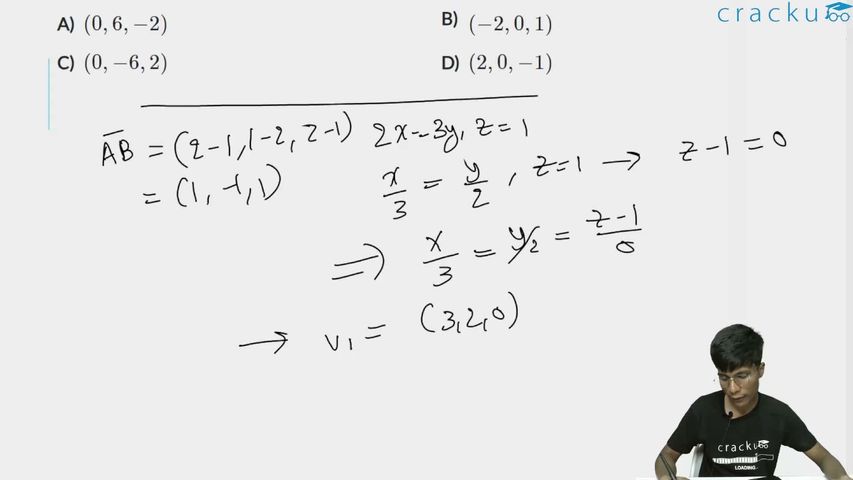
The plane passing through the points $$(1, 2, 1)$$, $$(2, 1, 2)$$ and parallel to the line, $$2x = 3y$$, $$z = 1$$ also passes through the point:
We have to find the required plane, so we first collect all the given geometric data. The plane must
$$\text{(i)}$$ pass through the two points $$(1,2,1) \; \text{and} \; (2,1,2),$$
$$\text{(ii)}$$ be parallel to the line defined by the simultaneous relations $$2x = 3y$$ and $$z = 1.$$
Because the plane is parallel to the line, the direction vector of that line will lie completely inside the plane. Let us obtain that vector.
From $$2x = 3y$$ we can set a parameter $$t$$ by taking $$x = t.$$ Then $$y = \dfrac{2}{3}t,$$ while $$z = 1$$ is fixed. Hence one step along the line (when $$t$$ increases by $$3$$ so that fractions disappear) is
$$\Delta x = 3,\; \Delta y = 2,\; \Delta z = 0.$$
So a convenient direction vector of the line is
$$\vec{v_1} = (3,\,2,\,0).$$
Next, the vector joining the two given points in the plane is
$$\vec{v_2} = (2-1,\;1-2,\;2-1) = (1,\,-1,\,1).$$
Since both $$\vec{v_1}$$ and $$\vec{v_2}$$ lie in the required plane, their cross product will give a normal vector to that plane. We now compute
$$ \vec{n} = \vec{v_1} \times \vec{v_2} = \begin{vmatrix} \mathbf{i} & \mathbf{j} & \mathbf{k}\\ 3 & 2 & 0\\ 1 & -1 & 1 \end{vmatrix}. $$
Expanding the determinant term-by-term,
$$ \vec{n} = \mathbf{i}\,(2\cdot1 - 0\cdot(-1)) - \mathbf{j}\,(3\cdot1 - 0\cdot1) + \mathbf{k}\,(3\cdot(-1) - 2\cdot1) = \mathbf{i}\,(2) - \mathbf{j}\,(3) + \mathbf{k}\,(-5). $$
Therefore
$$\vec{n} = (2,\,-3,\,-5).$$
Now we write the point-normal form of a plane. The formula is $$\vec{n}\cdot\bigl((x,y,z)-(x_0,y_0,z_0)\bigr)=0,$$ where $$(x_0,y_0,z_0)$$ is any known point on the plane. Taking the point $$(1,2,1)$$, we get
$$ (2,\,-3,\,-5)\cdot\bigl((x-1,\;y-2,\;z-1)\bigr)=0. $$
Carrying out the dot product step by step,
$$ 2(x-1)\;-\;3(y-2)\;-\;5(z-1)=0. $$
Expanding every bracket one at a time:
$$ 2x - 2 \;-\;3y + 6 \;-\;5z + 5 = 0. $$
Combining the constant terms,
$$ 2x - 3y - 5z + 9 = 0. $$
So the required plane has the cartesian equation
$$ 2x - 3y - 5z + 9 = 0. $$
Now we simply check which option satisfies this equation.
Option A: $$(0,6,-2)$$ gives $$2(0) - 3(6) - 5(-2) + 9 = 0 - 18 + 10 + 9 = 1 \ne 0.$$ Hence A is not on the plane.
Option B: $$(-2,0,1)$$ gives $$2(-2) - 3(0) - 5(1) + 9 = -4 - 0 - 5 + 9 = 0.$$ Thus Option B lies exactly on the plane.
Option C: $$(0,-6,2)$$ gives $$2(0) - 3(-6) - 5(2) + 9 = 0 + 18 - 10 + 9 = 17 \ne 0.$$ So C is not on the plane.
Option D: $$(2,0,-1)$$ gives $$2(2) - 3(0) - 5(-1) + 9 = 4 + 0 + 5 + 9 = 18 \ne 0.$$ Hence D is also not on the plane.
Only the point in Option B satisfies the plane equation. Hence, the correct answer is Option B.
Was this solution helpful?
Click on the Email ☝️ to Watch the Video Solution
Create a FREE account and get:
_1.webp)

Educational materials for JEE preparation

Ask our AI anything

AI can make mistakes. Please verify important information.
AI can make mistakes. Please verify important information.
