
Join Our JEE Preparation Group
Prep with like-minded aspirants; Get access to free daily tests and study material.
Sign in
Please select an account to continue using cracku.in
↓ →
Join Our JEE Preparation Group
Prep with like-minded aspirants; Get access to free daily tests and study material.
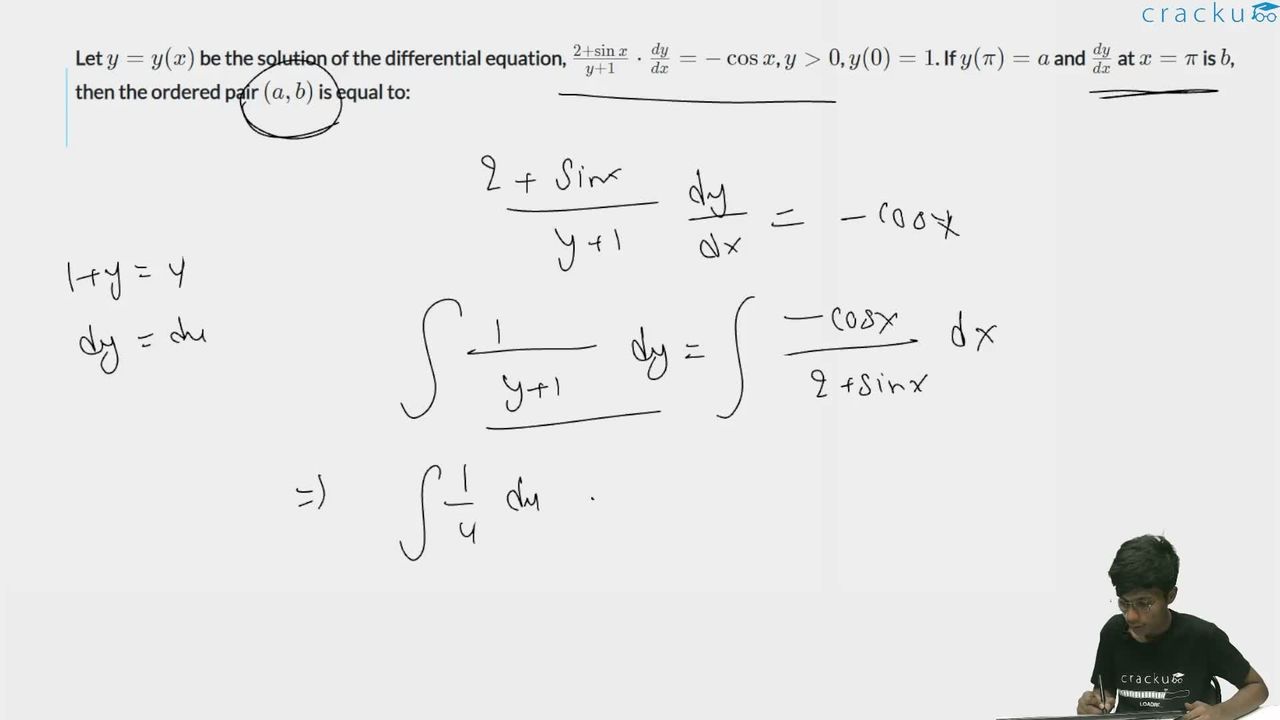
Let $$y = y(x)$$ be the solution of the differential equation, $$\frac{2+\sin x}{y+1} \cdot \frac{dy}{dx} = -\cos x$$, $$y > 0$$, $$y(0) = 1$$. If $$y(\pi) = a$$ and $$\frac{dy}{dx}$$ at $$x = \pi$$ is $$b$$, then the ordered pair $$(a, b)$$ is equal to:
We have the differential equation
$$\frac{2+\sin x}{\,y+1\,}\;\frac{dy}{dx}=-\cos x,\qquad y>0.$$
First we isolate the differentials. Multiplying both sides by $$\dfrac{dx}{2+\sin x}$$ and by $$\dfrac{y+1}{1}$$ we get
$$\frac{dy}{y+1}=-\;\frac{\cos x}{2+\sin x}\;dx.$$
This equation is separable, so we integrate both sides. The left side is a standard logarithmic integral, and on the right we notice that the derivative of $$2+\sin x$$ is $$\cos x$$, which appears in the numerator.
Left integral:
$$\int\frac{dy}{y+1}=\ln|y+1|.$$
Right integral: Put $$u=2+\sin x\;\Rightarrow\;du=\cos x\,dx$$. Hence
$$\int-\frac{\cos x}{2+\sin x}\,dx=-\int\frac{du}{u}=-\ln|u|=-\ln|2+\sin x|.$$
So after integrating we obtain
$$\ln|y+1|=-\ln|2+\sin x|+C.$$
Exponentiating both sides gives
$$|y+1|=\frac{K}{2+\sin x},$$
where $$K=e^{C}$$ is a positive constant. Because the condition $$y>0$$ implies $$y+1>1>0$$, we can drop the absolute value:
$$y+1=\frac{K}{2+\sin x}.$$
Now we use the initial value $$y(0)=1$$. At $$x=0$$, $$\sin 0=0$$, so $$2+\sin 0=2$$. Substituting,
$$1+1=\frac{K}{2}\;\Longrightarrow\;2=\frac{K}{2}\;\Longrightarrow\;K=4.$$
Therefore the explicit solution is
$$y(x)=\frac{4}{2+\sin x}-1.$$
Next, we evaluate $$y(\pi)$$. Since $$\sin\pi=0$$, we have
$$y(\pi)=\frac{4}{2+0}-1=\frac{4}{2}-1=2-1=1.$$
Thus $$a=1$$.
For the derivative, we may either differentiate the explicit form or use the original rearranged formula. From earlier we had
$$\frac{dy}{dx}= -\frac{\cos x}{2+\sin x}\,(y+1).$$
At $$x=\pi$$ we substitute $$\cos\pi=-1$$, $$\sin\pi=0$$, $$2+\sin\pi=2$$, and $$y(\pi)+1=1+1=2$$:
$$\left.\frac{dy}{dx}\right|_{x=\pi}= -\frac{(-1)}{2}\,(2)=\frac{1}{2}\times2=1.$$
Hence $$b=1$$.
We have found the ordered pair $$(a,b)=(1,1)$$, which matches Option C.
Hence, the correct answer is Option C.
Was this solution helpful?
Click on the Email ☝️ to Watch the Video Solution
Create a FREE account and get:
_1.webp)

Educational materials for JEE preparation

Ask our AI anything

AI can make mistakes. Please verify important information.
AI can make mistakes. Please verify important information.
