
Join Our JEE Preparation Group
Prep with like-minded aspirants; Get access to free daily tests and study material.
Sign in
Please select an account to continue using cracku.in
↓ →
Join Our JEE Preparation Group
Prep with like-minded aspirants; Get access to free daily tests and study material.
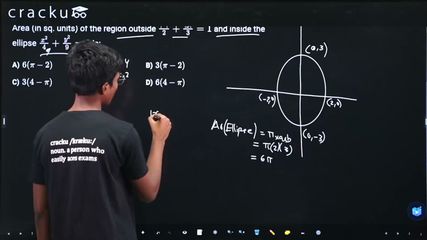
Area (in sq. units) of the region outside $$\frac{|x|}{2} + \frac{|y|}{3} = 1$$ and inside the ellipse $$\frac{x^2}{4} + \frac{y^2}{9} = 1$$ is:
We have two curves to consider. The first curve is given by the equation $$\frac{|x|}{2}+\frac{|y|}{3}=1.$$ Because of the absolute‐value signs, this single equation actually represents four straight lines obtained by taking all possible sign combinations of $$x$$ and $$y$$. Writing them explicitly we get
$$\frac{\pm x}{2}+\frac{\pm y}{3}=1.$$
Rearranging, each of these is a straight line passing through the intercepts $$x=\pm2$$ and $$y=\pm3$$. Joining the intercept points $$(2,0),\,(0,3),\,(-2,0),\,(0,-3)$$ in order, we obtain a rhombus (a diamond) whose diagonals lie along the coordinate axes. The length of the horizontal diagonal is
$$d_1 = 2-(-2)=4,$$
and the length of the vertical diagonal is
$$d_2 = 3-(-3)=6.$$
The second curve is the ellipse
$$\frac{x^2}{4}+\frac{y^2}{9}=1.$$
Comparing with the standard form $$\frac{x^2}{a^2}+\frac{y^2}{b^2}=1,$$ we recognise the semi-major and semi-minor axes as
$$a=2,\qquad b=3.$$
The ellipse therefore has the very same four intercept points $$(\pm2,0)$$ and $$(0,\pm3)$$ as the rhombus. Consequently the rhombus is completely inside the ellipse, touching it exactly at those four vertices.
The region asked for in the question is “outside the rhombus but inside the ellipse”. Hence its area equals
$$\text{Area(region)}=\text{Area(ellipse)}-\text{Area(rhombus)}.$$
First we calculate the area of the ellipse. The standard formula for an ellipse of semi-axes $$a$$ and $$b$$ is
$$\text{Area(ellipse)}=\pi a b.$$
Substituting $$a=2$$ and $$b=3$$, we get
$$\text{Area(ellipse)}=\pi\,(2)\,(3)=6\pi.$$
Next we calculate the area of the rhombus. A rhombus with diagonals $$d_1$$ and $$d_2$$ has area given by
$$\text{Area(rhombus)}=\frac{1}{2}d_1d_2.$$
We already found $$d_1=4$$ and $$d_2=6$$, so
$$\text{Area(rhombus)}=\frac{1}{2}\,(4)\,(6)=12.$$
Now we subtract:
$$\text{Area(region)}=6\pi-12.$$
Factoring out the common factor $$6$$, we write
$$\text{Area(region)}=6(\pi-2).$$
Hence, the correct answer is Option A.
Click on the Email ☝️ to Watch the Video Solution
Create a FREE account and get:
_1.webp)

Educational materials for JEE preparation

Ask our AI anything

AI can make mistakes. Please verify important information.
AI can make mistakes. Please verify important information.


