
Join Our JEE Preparation Group
Prep with like-minded aspirants; Get access to free daily tests and study material.
Sign in
Please select an account to continue using cracku.in
↓ →
Join Our JEE Preparation Group
Prep with like-minded aspirants; Get access to free daily tests and study material.
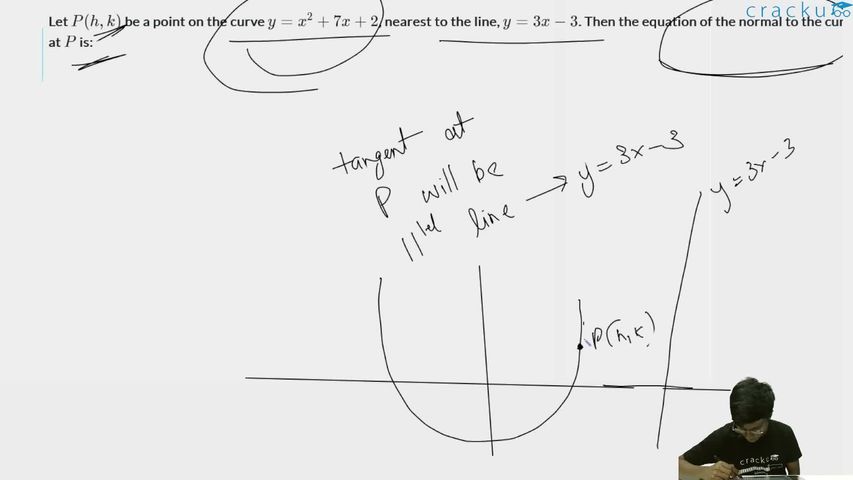
Let $$P(h, k)$$ be a point on the curve $$y = x^2 + 7x + 2$$, nearest to the line, $$y = 3x - 3$$. Then the equation of the normal to the curve at $$P$$ is:
We have the curve $$y = x^{2}+7x+2$$ and the straight line $$y = 3x-3$$. To find the point $$P(h,k)$$ on the curve that is nearest to the line, we minimise the perpendicular distance from a general point $$(x,\,x^{2}+7x+2)$$ of the curve to the given line.
First we write the line in the standard form $$Ax+By+C=0$$. Starting from $$y = 3x-3$$ we bring all terms to the left:
$$3x-y-3 = 0$$
Thus $$A = 3,\;B = -1,\;C = -3$$.
The perpendicular distance $$D$$ of a point $$(x_1,y_1)$$ from $$Ax+By+C=0$$ is given by the formula $$D = \dfrac{|Ax_1+By_1+C|}{\sqrt{A^{2}+B^{2}}}\,.$$
Substituting $$(x_1,y_1)=\left(x,\;x^{2}+7x+2\right)$$ and $$(A,B,C)=(3,-1,-3)$$ we obtain
$$D =\dfrac{\bigl|\,3x-\,\bigl(x^{2}+7x+2\bigr)\,-3\bigr|}{\sqrt{3^{2}+(-1)^{2}}} =\dfrac{|\, -x^{2}-4x-5\,|}{\sqrt{10}}.$$
Because the denominator $$\sqrt{10}$$ is constant, minimising $$D$$ is the same as minimising the numerator’s absolute value. Let us denote
$$g(x) = -x^{2}-4x-5 = -(x^{2}+4x+5).$$
The square of the distance is proportional to $$g(x)^{2}$$, and minimising $$g(x)^{2}$$ is equivalent to minimising the non-negative quadratic
$$h(x)=x^{2}+4x+5.$$ Now we differentiate $$h(x)$$ with respect to $$x$$ and set the derivative to zero:
$$\dfrac{dh}{dx}=2x+4,$$ $$2x+4=0\;\Longrightarrow\;x=-2.$$
This value indeed gives the minimum because $$\dfrac{d^{2}h}{dx^{2}}=2>0.$$ Hence the abscissa of the required point is $$h=-2$$.
Substituting $$x=-2$$ in the equation of the curve to find the ordinate:
$$k = (-2)^{2}+7(-2)+2 = 4-14+2 = -8.$$
Therefore the nearest point is $$P(h,k)=(-2,-8).$$
Next we need the equation of the normal to the curve at this point. The slope of the tangent to the curve $$y=x^{2}+7x+2$$ is obtained by differentiation:
$$\frac{dy}{dx}=2x+7.$$
At $$x=-2$$, the tangent slope is $$m_{\text{tangent}} = 2(-2)+7 = -4+7 = 3.$$
The normal is perpendicular to the tangent, so its slope is the negative reciprocal:
$$m_{\text{normal}} = -\dfrac{1}{3}.$$
Using the point-slope form of a line through $$(-2,-8)$$ with slope $$-\dfrac{1}{3}$$: $$y-(-8)= -\dfrac{1}{3}\,\bigl(x-(-2)\bigr),$$ $$y+8 = -\dfrac{1}{3}(x+2).$$
Multiplying by $$3$$ to clear the fraction:
$$3(y+8)=-(x+2),$$ $$3y + 24 = -x - 2.$$
Bringing all terms to the left:
$$x + 3y + 26 = 0.$$
This is precisely option A.
Hence, the correct answer is Option A.
Was this solution helpful?
Click on the Email ☝️ to Watch the Video Solution
Create a FREE account and get:
_1.webp)

Educational materials for JEE preparation

Ask our AI anything

AI can make mistakes. Please verify important information.
AI can make mistakes. Please verify important information.
