
Join Our JEE Preparation Group
Prep with like-minded aspirants; Get access to free daily tests and study material.
Sign in
Please select an account to continue using cracku.in
↓ →
Join Our JEE Preparation Group
Prep with like-minded aspirants; Get access to free daily tests and study material.
If $$p(x)$$ be a polynomial of degree three that has a local maximum value 8 at $$x = 1$$ and a local minimum value 4 at $$x = 2$$ then $$p(0)$$ is equal to:
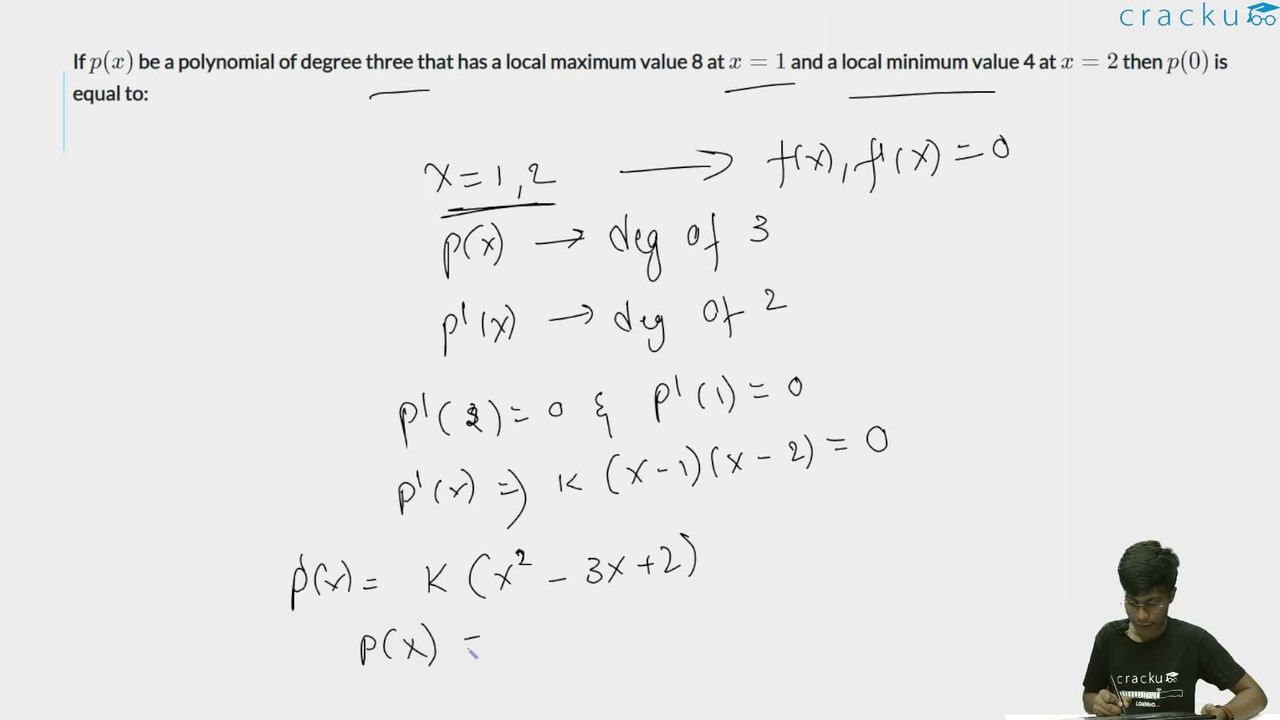
We have a cubic polynomial $$p(x)$$ whose derivative will therefore be a quadratic. For any polynomial, local maxima and minima occur where the first derivative is zero. Hence, if $$x = 1$$ gives a local maximum and $$x = 2$$ gives a local minimum, we must have
$$p'(1)=0 \quad\text{and}\quad p'(2)=0.$$
Because a quadratic that vanishes at $$x = 1$$ and $$x = 2$$ can be written (up to a constant multiple) as $$k(x-1)(x-2),$$ we may write
$$p'(x)=k(x-1)(x-2),$$
where $$k$$ is a non-zero constant that we will determine shortly.
Now we integrate to recover $$p(x).$$ Using the formula $$\int (x-1)(x-2)\,dx=\int (x^2-3x+2)\,dx,$$ we obtain
$$\int (x^2-3x+2)\,dx=x^3/3-3x^2/2+2x.$$
Multiplying by the constant $$k$$ and adding an integration constant $$C$$, we get the most general cubic whose derivative is $$k(x-1)(x-2):$$
$$p(x)=k\!\left(\frac{x^3}{3}-\frac{3x^2}{2}+2x\right)+C.$$
Next, we use the given extreme values. At the local maximum $$x = 1$$, the polynomial attains the value $$8$$, so
$$p(1)=8.$$
Evaluating $$p(1)$$ from the expression above, we find
$$p(1)=k\!\left(\frac{1^3}{3}-\frac{3\cdot1^2}{2}+2\cdot1\right)+C =k\!\left(\frac{1}{3}-\frac{3}{2}+2\right)+C =k\!\left(\frac{1}{3}-\frac{9}{6}+\frac{12}{6}\right)+C =k\!\left(\frac{5}{6}\right)+C.$$
Thus
$$\frac{5k}{6}+C=8 \quad\text{(Equation 1)}.$$
Similarly, at the local minimum $$x = 2$$, the value is $$4$$, so
$$p(2)=4.$$
Compute $$p(2)$$:
$$p(2)=k\!\left(\frac{2^3}{3}-\frac{3\cdot2^2}{2}+2\cdot2\right)+C =k\!\left(\frac{8}{3}-\frac{12}{2}+4\right)+C =k\!\left(\frac{8}{3}-6+4\right)+C =k\!\left(\frac{8}{3}-\frac{18}{3}+\frac{12}{3}\right)+C =k\!\left(\frac{2}{3}\right)+C.$$
Therefore
$$\frac{2k}{3}+C=4 \quad\text{(Equation 2)}.$$
We now solve Equations 1 and 2. Subtracting Equation 2 from Equation 1, we get
$$\left(\frac{5k}{6}-\frac{2k}{3}\right)+\bigl(C-C\bigr)=8-4.$$ $$\frac{5k}{6}-\frac{4k}{6}=\frac{k}{6}=4.$$ $$k=24.$$
Substituting $$k=24$$ into Equation 2,
$$\frac{2\cdot24}{3}+C=4 \quad\Longrightarrow\quad 16+C=4 \quad\Longrightarrow\quad C=-12.$$
Hence, the explicit form of the cubic is
$$p(x)=24\!\left(\frac{x^3}{3}-\frac{3x^2}{2}+2x\right)-12.$$
Finally, we evaluate $$p(0)$$:
$$p(0)=24\!\left(\frac{0^3}{3}-\frac{3\cdot0^2}{2}+2\cdot0\right)-12 =24\cdot0-12 =-12.$$
Hence, the correct answer is Option B.
Was this solution helpful?
Click on the Email ☝️ to Watch the Video Solution
Create a FREE account and get:
_1.webp)

Educational materials for JEE preparation

Ask our AI anything

AI can make mistakes. Please verify important information.
AI can make mistakes. Please verify important information.
