
Join Our JEE Preparation Group
Prep with like-minded aspirants; Get access to free daily tests and study material.
Sign in
Please select an account to continue using cracku.in
↓ →
Join Our JEE Preparation Group
Prep with like-minded aspirants; Get access to free daily tests and study material.
Box 1 contains 30 cards numbered 1 to 30 and Box 2 contains 20 cards numbered 31 to 50. A box is selected at random and a card is drawn from it. The number on the card is found to be a non-prime number. The probability that the card was drawn from Box 1 is:
We are asked to find the probability that the chosen card came from Box 1 after we have been told that the number on the card is a non-prime. This is a question of conditional probability, so we begin by recalling Bayes’ theorem.
Bayes’ theorem for two events $$A$$ and $$B$$ is stated as
$$P(A\mid B)=\dfrac{P(B\mid A)\,P(A)}{P(B\mid A)\,P(A)+P(B\mid A^{\!\!c})\,P(A^{\!\!c})}.$$
In the present situation:
Thus we want $$P(A\mid B)$$, the probability that the card came from Box 1 given that it is non-prime.
First we note that the choice between the two boxes is made at random, so
$$P(A)=\dfrac12,\qquad P(A^{\!\!c})=\dfrac12.$$
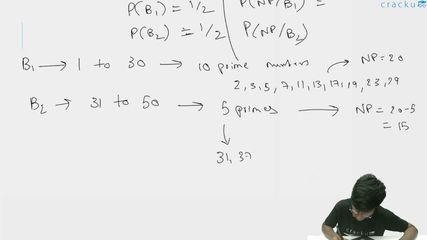
Next we must compute $$P(B\mid A)$$, the probability that the number is non-prime when the card is taken from Box 1. Box 1 contains the integers from $$1$$ to $$30$$.
We list all primes up to $$30$$:
$$2,\,3,\,5,\,7,\,11,\,13,\,17,\,19,\,23,\,29.$$
There are $$10$$ such primes. Since Box 1 has $$30$$ cards altogether, the number of non-primes (including the number $$1$$ and all composites) is
$$30-10=20.$$
Hence
$$P(B\mid A)=\dfrac{20}{30}=\dfrac23.$$
Now we find $$P(B\mid A^{\!\!c})$$, the probability that the number is non-prime when the card comes from Box 2. Box 2 contains the integers from $$31$$ to $$50$$, a total of $$20$$ numbers.
We list the primes between $$31$$ and $$50$$:
$$31,\,37,\,41,\,43,\,47.$$
There are $$5$$ such primes. Therefore the count of non-primes in Box 2 is
$$20-5=15.$$
So
$$P(B\mid A^{\!\!c})=\dfrac{15}{20}=\dfrac34.$$
We have gathered all the ingredients needed for Bayes’ theorem. Substituting into the formula gives
$$P(A\mid B)=\dfrac{\,P(B\mid A)\,P(A)\,}{P(B\mid A)\,P(A)+P(B\mid A^{\!\!c})\,P(A^{\!\!c})}=\dfrac{\left(\dfrac23\right)\!\left(\dfrac12\right)}{\left(\dfrac23\right)\!\left(\dfrac12\right)+\left(\dfrac34\right)\!\left(\dfrac12\right)}.$$
We simplify the numerator first:
$$\left(\dfrac23\right)\!\left(\dfrac12\right)=\dfrac{2}{3}\times\dfrac{1}{2}=\dfrac{2}{6}=\dfrac13.$$
Now we simplify each part of the denominator:
First term in the denominator:
$$\left(\dfrac23\right)\!\left(\dfrac12\right)=\dfrac13$$
Second term in the denominator:
$$\left(\dfrac34\right)\!\left(\dfrac12\right)=\dfrac{3}{4}\times\dfrac{1}{2}=\dfrac{3}{8}.$$
Add the two terms to complete the denominator:
$$\dfrac13+\dfrac38=\dfrac{8}{24}+\dfrac{9}{24}=\dfrac{17}{24}.$$
Thus the conditional probability becomes
$$P(A\mid B)=\dfrac{\dfrac13}{\dfrac{17}{24}}=\dfrac13\times\dfrac{24}{17}=\dfrac{24}{51}=\dfrac{8}{17}.$$
Hence, the correct answer is Option B.
Was this solution helpful?
Click on the Email ☝️ to Watch the Video Solution
Create a FREE account and get:
_1.webp)

Educational materials for JEE preparation

Ask our AI anything

AI can make mistakes. Please verify important information.
AI can make mistakes. Please verify important information.
