
Join Our JEE Preparation Group
Prep with like-minded aspirants; Get access to free daily tests and study material.
Sign in
Please select an account to continue using cracku.in
↓ →
Join Our JEE Preparation Group
Prep with like-minded aspirants; Get access to free daily tests and study material.
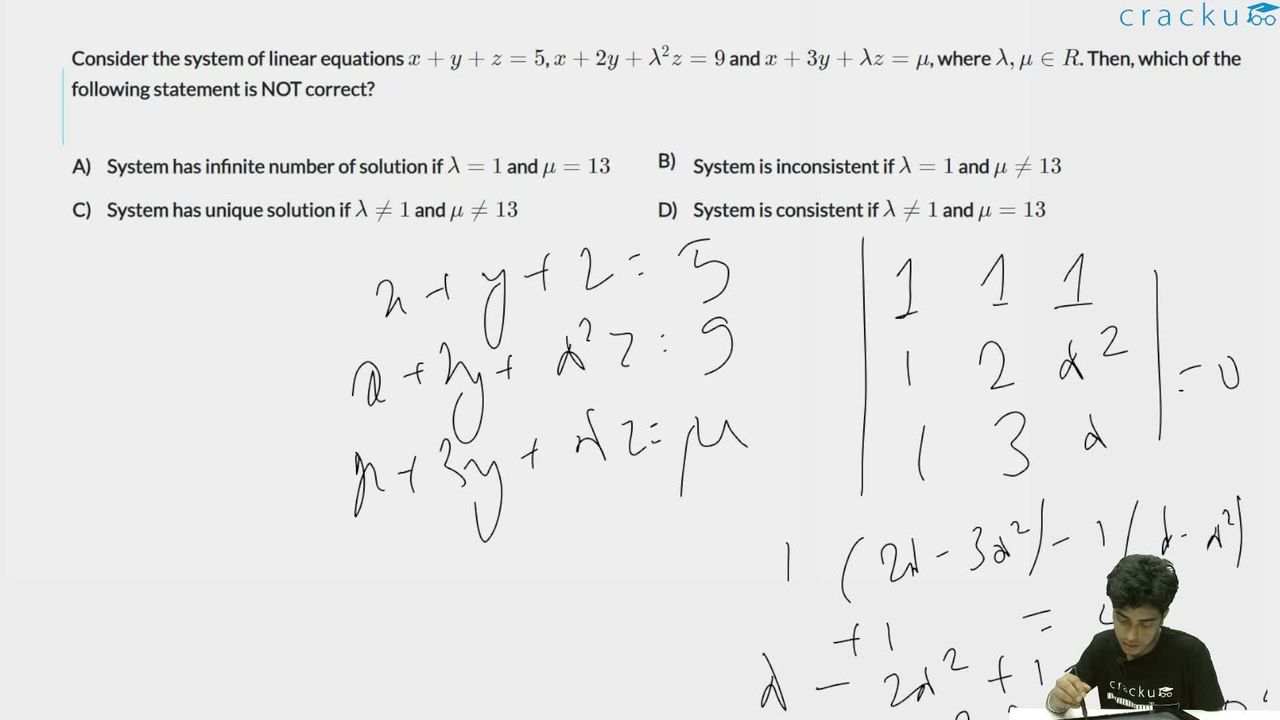
Consider the system of linear equations $$x + y + z = 5$$, $$x + 2y + \lambda^2 z = 9$$ and $$x + 3y + \lambda z = \mu$$, where $$\lambda, \mu \in R$$. Then, which of the following statement is NOT correct?
System: $$x + y + z = 5$$, $$x + 2y + \lambda^2 z = 9$$, $$x + 3y + \lambda z = \mu$$.
Determinant: $$D = \begin{vmatrix} 1&1&1\\1&2&\lambda^2\\1&3&\lambda\end{vmatrix} = 1(2\lambda-3\lambda^2) - 1(\lambda-\lambda^2) + 1(3-2) = 2\lambda-3\lambda^2-\lambda+\lambda^2+1 = -2\lambda^2+\lambda+1 = -(2\lambda^2-\lambda-1) = -(2\lambda+1)(\lambda-1)$$
$$D = 0$$ when $$\lambda = 1$$ or $$\lambda = -1/2$$.
Option (3): "System has unique solution if $$\lambda \neq 1$$ and $$\mu \neq 13$$." But $$D = 0$$ also when $$\lambda = -1/2$$, not just $$\lambda = 1$$. So for unique solution we need $$\lambda \neq 1$$ AND $$\lambda \neq -1/2$$. The statement ignores $$\lambda = -1/2$$ case.
This statement is NOT correct — if $$\lambda = -1/2$$ and $$\mu \neq 13$$, $$D = 0$$ so no unique solution.
The answer is Option (3): The statement that is NOT correct.
Was this solution helpful?
Click on the Email ☝️ to Watch the Video Solution
Create a FREE account and get:
_1.webp)

Educational materials for JEE preparation

Ask our AI anything

AI can make mistakes. Please verify important information.
AI can make mistakes. Please verify important information.
