
Join Our JEE Preparation Group
Prep with like-minded aspirants; Get access to free daily tests and study material.
Sign in
Please select an account to continue using cracku.in
↓ →
Join Our JEE Preparation Group
Prep with like-minded aspirants; Get access to free daily tests and study material.
Let $$R = \begin{pmatrix} x & 0 & 0 \\ 0 & y & 0 \\ 0 & 0 & z \end{pmatrix}$$ be a non-zero $$3 \times 3$$ matrix, where $$x\sin\theta = y\sin\left(\theta + \frac{2\pi}{3}\right) = z\sin\left(\theta + \frac{4\pi}{3}\right) \neq 0$$, $$\theta \in (0, 2\pi)$$.
For a square matrix $$M$$, let Trace($$M$$) denote the sum of all the diagonal entries of $$M$$. Then, among the statements:
(I) Trace($$R$$) = 0
(II) If Trace(adj(adj($$R$$))) = 0, then $$R$$ has exactly one non-zero entry.
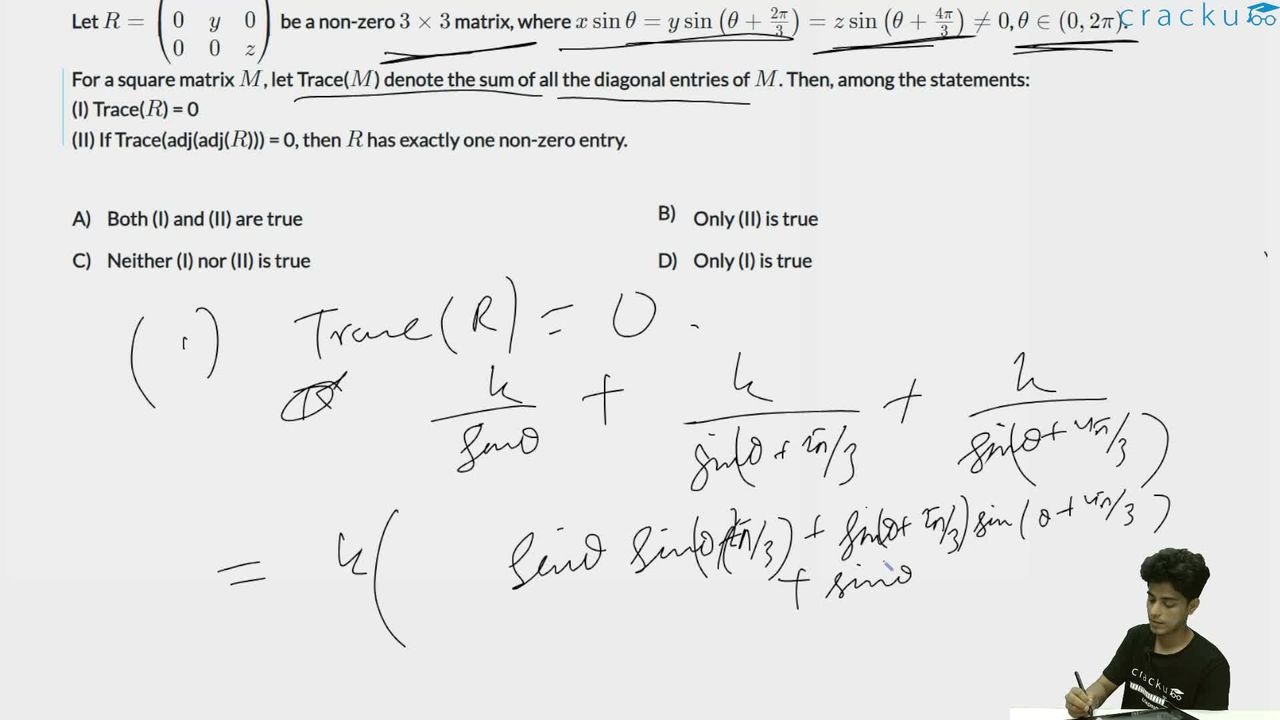
Given $$x\sin\theta = y\sin(\theta + 2\pi/3) = z\sin(\theta + 4\pi/3) \neq 0$$.
Let this common value be $$k$$. Then $$x = k/\sin\theta$$, $$y = k/\sin(\theta+2\pi/3)$$, $$z = k/\sin(\theta+4\pi/3)$$.
Trace(R) = $$x + y + z = k\left[\frac{1}{\sin\theta} + \frac{1}{\sin(\theta+2\pi/3)} + \frac{1}{\sin(\theta+4\pi/3)}\right]$$.
We know that $$\frac{1}{\sin\theta} + \frac{1}{\sin(\theta+2\pi/3)} + \frac{1}{\sin(\theta+4\pi/3)}$$ is generally NOT zero.
For example, at $$\theta = \pi/2$$: $$1 + 1/\sin(7\pi/6) + 1/\sin(11\pi/6) = 1 + (-2) + (-2) = -3 \neq 0$$.
So statement (I) is NOT always true.
For statement (II): adj(adj(R)) for a diagonal matrix has entries related to the (n-1)th powers of cofactors. For 3×3: adj(adj(R)) = det(R) · R (when R is invertible). Trace(adj(adj(R))) = det(R) · Trace(R).
If Trace(adj(adj(R))) = 0, then either det(R) = 0 or Trace(R) = 0. This doesn't necessarily mean R has exactly one non-zero entry. So (II) is also not necessarily true.
The answer is Option (3): Neither (I) nor (II) is true.
Was this solution helpful?
Click on the Email ☝️ to Watch the Video Solution
Create a FREE account and get:
_1.webp)

Educational materials for JEE preparation

Ask our AI anything

AI can make mistakes. Please verify important information.
AI can make mistakes. Please verify important information.
