
Join Our JEE Preparation Group
Prep with like-minded aspirants; Get access to free daily tests and study material.
Sign in
Please select an account to continue using cracku.in
↓ →
Join Our JEE Preparation Group
Prep with like-minded aspirants; Get access to free daily tests and study material.
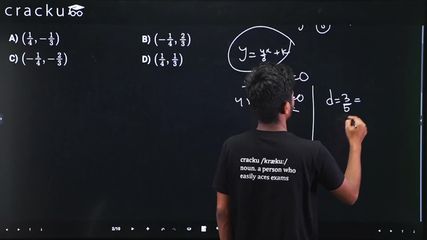
Lines are drawn parallel to the line $$4x - 3y + 2 = 0$$, at a distance $$\frac{3}{5}$$ units from the origin. Then which one of the following points lies on any of these lines?
We have the given line $$4x - 3y + 2 = 0$$. Any line that is parallel to this line must have the same coefficients of $$x$$ and $$y$$; therefore its general equation can be written as
$$4x - 3y + c = 0,$$
where $$c$$ is a constant that we are free to choose.
The problem states that such a parallel line must be at a distance $$\dfrac{3}{5}$$ units from the origin $$O(0,0)$$. We recall the distance formula from a point $$(x_0,y_0)$$ to a line $$ax + by + c = 0$$:
$$\text{Distance} = \frac{|ax_0 + by_0 + c|}{\sqrt{a^2 + b^2}}.$$
Here the point is the origin, so $$x_0 = 0$$ and $$y_0 = 0$$. Substituting these, the distance from the origin to the line $$4x - 3y + c = 0$$ is
$$\frac{|4(0) - 3(0) + c|}{\sqrt{4^2 + (-3)^2}} \;=\; \frac{|c|}{\sqrt{16 + 9}} \;=\; \frac{|c|}{\sqrt{25}} \;=\; \frac{|c|}{5}.$$
The required distance is $$\dfrac{3}{5}$$, so
$$\frac{|c|}{5} = \frac{3}{5} \quad\Longrightarrow\quad |c| = 3.$$
Hence $$c = 3$$ or $$c = -3$$. Therefore the only two lines that satisfy the condition are
$$4x - 3y + 3 = 0 \quad\text{and}\quad 4x - 3y - 3 = 0.$$
Now we check each option to see whether the point lies on either of these two lines.
Option A: Point $$\left(\dfrac{1}{4}, -\dfrac{1}{3}\right).$$
We compute $$4x - 3y$$:
$$4\!\left(\frac{1}{4}\right) - 3\!\left(-\frac{1}{3}\right) = 1 + 1 = 2.$$
Add $$c = 3$$: $$2 + 3 = 5 \neq 0.$$
Add $$c = -3$$: $$2 - 3 = -1 \neq 0.$$
So the point is on neither line.
Option B: Point $$\left(-\dfrac{1}{4}, \dfrac{2}{3}\right).$$
We compute $$4x - 3y$$:
$$4\!\left(-\frac{1}{4}\right) - 3\!\left(\frac{2}{3}\right) = -1 - 2 = -3.$$
Add $$c = 3$$: $$-3 + 3 = 0.$$
Thus this point satisfies $$4x - 3y + 3 = 0$$ and therefore lies on the required line.
Option C: Point $$\left(-\dfrac{1}{4}, -\dfrac{2}{3}\right).$$
Compute $$4x - 3y$$:
$$4\!\left(-\frac{1}{4}\right) - 3\!\left(-\frac{2}{3}\right) = -1 + 2 = 1.$$
Add $$c = 3$$: $$1 + 3 = 4 \neq 0.$$
Add $$c = -3$$: $$1 - 3 = -2 \neq 0.$$
So this point is not on either line.
Option D: Point $$\left(\dfrac{1}{4}, \dfrac{1}{3}\right).$$
Compute $$4x - 3y$$:
$$4\!\left(\frac{1}{4}\right) - 3\!\left(\frac{1}{3}\right) = 1 - 1 = 0.$$
Add $$c = 3$$: $$0 + 3 = 3 \neq 0.$$
Add $$c = -3$$: $$0 - 3 = -3 \neq 0.$$
So this point also fails to lie on the required lines.
Only Option B satisfies the equation of one of the lines at the specified distance.
Hence, the correct answer is Option B.
Was this solution helpful?
Click on the Email ☝️ to Watch the Video Solution
Create a FREE account and get:
_1.webp)

Educational materials for JEE preparation

Ask our AI anything

AI can make mistakes. Please verify important information.
AI can make mistakes. Please verify important information.
