
Join Our JEE Preparation Group
Prep with like-minded aspirants; Get access to free daily tests and study material.
Sign in
Please select an account to continue using cracku.in
↓ →
Join Our JEE Preparation Group
Prep with like-minded aspirants; Get access to free daily tests and study material.
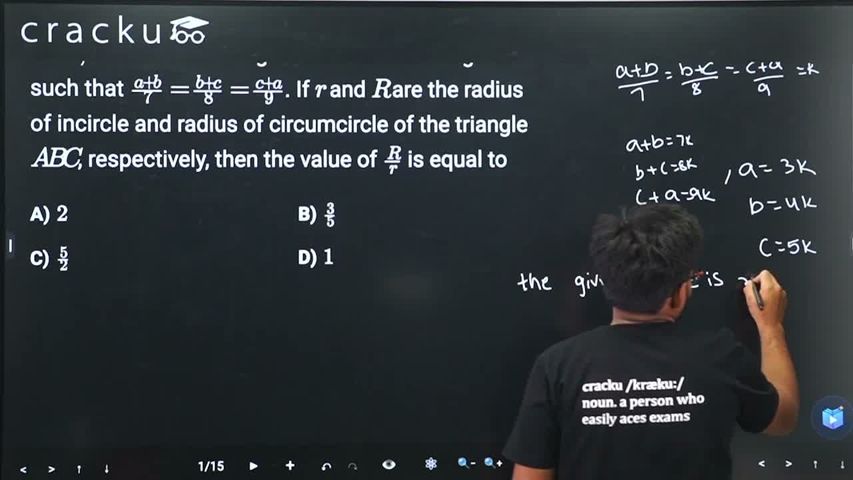
Let $$a, b$$ and $$c$$ be the length of sides of a triangle $$ABC$$ such that $$\frac{a+b}{7} = \frac{b+c}{8} = \frac{c+a}{9}$$. If $$r$$ and $$R$$ are the radius of incircle and radius of circumcircle of the triangle $$ABC$$, respectively, then the value of $$\frac{R}{r}$$ is equal to
We need to find $$\frac{R}{r}$$ for a triangle whose sides satisfy $$\frac{a+b}{7} = \frac{b+c}{8} = \frac{c+a}{9}$$.
Let the common value be $$k$$, so that $$\frac{a+b}{7} = \frac{b+c}{8} = \frac{c+a}{9} = k$$. It follows that
$$a + b = 7k,\quad b + c = 8k,\quad c + a = 9k$$ and adding these gives $$2(a + b + c) = 24k\implies a + b + c = 12k$$. Hence $$c = 12k - 7k = 5k$$, $$a = 12k - 8k = 4k$$, and $$b = 12k - 9k = 3k$$.
Since the sides are $$3k, 4k, 5k$$ and $$3^2 + 4^2 = 5^2$$, the triangle is right-angled with hypotenuse $$c = 5k$$.
In a right triangle, the circumradius is half the hypotenuse, so $$R = \frac{c}{2} = \frac{5k}{2}$$.
Moreover, the semi-perimeter is $$s = \frac{a + b + c}{2} = \frac{12k}{2} = 6k$$ and the area is $$\Delta = \frac{1}{2}\times a \times b = \frac{1}{2}\times 3k \times 4k = 6k^2$$ (using the two legs). Therefore, $$r = \frac{\Delta}{s} = \frac{6k^2}{6k} = k$$.
It follows that $$\frac{R}{r} = \frac{5k/2}{k} = \frac{5}{2}$$.
The correct answer is Option C: $$\dfrac{5}{2}$$.
Was this solution helpful?
Click on the Email ☝️ to Watch the Video Solution
Create a FREE account and get:
_1.webp)

Educational materials for JEE preparation

Ask our AI anything

AI can make mistakes. Please verify important information.
AI can make mistakes. Please verify important information.
