
Join Our JEE Preparation Group
Prep with like-minded aspirants; Get access to free daily tests and study material.
Sign in
Please select an account to continue using cracku.in
↓ →
Join Our JEE Preparation Group
Prep with like-minded aspirants; Get access to free daily tests and study material.
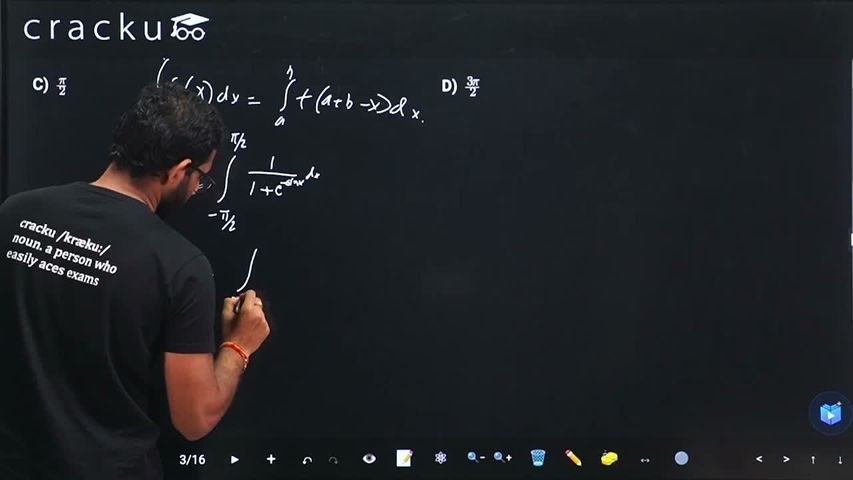
The value of $$\int_{-\frac{\pi}{2}}^{\frac{\pi}{2}} \frac{1}{1 + e^{\sin x}}\,dx$$ is:
We are asked to evaluate the definite integral
$$I=\int_{-\frac{\pi}{2}}^{\frac{\pi}{2}}\frac{1}{1+e^{\sin x}}\;dx.$$
To handle such integrals, a very useful technique is to pair each value of the integrand at $$x$$ with its value at $$-x$$. This is motivated by the fact that $$\sin(-x)=-\sin x$$, which often produces a simplification.
First, let us define the integrand clearly:
$$f(x)=\frac{1}{1+e^{\sin x}}.$$
Now we write the integrand at the symmetric point $$-x$$:
$$f(-x)=\frac{1}{1+e^{\sin(-x)}}=\frac{1}{1+e^{-\sin x}}.$$
The next step is to add $$f(x)$$ and $$f(-x)$$ and simplify completely. We have
$$f(x)+f(-x)=\frac{1}{1+e^{\sin x}}+\frac{1}{1+e^{-\sin x}}.$$
To combine these, it is convenient to set
$$t=e^{\sin x}\quad\text{so that}\quad e^{-\sin x}=\frac{1}{t}.$$
Substituting these into the expression gives
$$f(x)+f(-x)=\frac{1}{1+t}+\frac{1}{1+\dfrac{1}{t}}.$$
We rewrite the second fraction with a common denominator:
$$\frac{1}{1+\dfrac{1}{t}}=\frac{1}{\dfrac{t+1}{t}}=\frac{t}{t+1}.$$
Hence
$$f(x)+f(-x)=\frac{1}{1+t}+\frac{t}{t+1}=\frac{1+t}{1+t}=1.$$
So we have established the elegant identity
$$f(x)+f(-x)=1\quad\text{for every real }x.$$
This identity lets us exploit symmetry in the definite integral. Specifically, we start from the integral we want, write a copy with the variable of integration renamed, and then add the two:
$$I=\int_{-\frac{\pi}{2}}^{\frac{\pi}{2}}f(x)\;dx,$$ $$I=\int_{-\frac{\pi}{2}}^{\frac{\pi}{2}}f(-x)\;dx.$$
Adding these two equalities term by term gives
$$2I=\int_{-\frac{\pi}{2}}^{\frac{\pi}{2}}\bigl(f(x)+f(-x)\bigr)\;dx.$$
But we just proved that $$f(x)+f(-x)=1$$. Therefore
$$2I=\int_{-\frac{\pi}{2}}^{\frac{\pi}{2}}1\;dx.$$
Integrating the constant $$1$$ over an interval simply yields the length of the interval. The interval from $$-\dfrac{\pi}{2}$$ to $$\dfrac{\pi}{2}$$ has length
$$\left(\frac{\pi}{2}-\bigl(-\frac{\pi}{2}\bigr)\right)=\pi.$$
Hence
$$2I=\pi\quad\Longrightarrow\quad I=\frac{\pi}{2}.$$
Thus the value of the given integral is
$$\frac{\pi}{2}.$$
Hence, the correct answer is Option C.
Was this solution helpful?
Click on the Email ☝️ to Watch the Video Solution
Create a FREE account and get:
_1.webp)

Educational materials for JEE preparation

Ask our AI anything

AI can make mistakes. Please verify important information.
AI can make mistakes. Please verify important information.


