
Join Our JEE Preparation Group
Prep with like-minded aspirants; Get access to free daily tests and study material.
Sign in
Please select an account to continue using cracku.in
↓ →
Join Our JEE Preparation Group
Prep with like-minded aspirants; Get access to free daily tests and study material.
If $$\int (e^{2x} + 2e^x - e^{-x} - 1)e^{(e^x + e^{-x})}\,dx = g(x)e^{(e^x + e^{-x})} + c$$, where $$c$$ is a constant of integration, then $$g(0)$$ is:
Let us solve the given indefinite integral by using the method of substitution. We start by analyzing the exponent of the exponential term outside the bracket:
$$t = e^x + e^{-x}$$
Differentiating both sides with respect to $$x$$ gives:
$$dt = (e^x - e^{-x})\,dx$$
Now, let us rewrite and rearrange the terms inside the algebraic integrand parentheses to look for components matching our substitution:
$$e^{2x} + 2e^x - e^{-x} - 1 = (e^{2x} + e^x) + (e^x - e^{-x}) - 1$$
$$e^{2x} + 2e^x - e^{-x} - 1 = e^x(e^x + 1) - 1 + (e^x - e^{-x})$$
This formulation does not simplify directly with our single substitution element. Instead, let us use the fundamental relationship of differentiation on the right-hand side of our original problem equation. By the Fundamental Theorem of Calculus, the derivative of the result must equal the original integrand function:
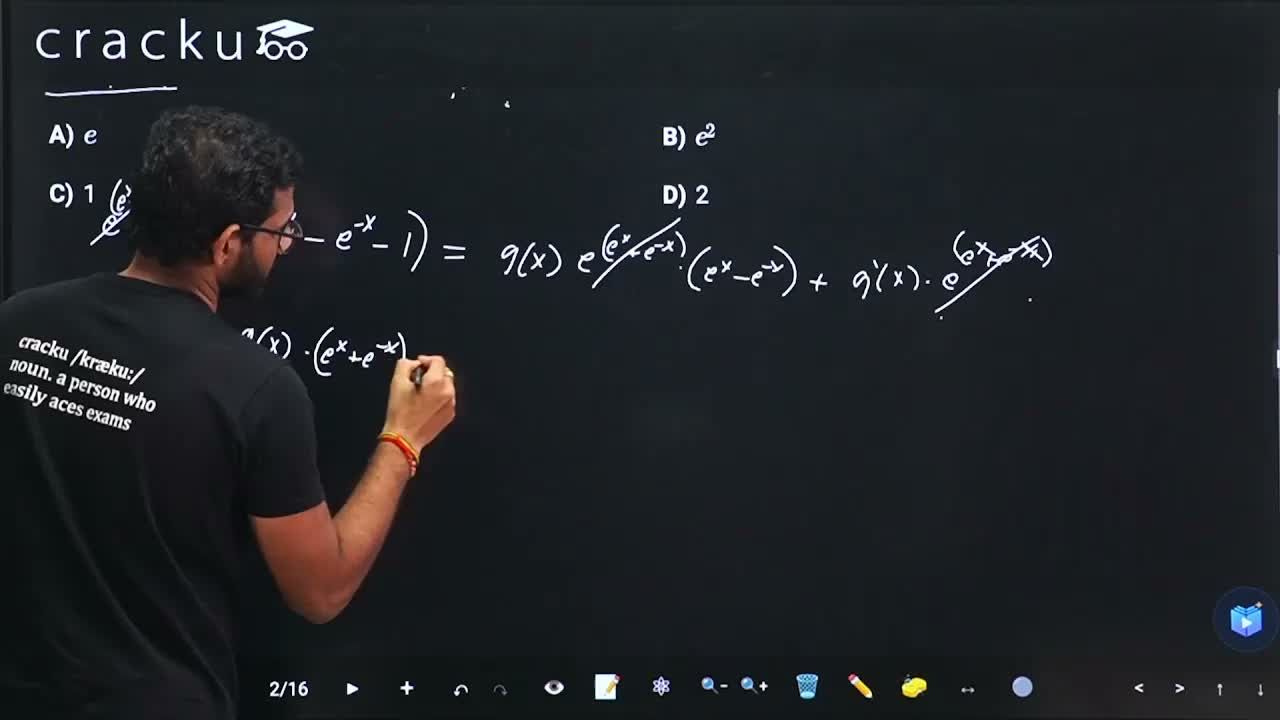
$$\frac{d}{dx}\left[g(x)e^{(e^x + e^{-x})}\right] = (e^{2x} + 2e^x - e^{-x} - 1)e^{(e^x + e^{-x})}$$
Let us apply the product rule of differentiation to the left-hand side:
$$g'(x)e^{(e^x + e^{-x})} + g(x) \cdot \frac{d}{dx}\left[e^{(e^x + e^{-x})}\right] = (e^{2x} + 2e^x - e^{-x} - 1)e^{(e^x + e^{-x})}$$
Using the chain rule to evaluate the derivative of the exponential function:
$$\frac{d}{dx}\left[e^{(e^x + e^{-x})}\right] = (e^x - e^{-x})e^{(e^x + e^{-x})}$$
Substitute this profile back into our product rule expanding step:
$$g'(x)e^{(e^x + e^{-x})} + g(x)(e^x - e^{-x})e^{(e^x + e^{-x})} = (e^{2x} + 2e^x - e^{-x} - 1)e^{(e^x + e^{-x})}$$
Since the exponential expression $$e^{(e^x + e^{-x})}$$ is a common factor across all terms and is never zero, we can divide the entire equation by it to simplify our calculation:
$$g'(x) + g(x)(e^x - e^{-x}) = e^{2x} + 2e^x - e^{-x} - 1 \quad \text{--- (Equation 1)}$$
We need to determine the function $$g(x)$$ that satisfies this relation. Let us assume that $$g(x)$$ is a polynomial or linear function of exponential terms. By inspecting the right-hand side, the highest power of the exponential is $$e^{2x}$$.
Let us guess a form for $$g(x)$$ with unknown coefficients:
$$g(x) = e^x + 1$$
Let us differentiate our assumed form of the function to find $$g'(x)$$:
$$g'(x) = e^x$$
Now, let us substitute $$g(x) = e^x + 1$$ and $$g'(x) = e^x$$ back into the left side of Equation 1 to check if it matches:
$$\text{Left Side} = e^x + (e^x + 1)(e^x - e^{-x})$$
Expanding the multiplied terms gives:
$$\text{Left Side} = e^x + (e^{2x} - 1 + e^x - e^{-x})$$
$$\text{Left Side} = e^{2x} + 2e^x - e^{-x} - 1$$
This matches the right-hand side of Equation 1 perfectly. Therefore, our guessed function is exactly correct:
$$g(x) = e^x + 1$$
Was this solution helpful?
Click on the Email ☝️ to Watch the Video Solution
Create a FREE account and get:
_1.webp)

Educational materials for JEE preparation

Ask our AI anything

AI can make mistakes. Please verify important information.
AI can make mistakes. Please verify important information.


