
Join Our JEE Preparation Group
Prep with like-minded aspirants; Get access to free daily tests and study material.
Sign in
Please select an account to continue using cracku.in
↓ →
Join Our JEE Preparation Group
Prep with like-minded aspirants; Get access to free daily tests and study material.
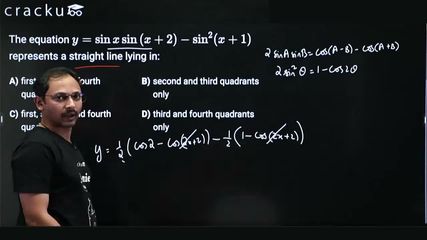
The equation $$y=\sin x\sin\left(x+2\right)-\sin^2(x+1)$$ represents a straight line lying in:
We start from the given relation
$$y=\sin x\,\sin (x+2)\;-\;\sin^{2}(x+1).$$
First we simplify the product $$\sin x\,\sin (x+2)$$ by recalling the product-to-sum identity
$$\sin A\,\sin B=\frac{\cos(A-B)-\cos(A+B)}{2}.$$
Taking $$A=x,\;B=x+2,$$ we get
$$\sin x\,\sin (x+2)=\frac{\cos\!\bigl(x-(x+2)\bigr)-\cos\!\bigl(x+(x+2)\bigr)}{2} =\frac{\cos(-2)-\cos(2x+2)}{2} =\frac{\cos 2-\cos(2x+2)}{2}.$$
Substituting this result back, the expression for y becomes
$$y=\frac{\cos 2-\cos(2x+2)}{2}-\sin^{2}(x+1).$$
Next we simplify $$\sin^{2}(x+1)$$ with the double-angle formula
$$\sin^{2}\theta=\frac{1-\cos 2\theta}{2}.$$
Putting $$\theta=x+1,$$ we have
$$\sin^{2}(x+1)=\frac{1-\cos\!\bigl(2x+2\bigr)}{2}.$$
Inserting this into the previous expression gives
$$ \begin{aligned} y &= \frac{\cos 2-\cos(2x+2)}{2}\;-\;\frac{1-\cos(2x+2)}{2} \\[4pt] &=\frac{\cos 2-\cos(2x+2)-1+\cos(2x+2)}{2} \\[4pt] &=\frac{\cos 2-1}{2}. \end{aligned} $$
Observe that every term containing x has cancelled out; hence y is a constant. To see its sign, rewrite
$$\cos 2-1=-(1-\cos 2).$$
Using $$1-\cos\theta=2\sin^{2}\dfrac{\theta}{2},$$ with $$\theta=2,$$ we get
$$1-\cos 2=2\sin^{2}1,$$
so
$$\cos 2-1=-2\sin^{2}1.$$
Therefore
$$y=\frac{\cos 2-1}{2}= \frac{-2\sin^{2}1}{2}=-\sin^{2}1.$$
The quantity $$\sin^{2}1$$ is positive (because $$1\text{ rad}\approx57^\circ$$ lies in the first quadrant). Hence
$$y=-\sin^{2}1\lt 0\quad\text{for every }x\in\mathbb R.$$
Thus every point of the straight line has a negative ordinate. Since x can take both positive and negative values, points on the line occur with
No point can appear in the first or second quadrants because there $$y\gt 0.$$
Hence, the correct answer is Option D.
Was this solution helpful?
Click on the Email ☝️ to Watch the Video Solution
Create a FREE account and get:
_1.webp)

Educational materials for JEE preparation

Ask our AI anything

AI can make mistakes. Please verify important information.
AI can make mistakes. Please verify important information.
