
Join Our JEE Preparation Group
Prep with like-minded aspirants; Get access to free daily tests and study material.
Sign in
Please select an account to continue using cracku.in
↓ →
Join Our JEE Preparation Group
Prep with like-minded aspirants; Get access to free daily tests and study material.
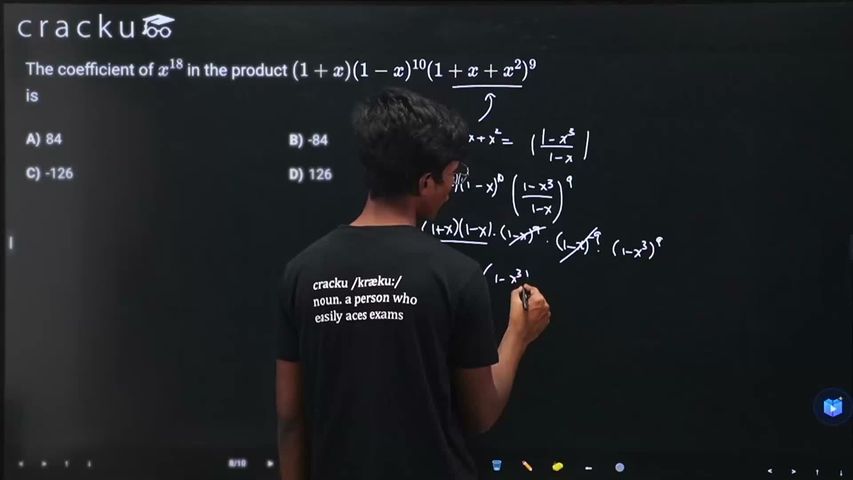
The coefficient of $$x^{18}$$ in the product $$(1 + x)(1 - x)^{10}(1 + x + x^2)^9$$ is
We have to calculate the coefficient of $$x^{18}$$ in the product
$$ (1 + x)\,(1 - x)^{10}\,(1 + x + x^2)^9. $$
First, recall the useful identity
$$ 1 + x + x^2 \;=\; \frac{1 - x^3}{1 - x}. $$
Raising both sides to the 9-th power gives
$$ (1 + x + x^2)^9 \;=\; \left(\frac{1 - x^3}{1 - x}\right)^9 \;=\; (1 - x^3)^9\,(1 - x)^{-9}. $$
Substituting this into the original product, we get
$$ (1 + x)\,(1 - x)^{10}\,(1 + x + x^2)^9 \;=\; (1 + x)\,(1 - x)^{10}\,(1 - x^3)^9\,(1 - x)^{-9}. $$
Because the exponents on $$(1 - x)$$ add algebraically, we have
$$ (1 - x)^{10}\,(1 - x)^{-9} \;=\; (1 - x)^{10-9} \;=\; (1 - x)^1 \;=\; (1 - x). $$
So the whole product simplifies to
$$ (1 + x)\,(1 - x)\,(1 - x^3)^9. $$
Now multiply the first two linear factors:
$$ (1 + x)\,(1 - x) \;=\; 1 - x^2. $$
Therefore the expression whose coefficient we need is
$$ (1 - x^2)\,(1 - x^3)^9. $$
Next we expand $$(1 - x^3)^9$$ with the binomial theorem. The binomial theorem states
$$ (1 + y)^n \;=\; \sum_{r=0}^{n} \binom{n}{r}\,y^r. $$
With $$y = -x^3$$ and $$n = 9,$$ this gives
$$ (1 - x^3)^9 \;=\; \sum_{r=0}^{9} \binom{9}{r}\,(-1)^r\,x^{3r}. $$
Multiplying by $$1 - x^2,$$ we write
$$ (1 - x^2)\,(1 - x^3)^9 \;=\; (1)\,\bigl[(1 - x^3)^9\bigr] \;-\; x^2\,(1 - x^3)^9. $$
Substituting the series for $$(1 - x^3)^9$$ in each part, we obtain
$$ \begin{aligned} (1 - x^2)\,(1 - x^3)^9 &=\; \sum_{r=0}^{9} \binom{9}{r}(-1)^r x^{3r} \;-\; \sum_{r=0}^{9} \binom{9}{r}(-1)^r x^{3r+2}. \\ \end{aligned} $$
The two sums now clearly show every power of $$x$$ that can occur. To get the coefficient of $$x^{18},$$ we examine each sum separately.
• In the first sum, the exponent is $$3r.$$ Setting $$3r = 18$$ gives $$r = 6,$$ which is indeed an integer between 0 and 9, so there is a contribution.
• In the second sum, the exponent is $$3r + 2.$$ Setting $$3r + 2 = 18$$ gives $$3r = 16,$$ or $$r = \dfrac{16}{3},$$ which is not an integer. Therefore no term in the second sum can produce $$x^{18}.$$
Thus the only contribution to the $$x^{18}$$ coefficient comes from the first sum with $$r = 6.$$ The corresponding term is
$$ \binom{9}{6}(-1)^6 x^{18}. $$
Since $$(-1)^6 = +1,$$ the coefficient is simply
$$ \binom{9}{6} \;=\; \binom{9}{3} \;=\; \frac{9\times8\times7}{3\times2\times1} \;=\; 84. $$
Hence, the correct answer is Option A.
Click on the Email ☝️ to Watch the Video Solution
Create a FREE account and get:
_1.webp)

Educational materials for JEE preparation

Ask our AI anything

AI can make mistakes. Please verify important information.
AI can make mistakes. Please verify important information.


