
Join Our JEE Preparation Group
Prep with like-minded aspirants; Get access to free daily tests and study material.
Sign in
Please select an account to continue using cracku.in
↓ →
Join Our JEE Preparation Group
Prep with like-minded aspirants; Get access to free daily tests and study material.
The differential equation of the family of curves, $$x^2 = 4b(y + b)$$, $$b \in R$$, is.
We are given the one-parameter family of curves
$$x^{2}=4b\,(y+b),\qquad b\in\mathbb R,$$
where $$y=y(x)$$ is the dependent variable and $$b$$ is the parameter. Because only one parameter is present, we expect the required differential equation to be of first order. Our aim is to eliminate $$b$$ by differentiating with respect to $$x$$ and then substituting.
First we differentiate the given relation with respect to $$x$$. Remember the rule $$\dfrac{d}{dx}(x^{n})=nx^{n-1}$$ and that, during differentiation, $$b$$ behaves as a constant:
$$\dfrac{d}{dx}(x^{2})=\dfrac{d}{dx}\!\bigl(4b(y+b)\bigr).$$
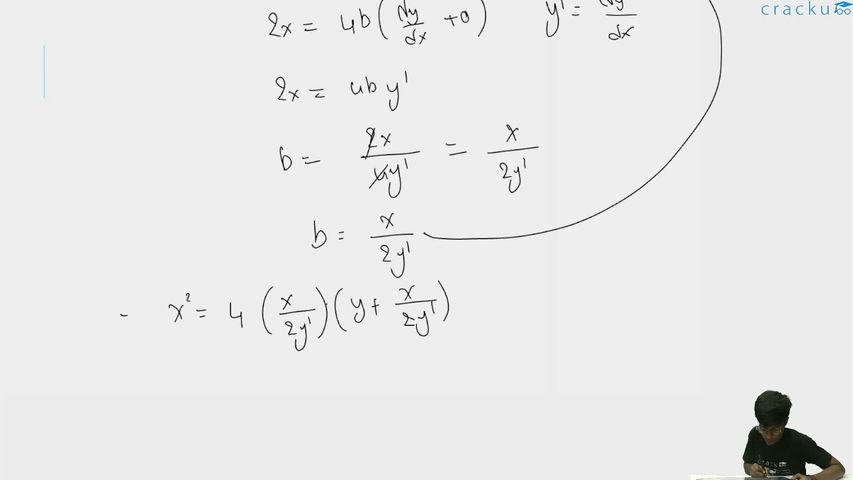
On the left we have $$2x.$$ On the right we have $$4b\dfrac{dy}{dx}+0$$ because $$\dfrac{d}{dx}(y)=\dfrac{dy}{dx}=y'$$ and $$\dfrac{d}{dx}(b)=0.$$ Thus
$$2x=4b\,y'.$$
Now we solve this equation for the parameter $$b$$:
$$b=\frac{2x}{4y'}=\frac{x}{2y'}.$$
Next we return to the original family equation and substitute this expression for $$b$$. We have
$$x^{2}=4b\,(y+b)$$
$$\Longrightarrow\;x^{2}=4\left(\frac{x}{2y'}\right)\!\left(y+\frac{x}{2y'}\right).$$
Simplifying step by step, we first combine the constant factors:
$$4\left(\frac{x}{2y'}\right)=\frac{4x}{2y'}=\frac{2x}{y'}.$$
Therefore
$$x^{2}=\frac{2x}{y'}\left(y+\frac{x}{2y'}\right).$$
We now distribute the factor $$\dfrac{2x}{y'}$$ inside the brackets:
$$x^{2}=\frac{2x}{y'}\cdot y\;+\;\frac{2x}{y'}\cdot\frac{x}{2y'}.$$
The first product gives $$\dfrac{2xy}{y'}.$$ For the second product the 2 in the numerator and denominator cancel, giving $$\dfrac{x^{2}}{(y')^{2}}.$$ Hence
$$x^{2}= \frac{2xy}{y'}+\frac{x^{2}}{(y')^{2}}.$$
To remove the denominators we multiply every term by $$(y')^{2}$$ (this is legitimate provided $$y'$$ is finite):
$$x^{2}(y')^{2}=2xy\,y'+x^{2}.$$
Now we rearrange all terms to one side in order to see the structure clearly:
$$x^{2}(y')^{2}-2xy\,y'-x^{2}=0.$$
Because $$x\neq0$$ for a non-trivial curve, we can divide the entire equation by $$x$$ to simplify:
$$x(y')^{2}-2y\,y'-x=0.$$
Finally we isolate the term $$x(y')^{2}$$:
$$x(y')^{2}=x+2y\,y'.$$
This matches exactly the form given in option A:
$$x(y')^{2}=x+2y\,y'.$$
Hence, the correct answer is Option A.
Was this solution helpful?
Click on the Email ☝️ to Watch the Video Solution
Create a FREE account and get:
_1.webp)

Educational materials for JEE preparation

Ask our AI anything

AI can make mistakes. Please verify important information.
AI can make mistakes. Please verify important information.


