
Join Our JEE Preparation Group
Prep with like-minded aspirants; Get access to free daily tests and study material.
Sign in
Please select an account to continue using cracku.in
↓ →
Join Our JEE Preparation Group
Prep with like-minded aspirants; Get access to free daily tests and study material.
The area (in sq. units) of the region $$\{(x, y) \in R^2 : x^2 \le y \le 3 - 2x\}$$, is.
We are asked to find the area of the set of all points $$(x,y)$$ in the plane that satisfy the two simultaneous inequalities $$x^{2}\le y\le 3-2x.$$
To calculate such an area, the standard plan is to identify the curves that bound the region, locate their points of intersection, decide which curve lies above the other in the interval between those intersection points, and finally integrate the vertical “height” (upper $$y$$ minus lower $$y$$) with respect to $$x$$ across that interval.
First, we note the two bounding curves explicitly:
Lower boundary: $$y = x^{2},$$ a parabola opening upward.
Upper boundary: $$y = 3 - 2x,$$ a straight line with negative slope.
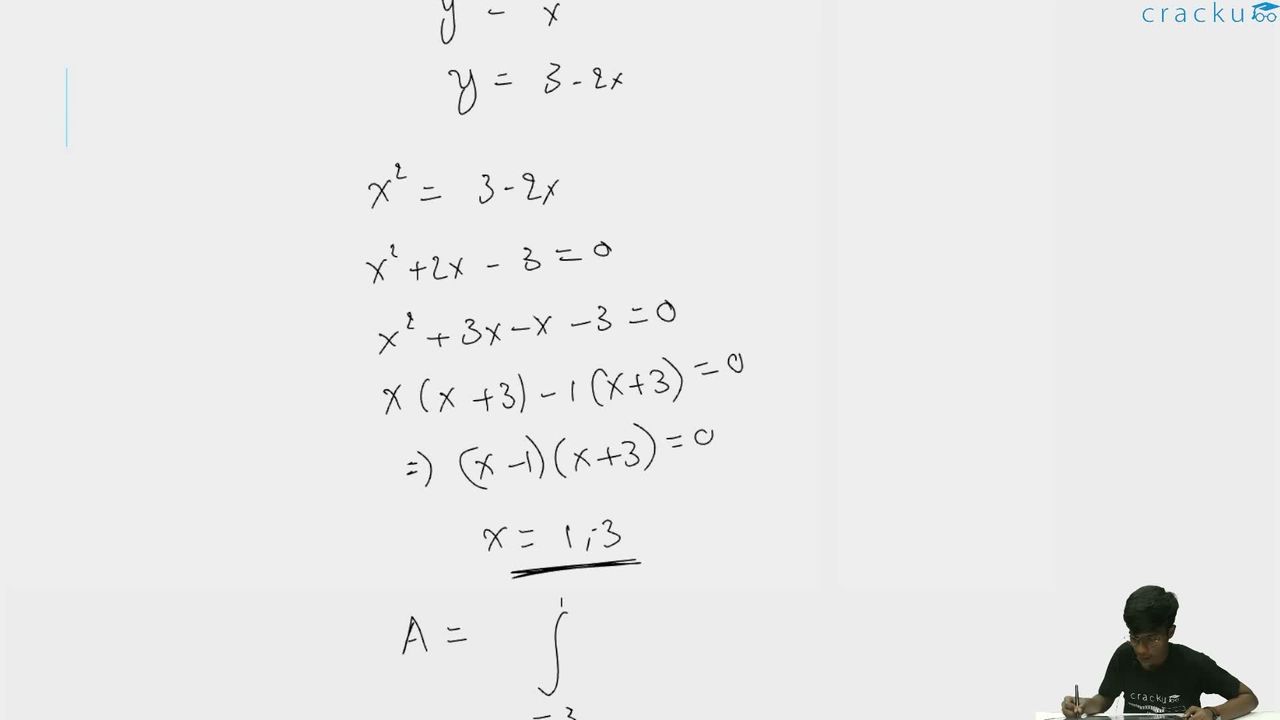
To find their intersection points we solve the equation obtained by setting the two $$y$$-expressions equal:
$$x^{2} = 3 - 2x.$$
Bringing all terms to the left gives
$$x^{2}+2x-3=0.$$
This is a quadratic equation of the general form $$ax^{2}+bx+c = 0.$$ For such an equation the roots are found by the quadratic formula $$x = \frac{-b\pm\sqrt{b^{2}-4ac}}{2a}.$$ Here $$a=1,\; b=2,\; c=-3.$$ Substituting these values we get
$$x = \frac{-2 \pm \sqrt{(2)^{2}-4(1)(-3)}}{2(1)} = \frac{-2 \pm \sqrt{4+12}}{2} = \frac{-2 \pm \sqrt{16}}{2} = \frac{-2 \pm 4}{2}.$$
Hence the two solutions are
$$x = \frac{-2+4}{2}=1 \quad\text{and}\quad x = \frac{-2-4}{2}=-3.$$
So the region is bounded in the horizontal ($$x$$) direction from $$x=-3$$ to $$x=1.$$
Next, we must decide which curve lies above the other in this entire interval. We can test any convenient value between $$-3$$ and $$1$$; say $$x=0.$$ At $$x=0$$ we have
$$y_{\text{line}} = 3-2(0)=3,$$ $$y_{\text{parabola}} = (0)^{2} = 0.$$
Clearly $$3 \gt 0,$$ so the straight line $$y = 3-2x$$ is above the parabola $$y=x^{2}$$ at that point. Because the two curves intersect only at the endpoints $$x=-3$$ and $$x=1,$$ this ordering stays the same on the whole closed interval $$[-3,1].$$ Thus for every $$x$$ between $$-3$$ and $$1,$$ the upper $$y$$-value is $$3-2x$$ and the lower $$y$$-value is $$x^{2}.$$
Therefore, the vertical “height” of the region at a particular $$x$$ is
$$\bigl(\text{upper }y\bigr) - \bigl(\text{lower }y\bigr) = (3-2x) - (x^{2}).$$
To obtain the entire area we integrate this height from $$x=-3$$ to $$x=1$$:
$$A = \int_{x=-3}^{\,1} \bigl[(3-2x) - x^{2}\bigr]\;dx.$$ That is $$A = \int_{-3}^{1} \left(3 - 2x - x^{2}\right)\,dx.$$
Now we integrate term by term, recalling the basic antiderivative rules $$\int k\,dx = kx,\;\; \int x\,dx = \frac{x^{2}}{2},\;\; \int x^{2}\,dx = \frac{x^{3}}{3}.$$ Applying them carefully with coefficients:
$$\int 3\,dx = 3x,$$ $$\int (-2x)\,dx = -2\cdot\frac{x^{2}}{2} = -x^{2},$$ $$\int (-x^{2})\,dx = -\frac{x^{3}}{3}.$$
So the full antiderivative (indefinite integral) is
$$F(x) = 3x - x^{2} - \frac{x^{3}}{3}.$$
We now evaluate $$F(x)$$ at the upper limit $$x=1$$ and at the lower limit $$x=-3$$ and subtract:
At $$x=1$$ we have $$F(1) = 3(1) - (1)^{2} - \frac{(1)^{3}}{3} = 3 - 1 - \frac{1}{3} = 2 - \frac{1}{3} = \frac{6}{3} - \frac{1}{3} = \frac{5}{3}.$$
At $$x=-3$$ we find $$F(-3) = 3(-3) - (-3)^{2} - \frac{(-3)^{3}}{3}.$$ Compute each term: $$3(-3) = -9,$$ $$(-3)^{2} = 9,$$ so $$-9$$ minus $$9$$ gives $$-9-9=-18.$$ Next, $$(-3)^{3} = -27,$$ so $$-\frac{(-27)}{3} = +9,$$ because the double negative becomes positive. Therefore $$F(-3)= -18 + 9 = -9.$$
Finally, the definite integral (area) is obtained by subtracting:
$$A = F(1) - F(-3) = \frac{5}{3} - (-9) = \frac{5}{3} + 9 = \frac{5}{3} + \frac{27}{3} = \frac{32}{3}.$$
Thus the required area of the region is $$\dfrac{32}{3}$$ square units.
Hence, the correct answer is Option A.
Was this solution helpful?
Click on the Email ☝️ to Watch the Video Solution
Create a FREE account and get:
_1.webp)

Educational materials for JEE preparation

Ask our AI anything

AI can make mistakes. Please verify important information.
AI can make mistakes. Please verify important information.


