
Join Our JEE Preparation Group
Prep with like-minded aspirants; Get access to free daily tests and study material.
Sign in
Please select an account to continue using cracku.in
↓ →
Join Our JEE Preparation Group
Prep with like-minded aspirants; Get access to free daily tests and study material.
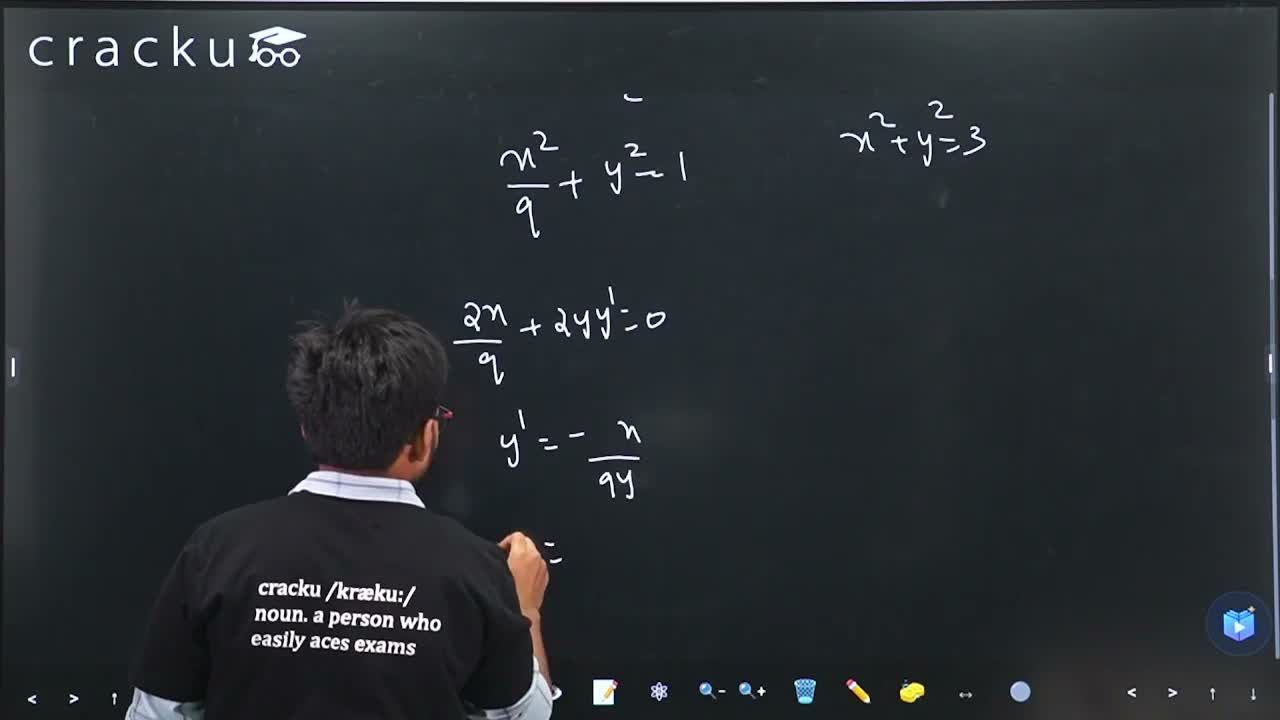
Let $$\theta$$ be the acute angle between the tangents to the ellipse $$\frac{x^2}{9} + \frac{y^2}{1} = 1$$ and the circle $$x^2 + y^2 = 3$$ at their point of intersection in the first quadrant. Then $$\tan\theta$$ is equal to:
We have two curves, the ellipse $$\dfrac{x^{2}}{9}+\dfrac{y^{2}}{1}=1$$ and the circle $$x^{2}+y^{2}=3$$. First we locate their points of intersection in the first quadrant by solving the two equations simultaneously.
From the ellipse we get $$y^{2}=1-\dfrac{x^{2}}{9}.$$ Substituting this in the circle gives
$$x^{2}+1-\dfrac{x^{2}}{9}=3.$$
Collecting the $$x^{2}$$ terms,
$$x^{2}-\dfrac{x^{2}}{9}=3-1 \;\;\Longrightarrow\;\; \left(1-\dfrac{1}{9}\right)x^{2}=2.$$
Since $$1-\dfrac{1}{9}=\dfrac{8}{9},$$ we get
$$\dfrac{8}{9}x^{2}=2 \;\;\Longrightarrow\;\; x^{2}=2\cdot\dfrac{9}{8}=\dfrac{18}{8}=\dfrac{9}{4}.$$
Because we want the first-quadrant point, $$x=\dfrac{3}{2}>0.$$ Now we use $$y^{2}=1-\dfrac{x^{2}}{9}$$ to find $$y$$:
$$y^{2}=1-\dfrac{9/4}{9}=1-\dfrac{1}{4}=\dfrac{3}{4}\;\;\Longrightarrow\;\;y=\dfrac{\sqrt{3}}{2}>0.$$
Thus the common point is $$P\!\left(\dfrac{3}{2},\dfrac{\sqrt{3}}{2}\right).$$
Next we write the tangent to each curve at $$P$$.
For the ellipse $$\dfrac{x^{2}}{a^{2}}+\dfrac{y^{2}}{b^{2}}=1,$$ the tangent at $$(x_{1},y_{1})$$ is given by the standard formula $$\dfrac{xx_{1}}{a^{2}}+\dfrac{yy_{1}}{b^{2}}=1.$$ Here $$a^{2}=9,\;b^{2}=1,\;x_{1}=\dfrac{3}{2},\;y_{1}=\dfrac{\sqrt{3}}{2},$$ so
$$\dfrac{x\!\left(\dfrac{3}{2}\right)}{9}+y\!\left(\dfrac{\sqrt{3}}{2}\right)=1.$$
Simplifying, $$\dfrac{3x}{18}+\dfrac{\sqrt{3}}{2}y=1 \;\;\Longrightarrow\;\; \dfrac{x}{6}+\dfrac{\sqrt{3}}{2}y=1.$$
Solving for $$y$$ in slope-intercept form,
$$\dfrac{\sqrt{3}}{2}y=1-\dfrac{x}{6} \;\;\Longrightarrow\;\; y=\dfrac{2}{\sqrt{3}}\!\left(1-\dfrac{x}{6}\right)=\dfrac{2}{\sqrt{3}}-\dfrac{x}{3\sqrt{3}}.$$
Hence the slope of the ellipse tangent is
$$m_{e}=-\dfrac{1}{3\sqrt{3}}.$$
For a circle $$x^{2}+y^{2}=r^{2}$$ centred at the origin, the tangent at $$(x_{1},y_{1})$$ is $$xx_{1}+yy_{1}=r^{2}.$$ Using $$x_{1}=\dfrac{3}{2},\;y_{1}=\dfrac{\sqrt{3}}{2},\;r^{2}=3,$$ we obtain
$$x\!\left(\dfrac{3}{2}\right)+y\!\left(\dfrac{\sqrt{3}}{2}\right)=3.$$
Multiplying by $$2,$$ $$3x+\sqrt{3}\,y=6.$$ Solving for $$y,$$
$$\sqrt{3}\,y=6-3x \;\;\Longrightarrow\;\; y=\dfrac{6-3x}{\sqrt{3}}=2\sqrt{3}-x\sqrt{3}.$$
Thus the slope of the circle tangent is
$$m_{c}=-\sqrt{3}.$$
Now we need the acute angle $$\theta$$ between the two tangents. For lines with slopes $$m_{1}$$ and $$m_{2}$$ we use the formula
$$\tan\theta=\left|\dfrac{m_{2}-m_{1}}{1+m_{1}m_{2}}\right|.$$
Taking $$m_{1}=m_{e}=-\dfrac{1}{3\sqrt{3}}$$ and $$m_{2}=m_{c}=-\sqrt{3},$$
$$m_{2}-m_{1}=-\sqrt{3}-\left(-\dfrac{1}{3\sqrt{3}}\right) =-\sqrt{3}+\dfrac{1}{3\sqrt{3}} =\dfrac{-8}{3\sqrt{3}},$$
and
$$1+m_{1}m_{2}=1+\left(-\dfrac{1}{3\sqrt{3}}\right)\!\left(-\sqrt{3}\right)=1+\dfrac{1}{3}=\dfrac{4}{3}.$$
Therefore
$$\tan\theta=\left|\dfrac{-8/(3\sqrt{3})}{4/3}\right| =\dfrac{8}{3\sqrt{3}}\cdot\dfrac{3}{4} =\dfrac{2}{\sqrt{3}}.$$
Hence, the correct answer is Option C.
Was this solution helpful?
Click on the Email ☝️ to Watch the Video Solution
Create a FREE account and get:
_1.webp)

Educational materials for JEE preparation

Ask our AI anything

AI can make mistakes. Please verify important information.
AI can make mistakes. Please verify important information.
