
Join Our JEE Preparation Group
Prep with like-minded aspirants; Get access to free daily tests and study material.
Sign in
Please select an account to continue using cracku.in
↓ →
Join Our JEE Preparation Group
Prep with like-minded aspirants; Get access to free daily tests and study material.
A square is inscribed in the circle $$x^2 + y^2 - 10x - 6y + 30 = 0$$. One side of this square is parallel to y = x + 3. If $$(x_i, y_i)$$ are the vertices of the square, then $$\sum(x_i^2 + y_i^2)$$ is equal to:
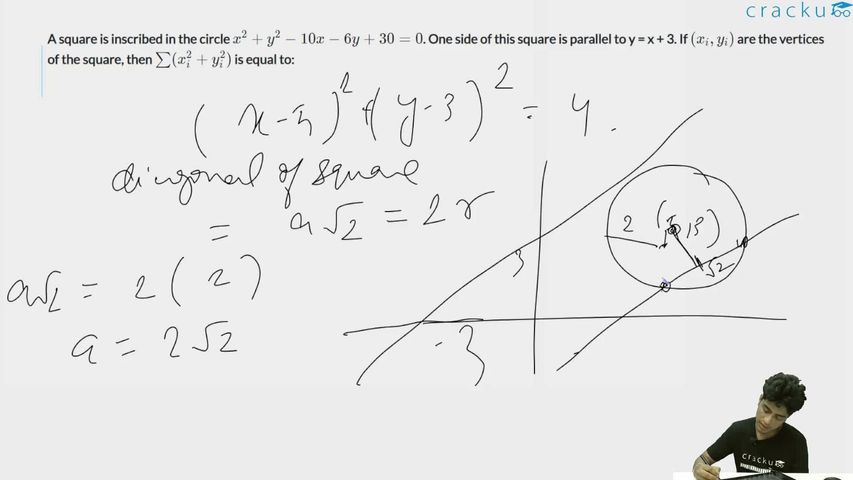
The given circle is $$x^2 + y^2 - 10x - 6y + 30 = 0$$.
Hence the centre is $$C(5,\,3)$$ and the radius is $$r = 2$$.
For a square inscribed in a circle, the diagonals are diameters of the circle
Therefore the point of intersection of the diagonals is the centre of the circle, i.e. $$C(5,3)$$ is also the centre of the square.
If the side length of the square is $$s$$ and its circum-radius is $$R$$, the relation is
$$R = \dfrac{\text{diagonal}}{2} = \dfrac{s\sqrt{2}}{2} = \dfrac{s}{\sqrt{2}}$$ $$-(1)$$
Putting $$R = r = 2$$ in $$(1)$$:
$$s = R\sqrt{2} = 2\sqrt{2}$$.
One side of the square is parallel to $$y = x + 3$$, whose slope is $$1$$.
A square whose sides have slopes $$\pm 1$$ has its diagonals along the coordinate axes.
Thus, starting from the centre $$C(5,3)$$, the vertices are reached by moving a distance $$R = 2$$ along the positive and negative coordinate axes.
Therefore the four vertices are
$$P_1(5+2,\,3) = (7,\,3),\; P_2(5-2,\,3) = (3,\,3),$$
$$P_3(5,\,3+2) = (5,\,5),\; P_4(5,\,3-2) = (5,\,1).$$
Now compute $$x_i^2 + y_i^2$$ for each vertex:
For $$P_1(7,3):\; 7^2 + 3^2 = 49 + 9 = 58$$
For $$P_2(3,3):\; 3^2 + 3^2 = 9 + 9 = 18$$
For $$P_3(5,5):\; 5^2 + 5^2 = 25 + 25 = 50$$
For $$P_4(5,1):\; 5^2 + 1^2 = 25 + 1 = 26$$
The required sum is
$$\sum (x_i^2 + y_i^2) = 58 + 18 + 50 + 26 = 152.$$
Was this solution helpful?
Click on the Email ☝️ to Watch the Video Solution
Create a FREE account and get:
_1.webp)

Educational materials for JEE preparation

Ask our AI anything

AI can make mistakes. Please verify important information.
AI can make mistakes. Please verify important information.
