
Join Our JEE Preparation Group
Prep with like-minded aspirants; Get access to free daily tests and study material.
Sign in
Please select an account to continue using cracku.in
↓ →
Join Our JEE Preparation Group
Prep with like-minded aspirants; Get access to free daily tests and study material.
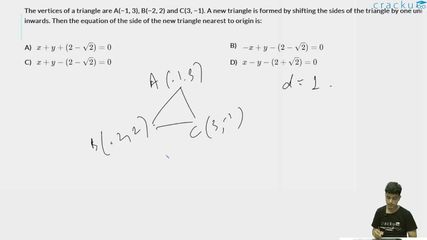
The vertices of a triangle are A(−1, 3), B(−2, 2) and C(3, −1). A new triangle is formed by shifting the sides of the triangle by one unit inwards. Then the equation of the side of the new triangle nearest to origin is:
The sides are $$AB: x-y+4=0$$, $$BC: 3x+5y-4=0$$, and $$AC: x+y-2=0$$.
Shifting a line $$ax+by+c=0$$ inward by $$d$$ units: $$\frac{ax+by+c}{\sqrt{a^2+b^2}} = \pm d$$.
For $$AC (x+y-2=0)$$, the distance from origin is $$\frac{|-2|}{\sqrt{2}} = \sqrt{2}$$. Shifting it 1 unit "inward" (towards the triangle's centroid) results in $$x+y-(2-\sqrt{2})=0$$.
This line is closest to the origin because the original distance was $$\sqrt{2}$$ and we moved 1 unit closer.
Answer: C ($$x+y-(2-\sqrt{2})=0$$)
Was this solution helpful?
Click on the Email ☝️ to Watch the Video Solution
Create a FREE account and get:
_1.webp)

Educational materials for JEE preparation

Ask our AI anything

AI can make mistakes. Please verify important information.
AI can make mistakes. Please verify important information.
