
Join Our JEE Preparation Group
Prep with like-minded aspirants; Get access to free daily tests and study material.
Sign in
Please select an account to continue using cracku.in
↓ →
Join Our JEE Preparation Group
Prep with like-minded aspirants; Get access to free daily tests and study material.
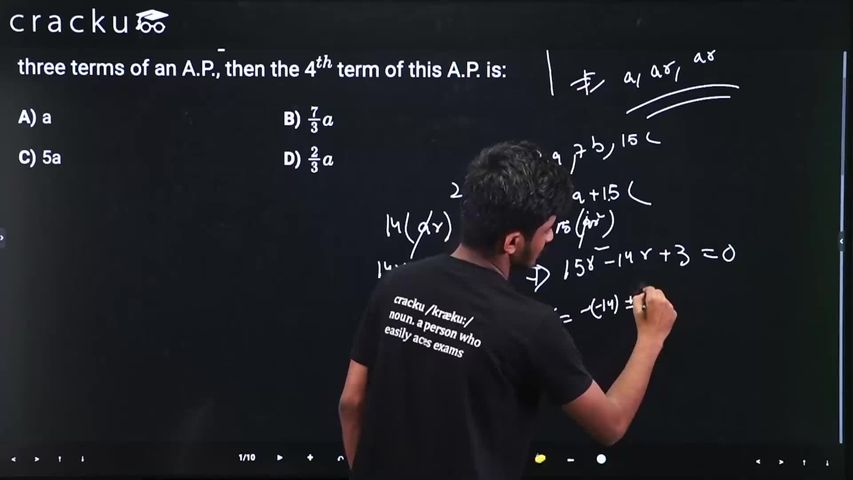
Let a, b and c be in G.P. with common ratio r, where $$a \neq 0$$ and $$0 \lt r \leq \frac{1}{2}$$. If 3a, 7b and 15c are the first three terms of an A.P., then the 4$$^{th}$$ term of this A.P. is:
We have that $$a,\;b,\;c$$ are in geometric progression with common ratio $$r$$, so by definition of a G.P.
$$b = ar \quad \text{and} \quad c = ar^{2}.$$
The extra information $$0 \lt r \le \dfrac12$$ will be used later to select the admissible value of $$r$$.
Now the numbers $$3a,\;7b,\;15c$$ form an arithmetic progression. For any A.P. the common difference is the same between every pair of consecutive terms, i.e.
$$\bigl(7b-3a\bigr) = \bigl(15c-7b\bigr).$$
Substituting $$b = ar$$ and $$c = ar^{2}$$ gives
$$7(ar) - 3a \;=\; 15(ar^{2}) - 7(ar).$$
Because $$a \neq 0$$ we can divide the entire equation by $$a$$ without changing the equality:
$$7r - 3 \;=\; 15r^{2} - 7r.$$
Bringing every term to the right produces the quadratic equation
$$15r^{2} - 7r - 7r + 3 = 0 \quad\Longrightarrow\quad 15r^{2} - 14r + 3 = 0.$$
We solve this quadratic using the formula $$r = \dfrac{-B \pm \sqrt{B^{2} - 4AC}}{2A}$$ for $$Ax^{2}+Bx+C=0$$. Here $$A = 15,\;B = -14,\;C = 3$$, so
$$r = \dfrac{14 \pm \sqrt{(-14)^{2} - 4 \cdot 15 \cdot 3}}{2 \cdot 15} = \dfrac{14 \pm \sqrt{196 - 180}}{30} = \dfrac{14 \pm \sqrt{16}}{30} = \dfrac{14 \pm 4}{30}.$$
This yields two possible roots:
$$r_{1} = \dfrac{14 + 4}{30} = \dfrac{18}{30} = \dfrac35 \quad\text{and}\quad r_{2} = \dfrac{14 - 4}{30} = \dfrac{10}{30} = \dfrac13.$$
Because we are told $$0 \lt r \le \dfrac12$$, the value $$r = \dfrac35$$ (which equals 0.6) is inadmissible. Hence we must take
$$r = \dfrac13.$$
Substituting this value back, the G.P. terms become
$$b = a\left(\dfrac13\right) = \dfrac{a}{3}, \qquad c = a\left(\dfrac13\right)^{2} = \dfrac{a}{9}.$$
The corresponding A.P. terms are therefore
$$T_{1} = 3a, \qquad T_{2} = 7b = 7\left(\dfrac{a}{3}\right) = \dfrac{7a}{3}, \qquad T_{3} = 15c = 15\left(\dfrac{a}{9}\right) = \dfrac{5a}{3}.$$
The common difference $$d$$ of the A.P. is
$$d = T_{2} - T_{1} = \dfrac{7a}{3} - 3a = \dfrac{7a - 9a}{3} = -\dfrac{2a}{3}.$$
Alternatively, $$d = T_{3} - T_{2} = \dfrac{5a}{3} - \dfrac{7a}{3} = -\dfrac{2a}{3},$$ confirming the same value.
The fourth term of an A.P. is given by $$T_{4} = T_{3} + d$$. Substituting the values just obtained:
$$T_{4} = \dfrac{5a}{3} + \left(-\dfrac{2a}{3}\right) = \dfrac{5a - 2a}{3} = \dfrac{3a}{3} = a.$$
Hence, the correct answer is Option A.
Was this solution helpful?
Click on the Email ☝️ to Watch the Video Solution
Create a FREE account and get:
_1.webp)

Educational materials for JEE preparation

Ask our AI anything

AI can make mistakes. Please verify important information.
AI can make mistakes. Please verify important information.
