
Join Our JEE Preparation Group
Prep with like-minded aspirants; Get access to free daily tests and study material.
Sign in
Please select an account to continue using cracku.in
↓ →
Join Our JEE Preparation Group
Prep with like-minded aspirants; Get access to free daily tests and study material.
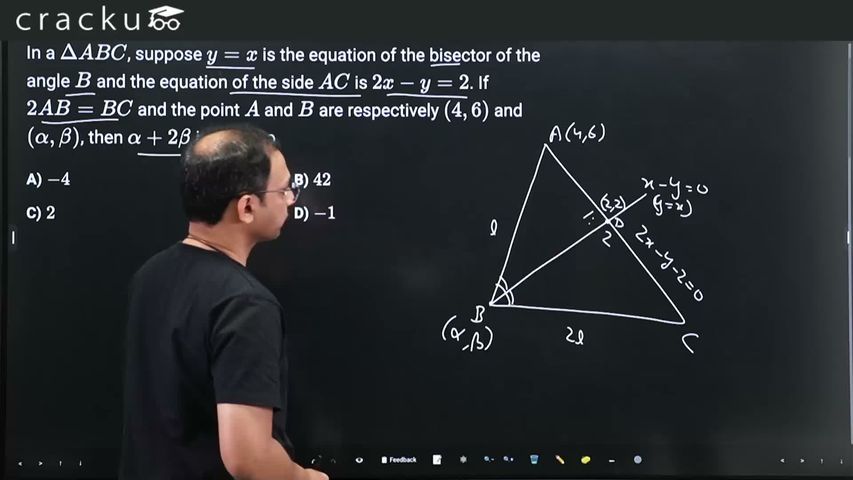
In a $$\Delta ABC$$, suppose $$y = x$$ is the equation of the bisector of the angle $$B$$ and the equation of the side $$AC$$ is $$2x - y = 2$$. If $$2AB = BC$$ and the point $$A$$ and $$B$$ are respectively $$(4, 6)$$ and $$(\alpha, \beta)$$, then $$\alpha + 2\beta$$ is equal to
The angle bisector from vertex $$B$$ is given by the line $$y = x$$, and it intersects side $$AC$$ at a point $$D$$. The equation of side $$AC$$ is $$2x - y = 2$$, and point $$A$$ is $$(4, 6)$$.
Since $$D$$ lies on both the angle bisector $$y = x$$ and side $$AC$$, substitute $$y = x$$ into $$2x - y = 2$$:
$$2x - x = 2 \implies x = 2, \quad y = 2$$
Thus, $$D = (2, 2)$$.
Given $$2AB = BC$$, it follows that $$AB/BC = 1/2$$. By the angle bisector theorem, $$AD/DC = AB/BC = 1/2$$. Therefore, $$D$$ divides $$AC$$ in the ratio $$AD:DC = 1:2$$.
Let $$C = (x, y)$$. Using the section formula, the coordinates of $$D$$ are:
$$D_x = \frac{2 \cdot x_A + 1 \cdot x_C}{1 + 2} = \frac{2 \cdot 4 + x_C}{3} = \frac{8 + x_C}{3}$$
$$D_y = \frac{2 \cdot y_A + 1 \cdot y_C}{1 + 2} = \frac{2 \cdot 6 + y_C}{3} = \frac{12 + y_C}{3}$$
Substitute $$D = (2, 2)$$:
$$\frac{8 + x_C}{3} = 2 \implies 8 + x_C = 6 \implies x_C = -2$$
$$\frac{12 + y_C}{3} = 2 \implies 12 + y_C = 6 \implies y_C = -6$$
Thus, $$C = (-2, -6)$$.
Since the angle bisector $$y = x$$ passes through $$B$$, and $$B = (\alpha, \beta)$$, it follows that $$\beta = \alpha$$, so $$B = (\alpha, \alpha)$$.
Given $$2AB = BC$$, compute the distances:
$$AB = \sqrt{(\alpha - 4)^2 + (\alpha - 6)^2}$$
$$BC = \sqrt{(\alpha - (-2))^2 + (\alpha - (-6))^2} = \sqrt{(\alpha + 2)^2 + (\alpha + 6)^2}$$
So:
$$2 \sqrt{(\alpha - 4)^2 + (\alpha - 6)^2} = \sqrt{(\alpha + 2)^2 + (\alpha + 6)^2}$$
Square both sides:
$$4 \left[ (\alpha - 4)^2 + (\alpha - 6)^2 \right] = (\alpha + 2)^2 + (\alpha + 6)^2$$
Expand:
Left side: $$4 \left[ (\alpha^2 - 8\alpha + 16) + (\alpha^2 - 12\alpha + 36) \right] = 4 \left[ 2\alpha^2 - 20\alpha + 52 \right] = 8\alpha^2 - 80\alpha + 208$$
Right side: $$(\alpha^2 + 4\alpha + 4) + (\alpha^2 + 12\alpha + 36) = 2\alpha^2 + 16\alpha + 40$$
Set equal:
$$8\alpha^2 - 80\alpha + 208 = 2\alpha^2 + 16\alpha + 40$$
Bring all terms to the left:
$$6\alpha^2 - 96\alpha + 168 = 0$$
Divide by 6:
$$\alpha^2 - 16\alpha + 28 = 0$$
Solve using the quadratic formula:
$$\alpha = \frac{16 \pm \sqrt{(-16)^2 - 4 \cdot 1 \cdot 28}}{2} = \frac{16 \pm \sqrt{256 - 112}}{2} = \frac{16 \pm \sqrt{144}}{2} = \frac{16 \pm 12}{2}$$
Thus:
$$\alpha = \frac{16 + 12}{2} = 14, \quad \alpha = \frac{16 - 12}{2} = 2$$
So $$B = (14, 14)$$ or $$B = (2, 2)$$.
If $$B = (2, 2)$$, it lies on $$AC$$ (since $$2(2) - 2 = 2$$), making the triangle degenerate. Thus, discard $$B = (2, 2)$$.
Therefore, $$B = (14, 14)$$, so $$\alpha = 14$$, $$\beta = 14$$, and:
$$\alpha + 2\beta = 14 + 2 \cdot 14 = 14 + 28 = 42$$
Verification:
$$AB = \sqrt{(14-4)^2 + (14-6)^2} = \sqrt{100 + 64} = \sqrt{164} = 2\sqrt{41}$$
$$BC = \sqrt{(14+2)^2 + (14+6)^2} = \sqrt{256 + 400} = \sqrt{656} = 4\sqrt{41}$$
$$2AB = 2 \cdot 2\sqrt{41} = 4\sqrt{41} = BC$$, satisfying the condition.
The angle bisector $$y = x$$ passes through $$B(14, 14)$$ and $$D(2, 2)$$, and the angle bisector theorem holds as $$AD/DC = 1/2$$ and $$AB/BC = 1/2$$.
Thus, $$\alpha + 2\beta = 42$$.
Was this solution helpful?
Click on the Email ☝️ to Watch the Video Solution
Create a FREE account and get:
_1.webp)

Educational materials for JEE preparation

Ask our AI anything

AI can make mistakes. Please verify important information.
AI can make mistakes. Please verify important information.
