
Join Our JEE Preparation Group
Prep with like-minded aspirants; Get access to free daily tests and study material.
Sign in
Please select an account to continue using cracku.in
↓ →
Join Our JEE Preparation Group
Prep with like-minded aspirants; Get access to free daily tests and study material.
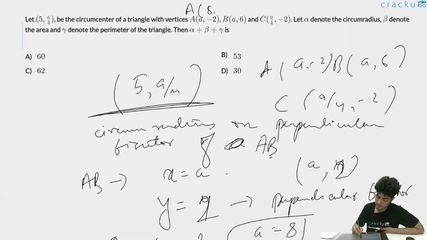
Let $$(5, \frac{a}{4})$$, be the circumcenter of a triangle with vertices $$A(a, -2)$$, $$B(a, 6)$$ and $$C(\frac{a}{4}, -2)$$. Let $$\alpha$$ denote the circumradius, $$\beta$$ denote the area and $$\gamma$$ denote the perimeter of the triangle. Then $$\alpha + \beta + \gamma$$ is
Since $$A(a, -2)$$ and $$B(a, 6)$$ have the same x-coordinate, side $$AB$$ is vertical (along $$x = a$$). The perpendicular bisector of $$AB$$ is horizontal, passing through the midpoint $$(a, 2)$$, so it is the line $$y = 2$$.
The circumcenter lies on this perpendicular bisector, so:
$$\frac{a}{4} = 2 \implies a = 8$$
$$A(8, -2)$$, $$B(8, 6)$$, $$C(2, -2)$$. Circumcenter: $$(5, 2)$$.
$$AB = |6 - (-2)| = 8$$
$$AC = |8 - 2| = 6$$
$$BC = \sqrt{(8-2)^2 + (6-(-2))^2} = \sqrt{36 + 64} = \sqrt{100} = 10$$
$$6^2 + 8^2 = 100 = 10^2$$, so this is a right triangle with the right angle at $$A$$.
For a right triangle, the circumradius equals half the hypotenuse:
$$\alpha = \frac{BC}{2} = \frac{10}{2} = 5$$
$$\beta = \frac{1}{2} \times AB \times AC = \frac{1}{2} \times 8 \times 6 = 24$$
$$\gamma = AB + AC + BC = 8 + 6 + 10 = 24$$
$$\alpha + \beta + \gamma = 5 + 24 + 24 = 53$$
The correct answer is Option (2): 53.
Was this solution helpful?
Click on the Email ☝️ to Watch the Video Solution
Create a FREE account and get:
_1.webp)

Educational materials for JEE preparation

Ask our AI anything

AI can make mistakes. Please verify important information.
AI can make mistakes. Please verify important information.
