
Join Our JEE Preparation Group
Prep with like-minded aspirants; Get access to free daily tests and study material.
Sign in
Please select an account to continue using cracku.in
↓ →
Join Our JEE Preparation Group
Prep with like-minded aspirants; Get access to free daily tests and study material.
The sum of the series: $$1 + \frac{1}{1+2} + \frac{1}{1+2+3} + \ldots$$ upto 10 terms, is:
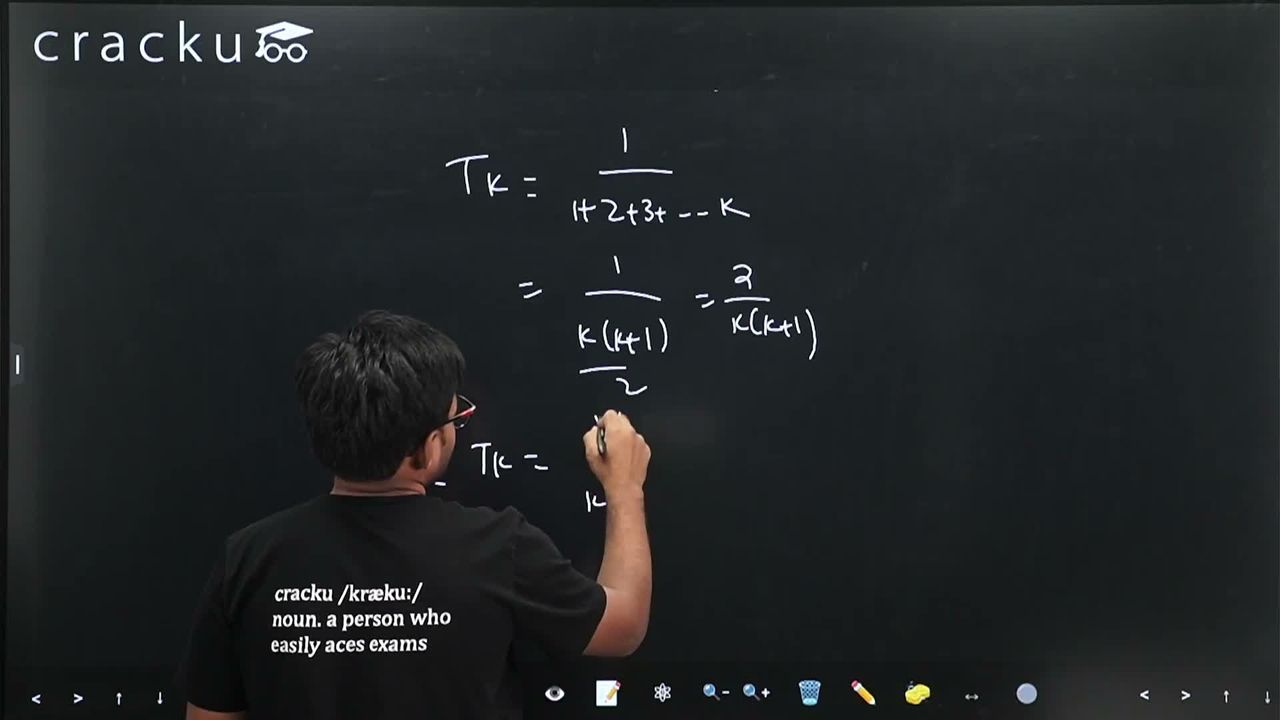
The given series is $$1 + \frac{1}{1+2} + \frac{1}{1+2+3} + \ldots$$ upto 10 terms. We recognize that each term corresponds to the reciprocal of the sum of the first $$k$$ natural numbers. The sum of the first $$k$$ natural numbers is $$\frac{k(k+1)}{2}$$. Therefore, the $$k$$-th term of the series is:
$$ t_k = \frac{1}{\frac{k(k+1)}{2}} = \frac{2}{k(k+1)} $$
The series becomes the sum of these terms from $$k=1$$ to $$k=10$$:
$$ \sum_{k=1}^{10} \frac{2}{k(k+1)} $$
To simplify the summation, we decompose the fraction $$\frac{2}{k(k+1)}$$ using partial fractions. We express it as:
$$ \frac{2}{k(k+1)} = \frac{A}{k} + \frac{B}{k+1} $$
Multiplying both sides by $$k(k+1)$$ gives:
$$ 2 = A(k+1) + Bk $$
We solve for $$A$$ and $$B$$. Setting $$k = 0$$:
$$ 2 = A(0+1) + B(0) \Rightarrow A = 2 $$
Setting $$k = -1$$:
$$ 2 = A(-1+1) + B(-1) \Rightarrow 2 = 0 - B \Rightarrow B = -2 $$
Alternatively, by expanding and equating coefficients:
$$ 2 = Ak + A + Bk = (A+B)k + A $$
Equating the coefficient of $$k$$: $$A + B = 0$$
Equating the constant term: $$A = 2$$
Then $$B = -2$$. Thus:
$$ \frac{2}{k(k+1)} = \frac{2}{k} - \frac{2}{k+1} $$
So the $$k$$-th term is:
$$ t_k = 2 \left( \frac{1}{k} - \frac{1}{k+1} \right) $$
The sum of the first $$n$$ terms is:
$$ S_n = \sum_{k=1}^{n} 2 \left( \frac{1}{k} - \frac{1}{k+1} \right) $$
This is a telescoping series. Writing out the terms explicitly:
$$ S_n = 2 \left[ \left( \frac{1}{1} - \frac{1}{2} \right) + \left( \frac{1}{2} - \frac{1}{3} \right) + \left( \frac{1}{3} - \frac{1}{4} \right) + \ldots + \left( \frac{1}{n} - \frac{1}{n+1} \right) \right] $$
Observing the cancellations, all intermediate terms cancel out, leaving only the first and the last term:
$$ S_n = 2 \left( 1 - \frac{1}{n+1} \right) $$
Simplifying:
$$ S_n = 2 \left( \frac{n+1}{n+1} - \frac{1}{n+1} \right) = 2 \left( \frac{n}{n+1} \right) = \frac{2n}{n+1} $$
For $$n = 10$$ terms:
$$ S_{10} = \frac{2 \times 10}{10 + 1} = \frac{20}{11} $$
Comparing with the options, $$\frac{20}{11}$$ corresponds to option C.
Hence, the correct answer is Option C.
Was this solution helpful?
Click on the Email ☝️ to Watch the Video Solution
Create a FREE account and get:
_1.webp)

Educational materials for JEE preparation

Ask our AI anything

AI can make mistakes. Please verify important information.
AI can make mistakes. Please verify important information.


