Sign in
Please select an account to continue using cracku.in
↓ →
Join Our JEE Preparation Group
Prep with like-minded aspirants; Get access to free daily tests and study material.
Let $$a_1, a_2, a_3, \ldots$$ be an A.P, such that $$\frac{a_1 + a_2 + \ldots + a_p}{a_1 + a_2 + a_3 + \ldots + a_q} = \frac{p^3}{q^3}$$; $$p \neq q$$. Then $$\frac{a_6}{a_{21}}$$ is equal to:
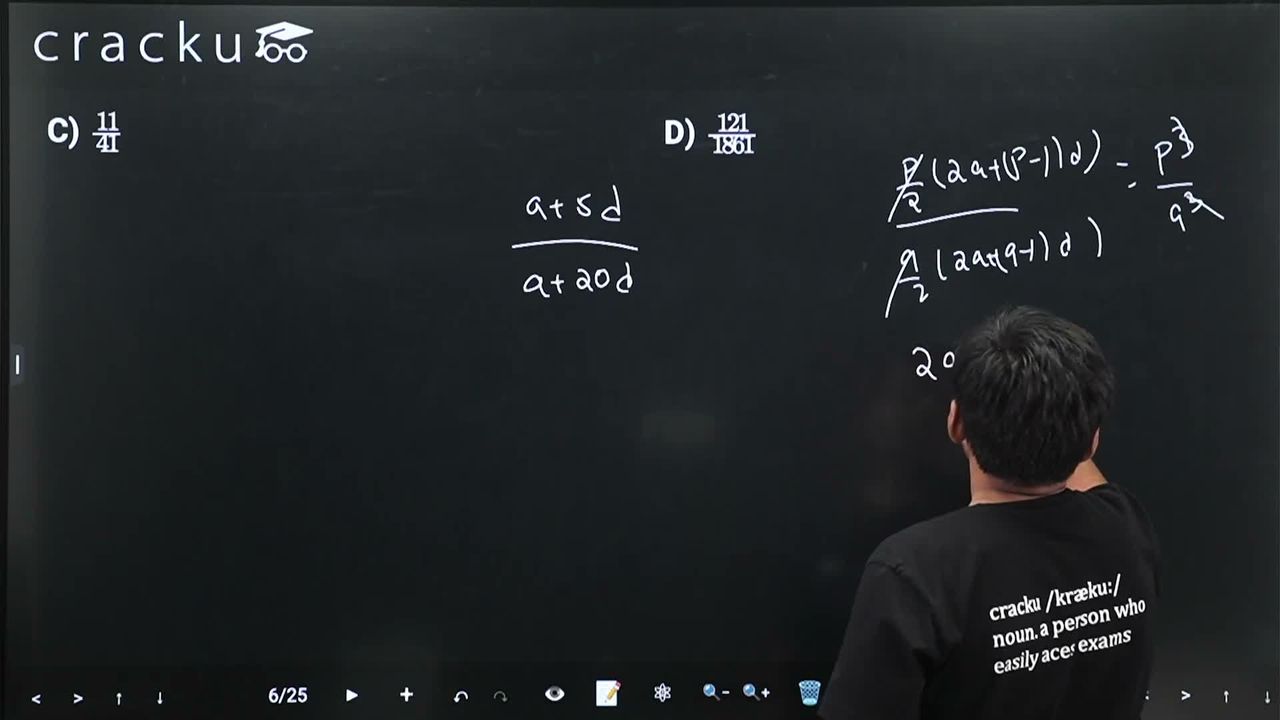
Given that $$a_1, a_2, a_3, \ldots$$ is an arithmetic progression (A.P.), each term is obtained by adding a constant difference $$d$$ to the previous term. The $$n$$-th term is $$a_n = a_1 + (n-1)d$$. The sum of the first $$n$$ terms is $$S_n = \frac{n}{2} [2a_1 + (n-1)d]$$. The problem states that for some $$p$$ and $$q$$ with $$p \neq q$$, the ratio $$\frac{S_p}{S_q} = \frac{p^3}{q^3}$$.
Substituting the sum formulas:
$$ \frac{\frac{p}{2} [2a_1 + (p-1)d]}{\frac{q}{2} [2a_1 + (q-1)d]} = \frac{p^3}{q^3} $$
Simplifying the left side by canceling $$\frac{1}{2}$$:
$$ \frac{p [2a_1 + (p-1)d]}{q [2a_1 + (q-1)d]} = \frac{p^3}{q^3} $$
Dividing both sides by $$\frac{p}{q}$$:
$$ \frac{2a_1 + (p-1)d}{2a_1 + (q-1)d} = \frac{p^2}{q^2} $$
This equation must hold for specific $$p$$ and $$q$$ with $$p \neq q$$. To find $$\frac{a_6}{a_{21}}$$, express the terms: $$a_6 = a_1 + 5d$$ and $$a_{21} = a_1 + 20d$$, so:
$$ \frac{a_6}{a_{21}} = \frac{a_1 + 5d}{a_1 + 20d} $$
Let $$r = \frac{d}{a_1}$$, assuming $$a_1 \neq 0$$. Then:
$$ \frac{a_1 + 5d}{a_1 + 20d} = \frac{1 + 5r}{1 + 20r} $$
From the ratio equation:
$$ \frac{2a_1 + (p-1)d}{2a_1 + (q-1)d} = \frac{p^2}{q^2} $$
Substituting $$d = r a_1$$:
$$ \frac{2a_1 + (p-1)r a_1}{2a_1 + (q-1)r a_1} = \frac{2 + (p-1)r}{2 + (q-1)r} = \frac{p^2}{q^2} $$
Cross-multiplying:
$$ q^2 [2 + (p-1)r] = p^2 [2 + (q-1)r] $$
Expanding:
$$ 2q^2 + q^2 (p-1)r = 2p^2 + p^2 (q-1)r $$
Bringing terms involving $$r$$ to one side:
$$ r [q^2 (p-1) - p^2 (q-1)] = 2p^2 - 2q^2 $$
Simplifying the left side:
$$ q^2 (p-1) - p^2 (q-1) = p q^2 - q^2 - p^2 q + p^2 = p q (q - p) + (p^2 - q^2) $$
Since $$p^2 - q^2 = (p - q)(p + q)$$ and $$q - p = -(p - q)$$:
$$ p q (q - p) + (p^2 - q^2) = -p q (p - q) + (p - q)(p + q) = (p - q) [-p q + (p + q)] $$
So:
$$ r (p - q) [-p q + p + q] = 2(p - q)(p + q) $$
Dividing by $$p - q$$ (since $$p \neq q$$):
$$ r (-p q + p + q) = 2(p + q) $$
Solving for $$r$$:
$$ r = \frac{2(p + q)}{p + q - p q} $$
Now, substituting into the ratio:
$$ \frac{1 + 5r}{1 + 20r} = \frac{1 + 5 \left( \frac{2(p + q)}{p + q - p q} \right)}{1 + 20 \left( \frac{2(p + q)}{p + q - p q} \right)} = \frac{\frac{p + q - p q + 10(p + q)}{p + q - p q}}{\frac{p + q - p q + 40(p + q)}{p + q - p q}} = \frac{p + q - p q + 10p + 10q}{p + q - p q + 40p + 40q} = \frac{-p q + 11p + 11q}{-p q + 41p + 41q} $$
This expression depends on $$p$$ and $$q$$, but for the pairs $$(p, q)$$ that satisfy the original ratio, the value of $$\frac{a_6}{a_{21}}$$ must be constant. Choosing specific values that satisfy the equation, such as $$p = 1$$, $$q = 2$$:
First, verify if the ratio holds for $$p = 1$$, $$q = 2$$:
$$ S_1 = a_1, \quad S_2 = a_1 + a_2 = a_1 + (a_1 + d) = 2a_1 + d $$
$$ \frac{S_1}{S_2} = \frac{a_1}{2a_1 + d} = \frac{1^3}{2^3} = \frac{1}{8} $$
So:
$$ \frac{a_1}{2a_1 + d} = \frac{1}{8} \implies 8a_1 = 2a_1 + d \implies d = 6a_1 $$
Thus, $$r = \frac{d}{a_1} = 6$$. Now compute:
$$ a_6 = a_1 + 5d = a_1 + 5(6a_1) = 31a_1, \quad a_{21} = a_1 + 20d = a_1 + 20(6a_1) = 121a_1 $$
So:
$$ \frac{a_6}{a_{21}} = \frac{31a_1}{121a_1} = \frac{31}{121} $$
Checking with another pair, such as $$p = 2$$, $$q = 1$$, gives the same ratio $$d = 6a_1$$ and $$\frac{a_6}{a_{21}} = \frac{31}{121}$$. Other pairs $$(p, q)$$ that satisfy the original ratio for this A.P. (like $$(1, 2)$$ or $$(2, 1)$$) yield the same result. Among the options, $$\frac{31}{121}$$ corresponds to option B.
Hence, the correct answer is Option B.
Create a FREE account and get:
Predict your JEE Main percentile, rank & performance in seconds
Educational materials for JEE preparation
Ask our AI anything
AI can make mistakes. Please verify important information.


