
Join Our JEE Preparation Group
Prep with like-minded aspirants; Get access to free daily tests and study material.
Sign in
Please select an account to continue using cracku.in
↓ →
Join Our JEE Preparation Group
Prep with like-minded aspirants; Get access to free daily tests and study material.
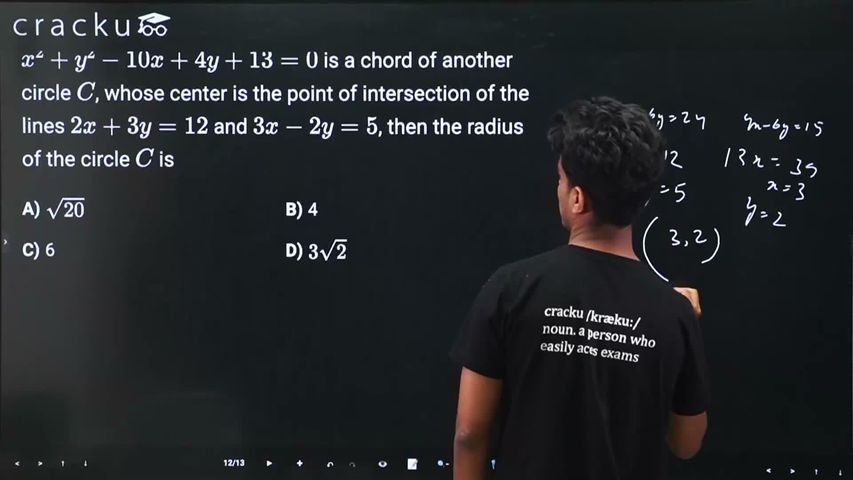
If one of the diameters of the circle $$x^2 + y^2 - 10x + 4y + 13 = 0$$ is a chord of another circle $$C$$, whose center is the point of intersection of the lines $$2x + 3y = 12$$ and $$3x - 2y = 5$$, then the radius of the circle $$C$$ is
$$x^2 + y^2 - 10x + 4y + 13 = 0$$
$$(x - 5)^2 + (y + 2)^2 = 16$$.
Hence, the centre is $$(5, -2)$$ and the radius is $$r = 4$$, making the length of its diameter $$8$$ and the half-length of the diameter (the chord length) equal to $$4$$.
The centre of the circle $$C$$ is determined by the intersection of the lines $$2x + 3y = 12$$ and $$3x - 2y = 5$$.
The centre of $$C$$ is $$(3, 2)$$.
The given diameter of the first circle serves as a chord of circle $$C$$ and its midpoint is the centre $$(5, -2)$$ of the first circle.
The perpendicular distance $$d$$ from the centre of $$C$$ to this chord is found by the distance formula: $$d = \sqrt{(5 - 3)^2 + (-2 - 2)^2} = \sqrt{20} = 2\sqrt{5}\,. $$
In any circle, the relationship between the radius $$R$$, the half-length of a chord $$l$$, and the perpendicular distance $$d$$ from the centre to the chord is given by $$R^2 = d^2 + l^2$$.
Substituting $$d^2 = 20$$ and $$l = 4$$ gives $$R^2 = 20 + 16 = 36$$, so $$R = 6$$.
Was this solution helpful?
Click on the Email ☝️ to Watch the Video Solution
Create a FREE account and get:
_1.webp)

Educational materials for JEE preparation

Ask our AI anything

AI can make mistakes. Please verify important information.
AI can make mistakes. Please verify important information.
