
Join Our JEE Preparation Group
Prep with like-minded aspirants; Get access to free daily tests and study material.
Sign in
Please select an account to continue using cracku.in
↓ →
Join Our JEE Preparation Group
Prep with like-minded aspirants; Get access to free daily tests and study material.
If $$\lim_{x \to \infty} \left(\sqrt{x^2 - x + 1} - ax\right) = b$$, then the ordered pair $$(a, b)$$ is:
We have to evaluate the limit
$$\lim_{x \to \infty}\Bigl(\sqrt{x^2 - x + 1}\;-\;a\,x\Bigr)=b.$$
For very large positive $$x$$, the expression inside the square-root is dominated by $$x^2$$, so we first factor $$x^2$$ out of the radical:
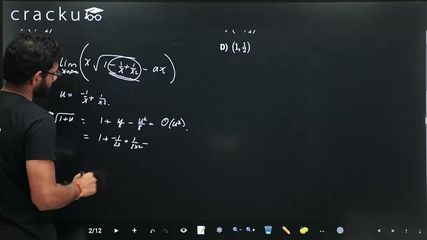
$$\sqrt{x^2 - x + 1}=\sqrt{x^2\Bigl(1-\frac{1}{x}+\frac{1}{x^2}\Bigr)}.$$
Using the property $$\sqrt{m\,n}=\sqrt{m}\,\sqrt{n}$$, we take $$\sqrt{x^2}=x$$ outside the radical:
$$\sqrt{x^2 - x + 1}=x\;\sqrt{1-\frac{1}{x}+\frac{1}{x^2}}.$$
Now we expand the square-root of a quantity close to 1. The Taylor (binomial) expansion about $$u=0$$ is
$$\sqrt{1+u}=1+\frac{u}{2}-\frac{u^2}{8}+O(u^3).$$
In our case
$$u=-\frac{1}{x}+\frac{1}{x^2}.$$
Substituting this $$u$$ into the series gives
$$\sqrt{1-\frac{1}{x}+\frac{1}{x^2}} \;=\;1+\frac{1}{2}\!\Bigl(-\frac{1}{x}+\frac{1}{x^2}\Bigr) -\frac{1}{8}\!\Bigl(-\frac{1}{x}+\frac{1}{x^2}\Bigr)^{\!2}+O\!\Bigl(\frac{1}{x^3}\Bigr).$$
We now simplify each part. First the linear term:
$$\frac{1}{2}\!\Bigl(-\frac{1}{x}+\frac{1}{x^2}\Bigr)=-\,\frac{1}{2x}+\frac{1}{2x^2}.$$
Next the quadratic term. Compute the square:
$$\Bigl(-\frac{1}{x}+\frac{1}{x^2}\Bigr)^{\!2} =\frac{1}{x^2}-\frac{2}{x^3}+\frac{1}{x^4}.$$
Multiplying by $$-\dfrac{1}{8}$$ gives
$$-\frac{1}{8}\Bigl(-\frac{1}{x}+\frac{1}{x^2}\Bigr)^{\!2} =-\frac{1}{8x^2}+\frac{1}{4x^3}-\frac{1}{8x^4}.$$
Adding the linear and quadratic pieces we obtain, up to order $$\dfrac{1}{x^2}$$:
$$\sqrt{1-\frac{1}{x}+\frac{1}{x^2}} =1-\frac{1}{2x}+\frac{1}{2x^2}-\frac{1}{8x^2}+O\!\Bigl(\frac{1}{x^3}\Bigr).$$
Combine the $$\dfrac{1}{x^2}$$ coefficients:
$$\frac{1}{2x^2}-\frac{1}{8x^2}=\frac{4-1}{8x^2}=\frac{3}{8x^2}.$$
Thus
$$\sqrt{1-\frac{1}{x}+\frac{1}{x^2}} =1-\frac{1}{2x}+\frac{3}{8x^2}+O\!\Bigl(\frac{1}{x^3}\Bigr).$$
Multiplying this by the prefactor $$x$$ we found earlier, we get
$$\sqrt{x^2 - x + 1} =x\Bigl[1-\frac{1}{2x}+\frac{3}{8x^2}+O\!\Bigl(\frac{1}{x^3}\Bigr)\Bigr] =x-\frac{1}{2}+\frac{3}{8x}+O\!\Bigl(\frac{1}{x^2}\Bigr).$$
So for large $$x$$ the entire expression behaves as
$$\sqrt{x^2 - x + 1}=x-\frac{1}{2}+O\!\Bigl(\frac{1}{x}\Bigr).$$
Returning to our limit, we substitute this approximation:
$$\sqrt{x^2 - x + 1}-a\,x =\Bigl(x-\frac{1}{2}+O\!\bigl(\tfrac{1}{x}\bigr)\Bigr)-a\,x =\bigl(1-a\bigr)x-\frac{1}{2}+O\!\Bigl(\frac{1}{x}\Bigr).$$
For the limit as $$x \to \infty$$ to settle at a finite number $$b$$, the coefficient of the unbounded term $$x$$ must vanish. Hence we require
$$1-a=0 \quad\Longrightarrow\quad a=1.$$
With $$a=1$$, the remaining constant term is clearly
$$b=-\frac{1}{2}.$$
Therefore the ordered pair $$(a,b)$$ equals $$\left(1,-\dfrac{1}{2}\right).$$
Hence, the correct answer is Option A.
Click on the Email ☝️ to Watch the Video Solution
Create a FREE account and get:
_1.webp)

Educational materials for JEE preparation

Ask our AI anything

AI can make mistakes. Please verify important information.
AI can make mistakes. Please verify important information.


