
Join Our JEE Preparation Group
Prep with like-minded aspirants; Get access to free daily tests and study material.
Sign in
Please select an account to continue using cracku.in
↓ →
Join Our JEE Preparation Group
Prep with like-minded aspirants; Get access to free daily tests and study material.
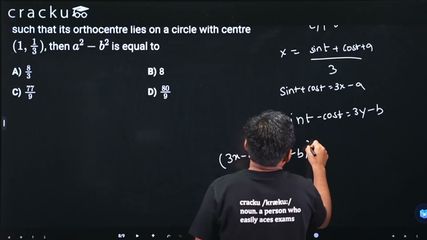
For $$t \in (0, 2\pi)$$, if ABC is an equilateral triangle with vertices $$A(\sin t, -\cos t)$$, $$B(\cos t, \sin t)$$ and $$C(a, b)$$ such that its orthocentre lies on a circle with centre $$(1, \frac{1}{3})$$, then $$a^2 - b^2$$ is equal to
We are given an equilateral triangle ABC with vertices $$A(\sin t,-\cos t)$$, $$B(\cos t,\sin t)$$, and $$C(a,b)$$, and its orthocentre lies on a circle with centre $$(1,\tfrac13)$$.
Since the triangle is equilateral, its orthocentre coincides with its centroid, which is
$$G=\Bigl(\frac{\sin t+\cos t+a}{3},\;\frac{-\cos t+\sin t+b}{3}\Bigr).$$
Letting $$G=(X,Y)$$, we have
$$X=\frac{\sin t+\cos t+a}{3},\qquad Y=\frac{\sin t-\cos t+b}{3},$$
so that
$$3X-a=\sin t+\cos t,\qquad 3Y-b=\sin t-\cos t.$$
Squaring and adding these two equations yields
$$ (3X-a)^2+(3Y-b)^2=(\sin t+\cos t)^2+(\sin t-\cos t)^2, $$
which simplifies to
$$\sin^2t+2\sin t\cos t+\cos^2t+\sin^2t-2\sin t\cos t+\cos^2t=2. $$
This shows that the centroid traces the circle
$$ (3X-a)^2+(3Y-b)^2=2, $$
or equivalently
$$\Bigl(X-\frac{a}{3}\Bigr)^2+\Bigl(Y-\frac{b}{3}\Bigr)^2=\frac{2}{9}.$$
From the above equation, the centre of this circle is $$\bigl(\tfrac{a}{3},\tfrac{b}{3}\bigr)$$, which must coincide with the given centre $$(1,\tfrac13)$$. Therefore,
$$\frac{a}{3}=1\;\Rightarrow\;a=3,\qquad \frac{b}{3}=\frac{1}{3}\;\Rightarrow\;b=1.$$
Substituting these values gives
$$a^2-b^2=9-1=8.$$
The correct answer is Option B: $$8$$.
Was this solution helpful?
Click on the Email ☝️ to Watch the Video Solution
Create a FREE account and get:
_1.webp)

Educational materials for JEE preparation

Ask our AI anything

AI can make mistakes. Please verify important information.
AI can make mistakes. Please verify important information.
