
Join Our JEE Preparation Group
Prep with like-minded aspirants; Get access to free daily tests and study material.
Sign in
Please select an account to continue using cracku.in
↓ →
Join Our JEE Preparation Group
Prep with like-minded aspirants; Get access to free daily tests and study material.
Let two straight lines drawn from the origin $$O$$ intersect the line $$3x + 4y = 12$$ at the points $$P$$ and $$Q$$ such that $$\triangle OPQ$$ is an isosceles triangle and $$\angle POQ = 90°$$. If $$l = OP^2 + PQ^2 + QO^2$$, then the greatest integer less than or equal to $$l$$ is :
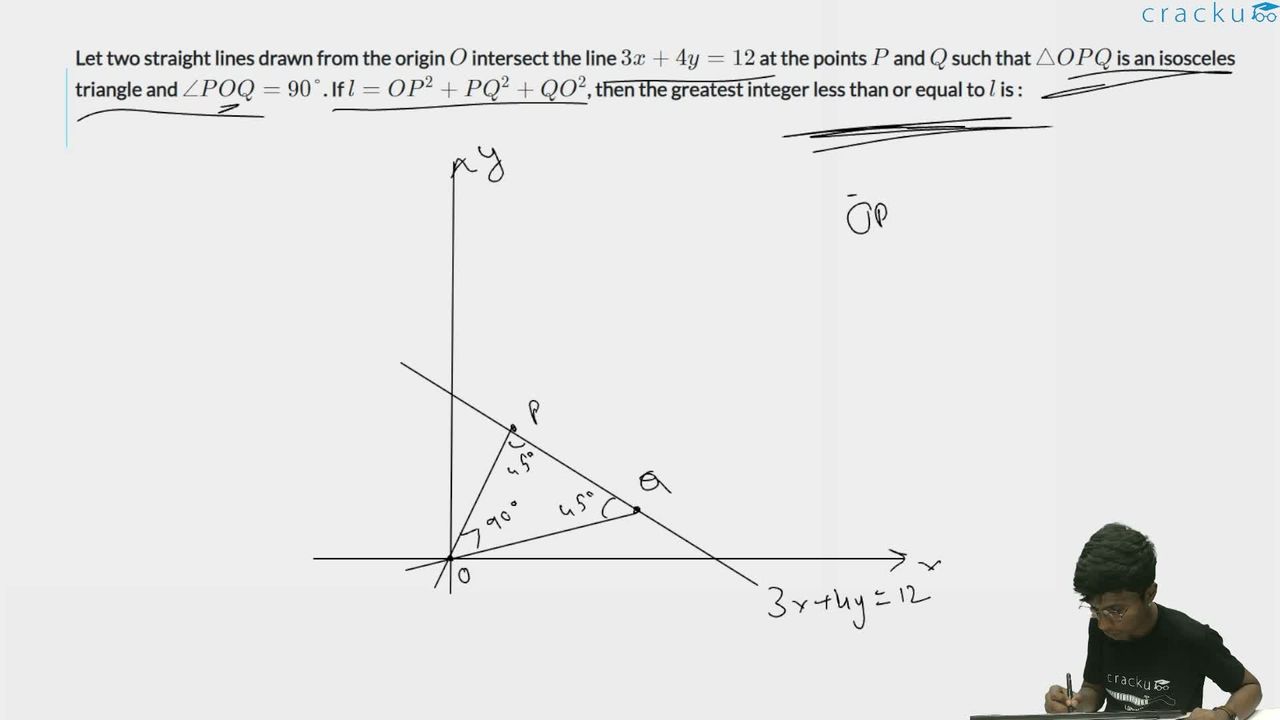
Two lines from origin O intersect $$3x + 4y = 12$$ at P and Q such that $$\triangle OPQ$$ is isosceles with $$\angle POQ = 90°$$ and $$OP = OQ$$.
The distance from O to the line $$3x + 4y = 12$$ is $$d = \frac{12}{\sqrt{9+16}} = \frac{12}{5}$$.
Since $$\angle POQ = 90°$$ and $$OP = OQ$$, the perpendicular from O to PQ bisects both $$PQ$$ and $$\angle POQ$$. Let M be the foot of the perpendicular from O to line PQ, so that $$OM = d = 12/5$$.
Because $$\angle POM = \angle QOM = 45°$$, we have
$$OP = \frac{OM}{\cos 45°} = \frac{12/5}{1/\sqrt{2}} = \frac{12\sqrt{2}}{5},$$
$$PM = OP \sin 45° = \frac{12\sqrt{2}}{5} \cdot \frac{1}{\sqrt{2}} = \frac{12}{5},$$
and hence
$$PQ = 2 \cdot PM = \frac{24}{5}.$$
Next, we calculate
$$l = OP^2 + PQ^2 + QO^2 = 2 \cdot OP^2 + PQ^2,$$
where
$$OP^2 = QO^2 = \left(\frac{12\sqrt{2}}{5}\right)^2 = \frac{288}{25},$$
$$PQ^2 = \left(\frac{24}{5}\right)^2 = \frac{576}{25}.$$
It follows that
$$l = \frac{576}{25} + \frac{576}{25} = \frac{1152}{25} = 46.08.$$
The greatest integer less than or equal to $$l$$ is $$\lfloor 46.08 \rfloor = 46$$.
The correct answer is Option (2): 46.
Was this solution helpful?
Click on the Email ☝️ to Watch the Video Solution
Create a FREE account and get:
_1.webp)

Educational materials for JEE preparation

Ask our AI anything

AI can make mistakes. Please verify important information.
AI can make mistakes. Please verify important information.
