
Join Our JEE Preparation Group
Prep with like-minded aspirants; Get access to free daily tests and study material.
Sign in
Please select an account to continue using cracku.in
↓ →
Join Our JEE Preparation Group
Prep with like-minded aspirants; Get access to free daily tests and study material.
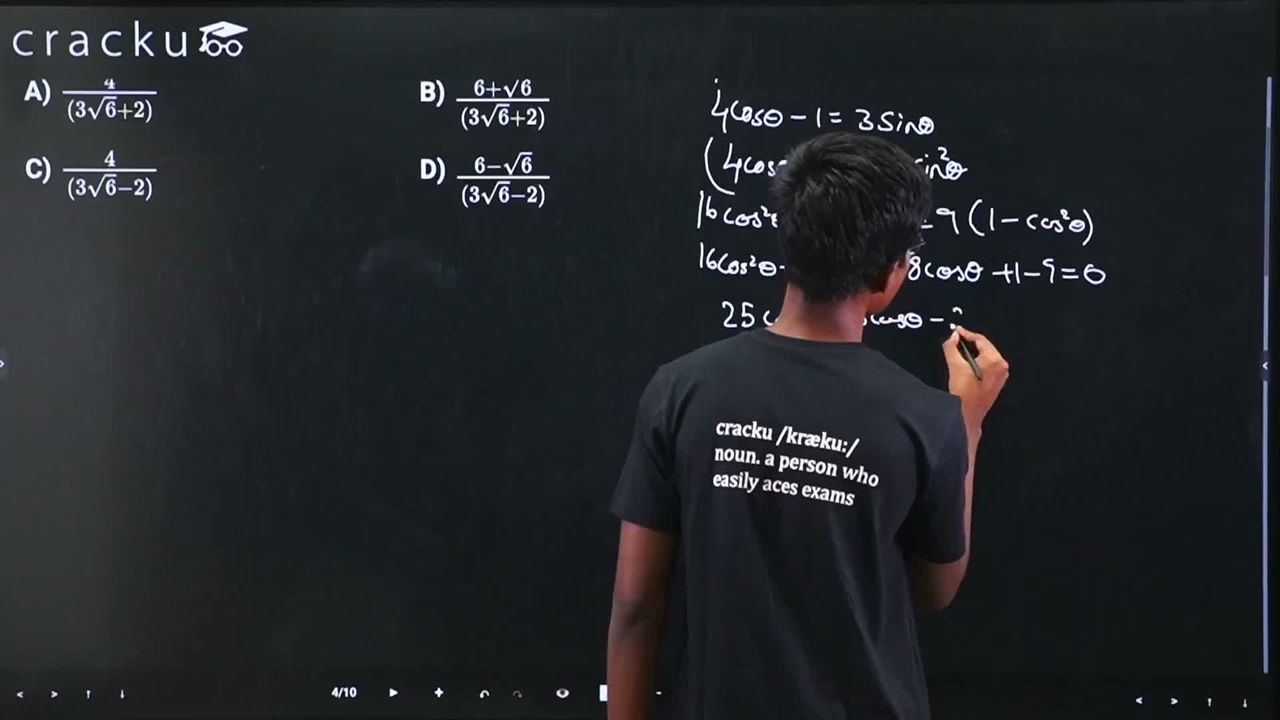
Suppose $$\theta \in [0, \frac{\pi}{4}]$$ is a solution of $$4\cos\theta - 3\sin\theta = 1$$. Then $$\cos\theta$$ is equal to :
Rearrange and Square: $$4\cos\theta - 1 = 3\sin\theta$$
$$(4\cos\theta - 1)^2 = (3\sin\theta)^2$$
$$16\cos^2\theta - 8\cos\theta + 1 = 9(1 - \cos^2\theta)$$
$$16\cos^2\theta - 8\cos\theta + 1 = 9 - 9\cos^2\theta$$
$$25\cos^2\theta - 8\cos\theta - 8 = 0$$
Using Quadratic Formula
$$\cos\theta = \frac{8 \pm \sqrt{64 - 4(25)(-8)}}{2(25)} = \frac{8 \pm \sqrt{864}}{50} = \frac{8 \pm 12\sqrt{6}}{50} = \frac{4 \pm 6\sqrt{6}}{25}$$
Option C is $$\frac{4}{3\sqrt{6}-2}$$. Multiplying by the conjugate $$\frac{3\sqrt{6}+2}{3\sqrt{6}+2}$$:
$$\frac{4(3\sqrt{6}+2)}{54-4} = \frac{4(3\sqrt{6}+2)}{50} = \frac{6\sqrt{6}+4}{25}$$
This matches our positive root.
Was this solution helpful?
Click on the Email ☝️ to Watch the Video Solution
Create a FREE account and get:
_1.webp)

Educational materials for JEE preparation

Ask our AI anything

AI can make mistakes. Please verify important information.
AI can make mistakes. Please verify important information.
