
Join Our JEE Preparation Group
Prep with like-minded aspirants; Get access to free daily tests and study material.
Sign in
Please select an account to continue using cracku.in
↓ →
Join Our JEE Preparation Group
Prep with like-minded aspirants; Get access to free daily tests and study material.
Let $$f(x)$$ be a polynomial of degree 5 such that $$x = \pm 1$$ are its critical points. If $$\lim_{x \to 0}\left(2 + \frac{f(x)}{x^3}\right) = 4$$, then which one of the following is not true?
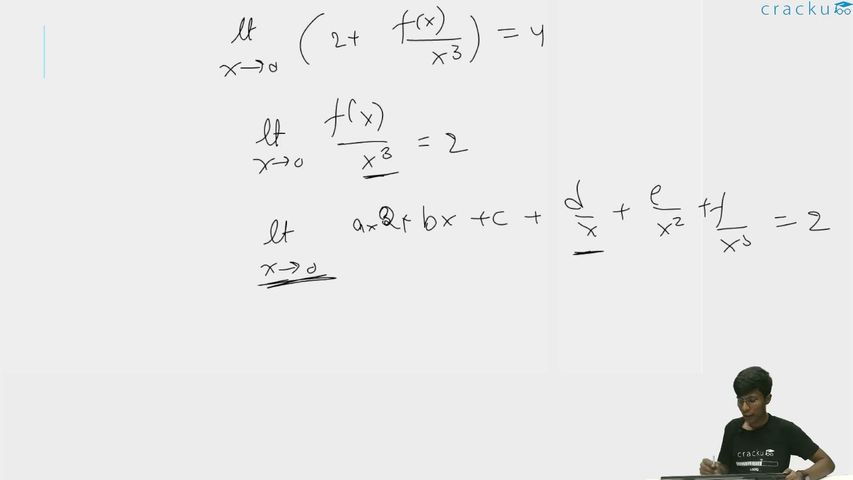
Let $$f(x)$$ be a polynomial of degree 5. Since $$\lim_{x \to 0}\left(2 + \frac{f(x)}{x^3}\right) = 4$$, the limit $$\lim_{x \to 0} \frac{f(x)}{x^3}$$ must exist and equal 2.
For $$\frac{f(x)}{x^3}$$ to have a finite limit as $$x \to 0$$, $$f(x)$$ must have no constant term, no $$x$$ term, and no $$x^2$$ term. So:
$$f(x) = ax^5 + bx^4 + cx^3$$
Then $$\frac{f(x)}{x^3} = ax^2 + bx + c$$, and $$\lim_{x \to 0} \frac{f(x)}{x^3} = c = 2$$.
So $$f(x) = ax^5 + bx^4 + 2x^3$$.
Since $$x = \pm 1$$ are critical points, we need $$f'(\pm 1) = 0$$.
$$f'(x) = 5ax^4 + 4bx^3 + 6x^2$$
$$f'(1) = 5a + 4b + 6 = 0$$ $$-(1)$$
$$f'(-1) = 5a - 4b + 6 = 0$$ $$-(2)$$
Adding $$(1)$$ and $$(2)$$: $$10a + 12 = 0$$, so $$a = -\frac{6}{5}$$.
Subtracting $$(2)$$ from $$(1)$$: $$8b = 0$$, so $$b = 0$$.
Therefore: $$f(x) = -\frac{6}{5}x^5 + 2x^3$$
Now we verify each option.
Option A: $$f$$ is an odd function.
$$f(-x) = -\frac{6}{5}(-x)^5 + 2(-x)^3 = \frac{6}{5}x^5 - 2x^3 = -f(x)$$
So $$f$$ is indeed an odd function. Option A is true.
Option B: $$f(1) - 4f(-1) = 4$$.
$$f(1) = -\frac{6}{5} + 2 = \frac{4}{5}$$
$$f(-1) = \frac{6}{5} - 2 = -\frac{4}{5}$$
$$f(1) - 4f(-1) = \frac{4}{5} - 4\left(-\frac{4}{5}\right) = \frac{4}{5} + \frac{16}{5} = \frac{20}{5} = 4$$
Option B is true.
Option C: $$x = 1$$ is a point of local minimum and $$x = -1$$ is a point of local maximum.
We compute the second derivative:
$$f''(x) = -24x^3 + 12x$$
$$f''(1) = -24 + 12 = -12 < 0$$, so $$x = 1$$ is a local maximum (not minimum).
$$f''(-1) = 24 - 12 = 12 > 0$$, so $$x = -1$$ is a local minimum (not maximum).
Option C states the exact opposite of what is true. Option C is not true.
Option D: $$x = 1$$ is a point of local maxima of $$f$$.
Since $$f''(1) = -12 < 0$$, $$x = 1$$ is indeed a local maximum. Option D is true.
The statement that is NOT true is Option C.
Was this solution helpful?
Click on the Email ☝️ to Watch the Video Solution
Create a FREE account and get:
_1.webp)

Educational materials for JEE preparation

Ask our AI anything

AI can make mistakes. Please verify important information.
AI can make mistakes. Please verify important information.
